D. Michael Miller – författare
Visar alla böcker från författaren D. Michael Miller. Handla med fri frakt och snabb leverans.
11 produkter
11 produkter
Häftad, Engelska, 2019
988 kr
Skickas inom 10-15 vardagar
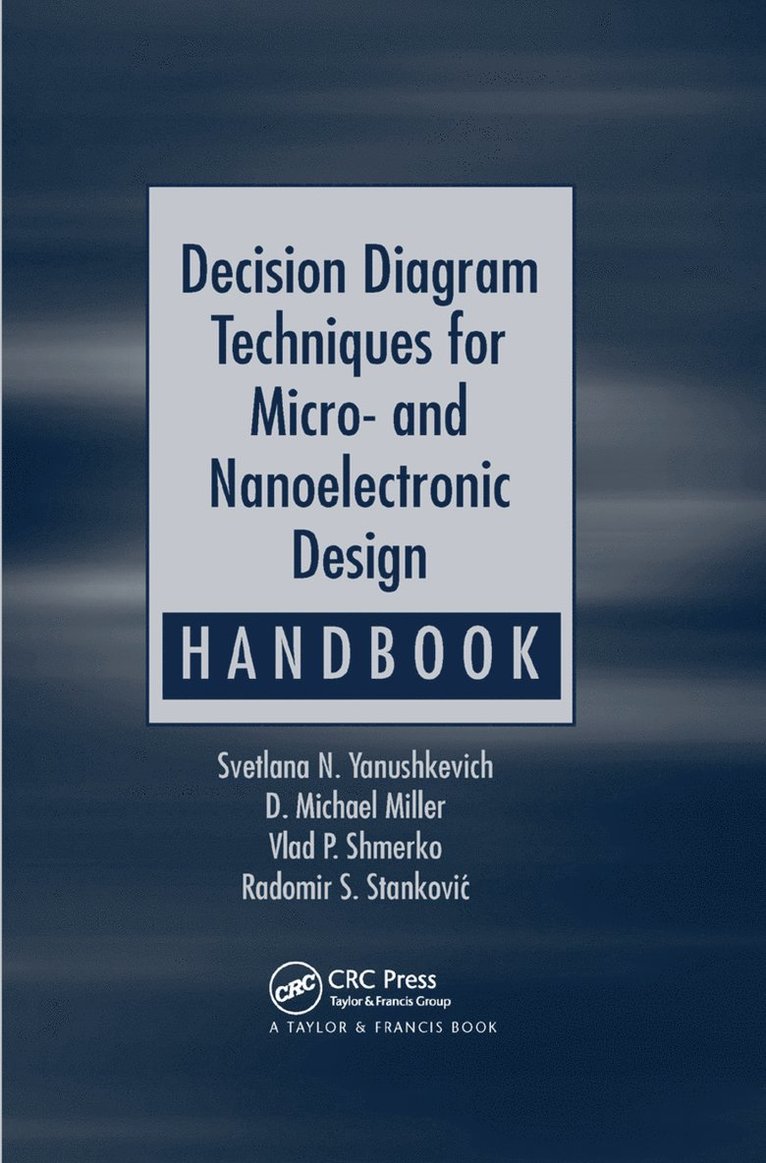
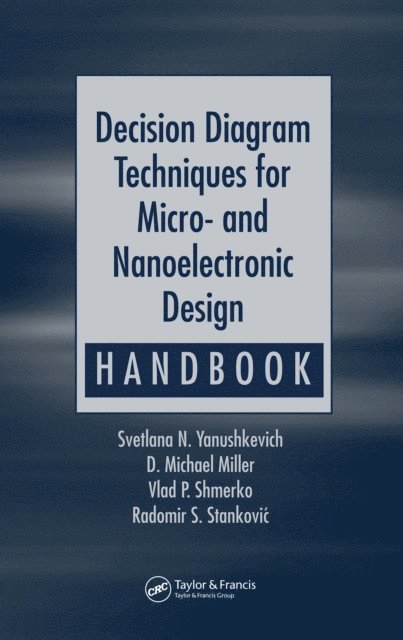
Decision diagram (DD) techniques are very popular in the electronic design automation (EDA) of integrated circuits, and for good reason. They can accurately simulate logic design, can show where to make reductions in complexity, and can be easily modified to model different scenarios.Presenting DD techniques from an applied perspective, Decision Diagram Techniques for Micro- and Nanoelectronic Design Handbook provides a comprehensive, up-to-date collection of DD techniques. Experts with more than forty years of combined experience in both industrial and academic settings demonstrate how to apply the techniques to full advantage with more than 400 examples and illustrations. Beginning with the fundamental theory, data structures, and logic underlying DD techniques, they explore a breadth of topics from arithmetic and word-level representations to spectral techniques and event-driven analysis. The book also includes abundant references to more detailed information and additional applications.Decision Diagram Techniques for Micro- and Nanoelectronic Design Handbook collects the theory, methods, and practical knowledge necessary to design more advanced circuits and places it at your fingertips in a single, concise reference.
Inbunden, Engelska, 2001
1 681 kr
Skickas inom 10-15 vardagar
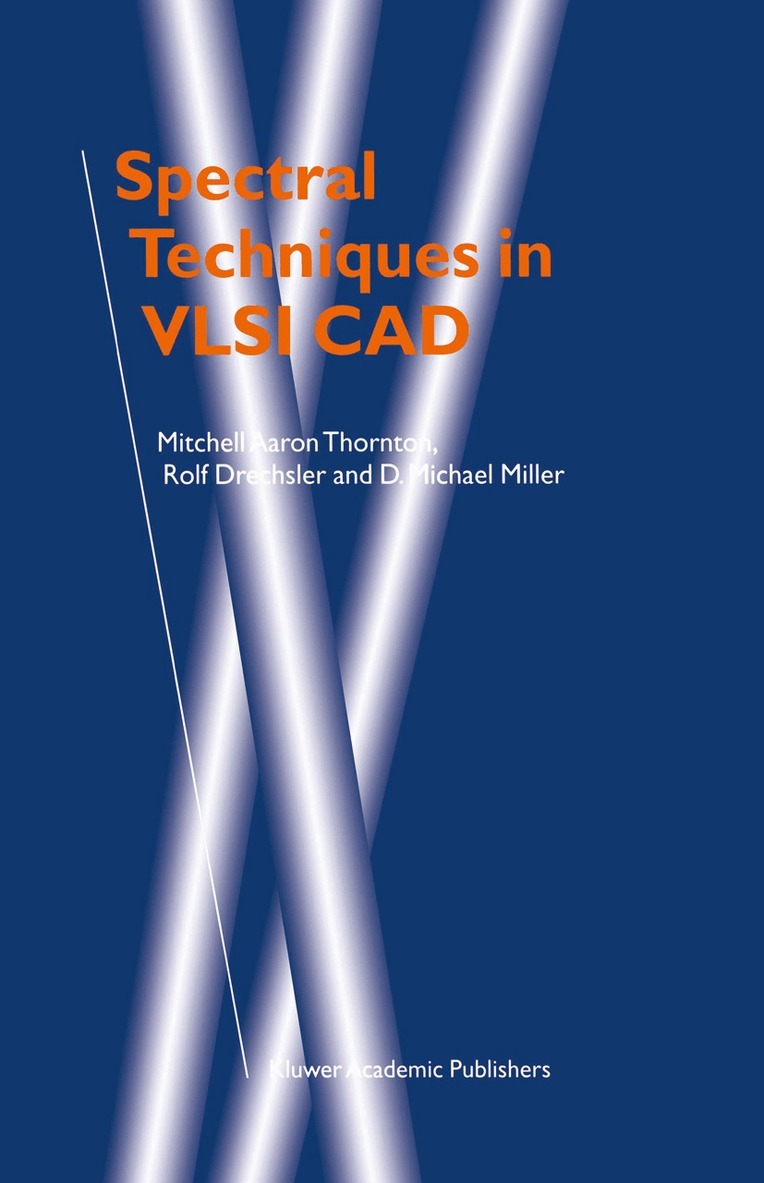
Spectral techniques in VLSI CAD have become a subject of renewed interest in the design automation community due to the emergence of efficient methods for the computation of discrete function spectra. In the past, spectral computations for digital logic were too complex for practical implementation. The use of decision diagrams for spectral computations has greatly reduced this obstacle allowing for the development of new and useful spectral techniques for VLSI synthesis and verification. Several algorithms for the computation of the Walsh, Reed-Muller, arithmetic and Haar spectra are described. The relation of these computational methods to traditional ones is also provided. Spectral Techniques in VLSI CAD provides a unified formalism of the representation of bit-level and word-level discrete functions in the spectral domain and as decision diagrams. An alternative and unifying interpretation of decision diagram representations is presented since it is shown that many of the different commonly used varieties of decision diagrams are merely graphical representations of various discrete function spectra.Viewing various decision diagrams as being described by specific sets of transformation functions not only illustrates the relationship between graphical and spectral representations of discrete functions, but also gives insight into how various decision diagram types are related. Spectral Techniques in VLSI CAD describes several new applications of spectral techniques in discrete function manipulation including decision diagram minimization, logic function synthesis, technology mapping and equivalence checking. The use of linear transformations in decision diagram size reduction is described and the relationship to the operation known as spectral translation is described. Several methods for synthesizing digital logic circuits based on a subset of spectral coefficients are described. An equivalence checking approach for functional verification is described based upon the use of matching pairs of Haar spectral coefficients.
Inbunden, Engelska, 2005
2 389 kr
Skickas inom 10-15 vardagar
Decision diagram (DD) techniques are very popular in the electronic design automation (EDA) of integrated circuits, and for good reason. They can accurately simulate logic design, can show where to make reductions in complexity, and can be easily modified to model different scenarios.Presenting DD techniques from an applied perspective, Decision Diagram Techniques for Micro- and Nanoelectronic Design Handbook provides a comprehensive, up-to-date collection of DD techniques. Experts with more than forty years of combined experience in both industrial and academic settings demonstrate how to apply the techniques to full advantage with more than 400 examples and illustrations. Beginning with the fundamental theory, data structures, and logic underlying DD techniques, they explore a breadth of topics from arithmetic and word-level representations to spectral techniques and event-driven analysis. The book also includes abundant references to more detailed information and additional applications.Decision Diagram Techniques for Micro- and Nanoelectronic Design Handbook collects the theory, methods, and practical knowledge necessary to design more advanced circuits and places it at your fingertips in a single, concise reference.
E-bok
Engelska, 2018909 kr
Läs direkt efter köp
Decision diagram (DD) techniques are very popular in the electronic design automation (EDA) of integrated circuits, and for good reason. They can accurately simulate logic design, can show where to make reductions in complexity, and can be easily modified to model different scenarios.Presenting DD techniques from an applied perspective, Decision Diagram Techniques for Micro- and Nanoelectronic Design Handbook provides a comprehensive, up-to-date collection of DD techniques. Experts with more than forty years of combined experience in both industrial and academic settings demonstrate how to apply the techniques to full advantage with more than 400 examples and illustrations. Beginning with the fundamental theory, data structures, and logic underlying DD techniques, they explore a breadth of topics from arithmetic and word-level representations to spectral techniques and event-driven analysis. The book also includes abundant references to more detailed information and additional applications.Decision Diagram Techniques for Micro- and Nanoelectronic Design Handbook collects the theory, methods, and practical knowledge necessary to design more advanced circuits and places it at your fingertips in a single, concise reference.
Häftad, Engelska, 2012
1 633 kr
Skickas inom 10-15 vardagar
Spectral Techniques in VLSI CAD have become a subject of renewed interest in the design automation community due to the emergence of new and efficient methods for the computation of discrete function spectra. In the past, spectral computations for digital logic were too complex for practical implementation. The use of decision diagrams for spectral computations has greatly reduced this obstacle allowing for the development of new and useful spectral techniques for VLSI synthesis and verification. Several new algorithms for the computation of the Walsh, Reed-Muller, arithmetic and Haar spectra are described. The relation of these computational methods to traditional ones is also provided.Spectral Techniques in VLSI CAD provides a unified formalism of the representation of bit-level and word-level discrete functions in the spectral domain and as decision diagrams. An alternative and unifying interpretation of decision diagram representations is presented since it is shown that many of the different commonly used varieties of decision diagrams are merely graphical representations of various discrete function spectra. Viewing various decision diagrams as being described by specific sets of transformation functions not only illustrates the relationship between graphical and spectral representations of discrete functions, but also gives insight into how various decision diagram types are related.Spectral Techniques in VLSI CAD describes several new applications of spectral techniques in discrete function manipulation including decision diagram minimization, logic function synthesis, technology mapping and equivalence checking. The use of linear transformations in decision diagram size reduction is described and the relationship to the operation known as spectral translation is described. Several methods for synthesizing digital logic circuits based on a subset of spectral coefficients are described. An equivalence checking approach for functional verification is described based upon the use of matching pairs of Haar spectral coefficients.
E-bok
PDF, Engelska, 20121 977 kr
Läs direkt efter köp
Spectral Techniques in VLSI CAD have become a subject of renewed interest in the design automation community due to the emergence of new and efficient methods for the computation of discrete function spectra. In the past, spectral computations for digital logic were too complex for practical implementation. The use of decision diagrams for spectral computations has greatly reduced this obstacle allowing for the development of new and useful spectral techniques for VLSI synthesis and verification. Several new algorithms for the computation of the Walsh, Reed-Muller, arithmetic and Haar spectra are described. The relation of these computational methods to traditional ones is also provided. Spectral Techniques in VLSI CAD provides a unified formalism of the representation of bit-level and word-level discrete functions in the spectral domain and as decision diagrams. An alternative and unifying interpretation of decision diagram representations is presented since it is shown that many of the different commonly used varieties of decision diagrams are merely graphical representations of various discrete function spectra. Viewing various decision diagrams as being described by specific sets of transformation functions not only illustrates the relationship between graphical and spectral representations of discrete functions, but also gives insight into how various decision diagram types are related. Spectral Techniques in VLSI CAD describes several new applications of spectral techniques in discrete function manipulation including decision diagram minimization, logic function synthesis, technology mapping and equivalence checking. The use of linear transformations in decision diagram size reduction is described and the relationship to the operation known as spectral translation is described. Several methods for synthesizing digital logic circuits based on a subset of spectral coefficients are described. An equivalence checking approach for functional verification is described based upon the use of matching pairs of Haar spectral coefficients.
Häftad, Engelska, 2007
365 kr
Skickas inom 10-15 vardagar
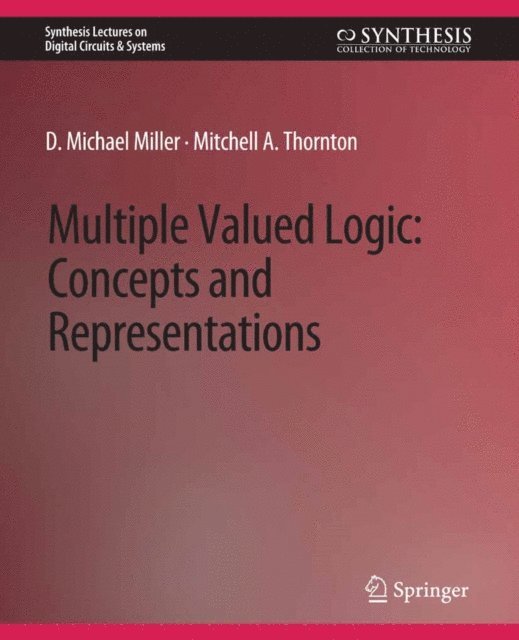
Multiple Valued Logic: Concepts and Representations begins with a survey of the use ofmultiple-valued logic in several modern application areas including electronic design automation algorithms and circuit design. The mathematical basis and concepts of various algebras and systems of multiple valued logic are provided including comparisons among various systems and examples of their application. The book also provides an examination of alternative representations of multiple-valued logic suitable for implementation as data structures in automated computer applications. Decision diagram structures for multiple valued applications are described in detail with particular emphasis on the recently developed quantum multiple valued decision diagram. Table of Contents: Multiple Valued Logic Applications / MVL Concepts and Algebra / Functional Representations / Reversible andQuantum Circuits / Quantum Multiple-Valued Decision Diagrams / Summary / Bibliography
E-bok
PDF, Engelska, 2022428 kr
Läs direkt efter köp
Multiple Valued Logic: Concepts and Representations begins with a survey of the use ofmultiple-valued logic in several modern application areas including electronic design automation algorithms and circuit design. The mathematical basis and concepts of various algebras and systems of multiple valued logic are provided including comparisons among various systems and examples of their application. The book also provides an examination of alternative representations of multiple-valued logic suitable for implementation as data structures in automated computer applications. Decision diagram structures for multiple valued applications are described in detail with particular emphasis on the recently developed quantum multiple valued decision diagram. Table of Contents: Multiple Valued Logic Applications / MVL Concepts and Algebra / Functional Representations / Reversible andQuantum Circuits / Quantum Multiple-Valued Decision Diagrams / Summary / Bibliography
Häftad, Engelska, 2013
521 kr
Skickas inom 10-15 vardagar
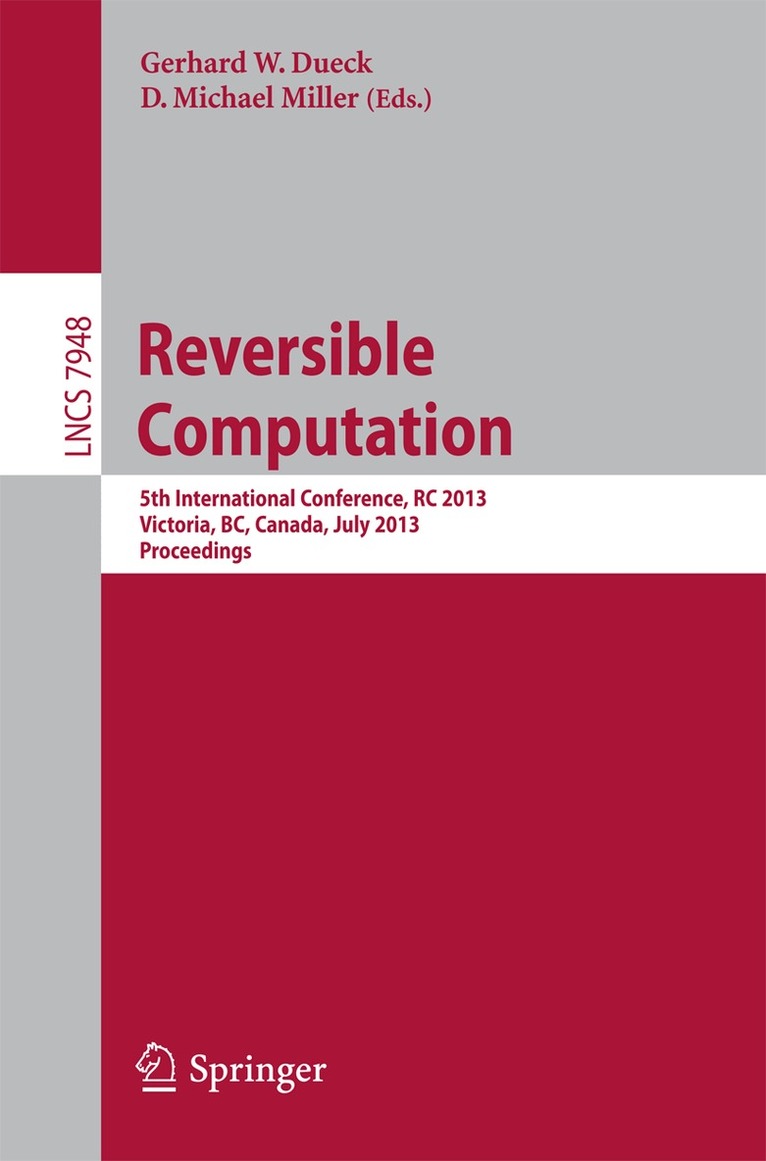
This book constitutes the refereed proceedings of the 5th International Conference on Reversible Computation, RC 2013, held in Victoria, BC, Canada, in July 2013. The 19 contributions presented together with one invited paper were carefully reviewed and selected from 37 submissions. The papers are organized in topical sections on physical implementation; arithmetic; programming and data structures; modelling; synthesis and optimization; and alternative technologies.
E-bok
PDF, Engelska, 2013661 kr
Läs direkt efter köp
This book constitutes the refereed proceedings of the 5th International Conference on Reversible Computation, RC 2013, held in Victoria, BC, Canada, in July 2013. The 19 contributions presented together with one invited paper were carefully reviewed and selected from 37 submissions. The papers are organized in topical sections on physical implementation; arithmetic; programming and data structures; modelling; synthesis and optimization; and alternative technologies.
E-bok
Engelska, 20181 062 kr
Läs direkt efter köp
Decision diagram (DD) techniques are very popular in the electronic design automation (EDA) of integrated circuits, and for good reason. They can accurately simulate logic design, can show where to make reductions in complexity, and can be easily modified to model different scenarios.Presenting DD techniques from an applied perspective, Decision Diagram Techniques for Micro- and Nanoelectronic Design Handbook provides a comprehensive, up-to-date collection of DD techniques. Experts with more than forty years of combined experience in both industrial and academic settings demonstrate how to apply the techniques to full advantage with more than 400 examples and illustrations. Beginning with the fundamental theory, data structures, and logic underlying DD techniques, they explore a breadth of topics from arithmetic and word-level representations to spectral techniques and event-driven analysis. The book also includes abundant references to more detailed information and additional applications.Decision Diagram Techniques for Micro- and Nanoelectronic Design Handbook collects the theory, methods, and practical knowledge necessary to design more advanced circuits and places it at your fingertips in a single, concise reference.