Although the basic theories of thermodynamics are adequately covered by a number of existing texts, there is little literature that addresses more advanced topics. In this comprehensive work the author redresses this balance, drawing on his twenty-five years of experience of teaching thermodynamics at undergraduate and postgraduate level, to produce a definitive text to cover thoroughly, advanced syllabuses.The book introduces the basic concepts which apply over the whole range of new technologies, considering: a new approach to cycles, enabling their irreversibility to be taken into account; a detailed study of combustion to show how the chemical energy in a fuel is converted into thermal energy and emissions; an analysis of fuel cells to give an understanding of the direct conversion of chemical energy to electrical power; a detailed study of property relationships to enable more sophisticated analyses to be made of both high and low temperature plant and irreversible thermodynamics, whose principles might hold a key to new ways of efficiently covering energy to power (e.g. solar energy, fuel cells). Worked examples are included in most of the chapters, followed by exercises with solutions. By developing thermodynamics from an explicitly equilibrium perspective, showing how all systems attempt to reach a state of equilibrium, and the effects of these systems when they cannot, the result is an unparalleled insight into the more advanced considerations when converting any form of energy into power, that will prove invaluable to students and professional engineers of all disciplines.
Advanced Thermodynamics for Engineers, Second Edition introduces the basic concepts of thermodynamics and applies them to a wide range of technologies. Authors Desmond Winterbone and Ali Turan also include a detailed study of combustion to show how the chemical energy in a fuel is converted into thermal energy and emissions; analyze fuel cells to give an understanding of the direct conversion of chemical energy to electrical power; and provide a study of property relationships to enable more sophisticated analyses to be made of irreversible thermodynamics, allowing for new ways of efficiently covering energy to power (e.g. solar energy, fuel cells). Worked examples are included in most of the chapters, followed by exercises with solutions. By developing thermodynamics from an explicitly equilibrium perspective and showing how all systems attempt to reach equilibrium (and the effects of these systems when they cannot), Advanced Thermodynamics for Engineers, Second Edition provides unparalleled insight into converting any form of energy into power. The theories and applications of this text are invaluable to students and professional engineers of all disciplines.- Includes new chapter that introduces basic terms and concepts for a firm foundation of study- Features clear explanations of complex topics and avoids complicated mathematical analysis- Updated chapters with recent advances in combustion, fuel cells, and more- Solutions manual will be provided for end-of-chapter problems
Advanced Thermodynamics for Engineers, Second Edition introduces the basic concepts of thermodynamics and applies them to a wide range of technologies. Authors Desmond Winterbone and Ali Turan also include a detailed study of combustion to show how the chemical energy in a fuel is converted into thermal energy and emissions; analyze fuel cells to give an understanding of the direct conversion of chemical energy to electrical power; and provide a study of property relationships to enable more sophisticated analyses to be made of irreversible thermodynamics, allowing for new ways of efficiently covering energy to power (e.g. solar energy, fuel cells). Worked examples are included in most of the chapters, followed by exercises with solutions. By developing thermodynamics from an explicitly equilibrium perspective and showing how all systems attempt to reach equilibrium (and the effects of these systems when they cannot), Advanced Thermodynamics for Engineers, Second Edition provides unparalleled insight into converting any form of energy into power. The theories and applications of this text are invaluable to students and professional engineers of all disciplines. Includes new chapter that introduces basic terms and concepts for a firm foundation of study Features clear explanations of complex topics and avoids complicated mathematical analysis Updated chapters with recent advances in combustion, fuel cells, and more Solutions manual will be provided for end-of-chapter problems
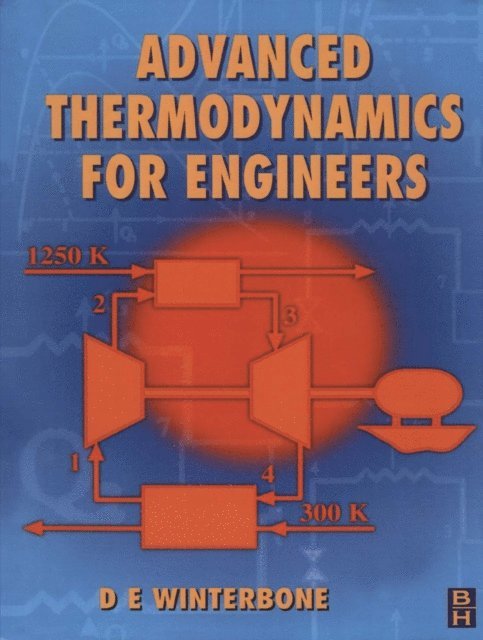
Although the basic theories of thermodynamics are adequately covered by a number of existing texts, there is little literature that addresses more advanced topics. In this comprehensive work the author redresses this balance, drawing on his twenty-five years of experience of teaching thermodynamics at undergraduate and postgraduate level, to produce a definitive text to cover thoroughly, advanced syllabuses.The book introduces the basic concepts which apply over the whole range of new technologies, considering: a new approach to cycles, enabling their irreversibility to be taken into account; a detailed study of combustion to show how the chemical energy in a fuel is converted into thermal energy and emissions; an analysis of fuel cells to give an understanding of the direct conversion of chemical energy to electrical power; a detailed study of property relationships to enable more sophisticated analyses to be made of both high and low temperature plant and irreversible thermodynamics, whose principles might hold a key to new ways of efficiently covering energy to power (e.g. solar energy, fuel cells). Worked examples are included in most of the chapters, followed by exercises with solutions. By developing thermodynamics from an explicitly equilibrium perspective, showing how all systems attempt to reach a state of equilibrium, and the effects of these systems when they cannot, the result is an unparalleled insight into the more advanced considerations when converting any form of energy into power, that will prove invaluable to students and professional engineers of all disciplines.
Advanced Thermodynamics for Engineers, Second Edition introduces the basic concepts of thermodynamics and applies them to a wide range of technologies. Authors Desmond Winterbone and Ali Turan also include a detailed study of combustion to show how the chemical energy in a fuel is converted into thermal energy and emissions; analyze fuel cells to give an understanding of the direct conversion of chemical energy to electrical power; and provide a study of property relationships to enable more sophisticated analyses to be made of irreversible thermodynamics, allowing for new ways of efficiently covering energy to power (e.g. solar energy, fuel cells). Worked examples are included in most of the chapters, followed by exercises with solutions. By developing thermodynamics from an explicitly equilibrium perspective and showing how all systems attempt to reach equilibrium (and the effects of these systems when they cannot), Advanced Thermodynamics for Engineers, Second Edition provides unparalleled insight into converting any form of energy into power. The theories and applications of this text are invaluable to students and professional engineers of all disciplines.- Includes new chapter that introduces basic terms and concepts for a firm foundation of study- Features clear explanations of complex topics and avoids complicated mathematical analysis- Updated chapters with recent advances in combustion, fuel cells, and more- Solutions manual will be provided for end-of-chapter problems
Advanced Thermodynamics for Engineers, Second Edition introduces the basic concepts of thermodynamics and applies them to a wide range of technologies. Authors Desmond Winterbone and Ali Turan also include a detailed study of combustion to show how the chemical energy in a fuel is converted into thermal energy and emissions; analyze fuel cells to give an understanding of the direct conversion of chemical energy to electrical power; and provide a study of property relationships to enable more sophisticated analyses to be made of irreversible thermodynamics, allowing for new ways of efficiently covering energy to power (e.g. solar energy, fuel cells). Worked examples are included in most of the chapters, followed by exercises with solutions. By developing thermodynamics from an explicitly equilibrium perspective and showing how all systems attempt to reach equilibrium (and the effects of these systems when they cannot), Advanced Thermodynamics for Engineers, Second Edition provides unparalleled insight into converting any form of energy into power. The theories and applications of this text are invaluable to students and professional engineers of all disciplines. Includes new chapter that introduces basic terms and concepts for a firm foundation of study Features clear explanations of complex topics and avoids complicated mathematical analysis Updated chapters with recent advances in combustion, fuel cells, and more Solutions manual will be provided for end-of-chapter problems