Dagmar Haase - Böcker
Visar alla böcker från författaren Dagmar Haase. Handla med fri frakt och snabb leverans.
3 produkter
3 produkter
Stoff- und Wasserhaushalt in Einzugsgebieten
Beiträge zur EU-Wasserrahmenrichtlinie und Fallbeispiele
Häftad, Tyska, 2004
801 kr
Skickas inom 10-15 vardagar
620 kr
Skickas inom 10-15 vardagar
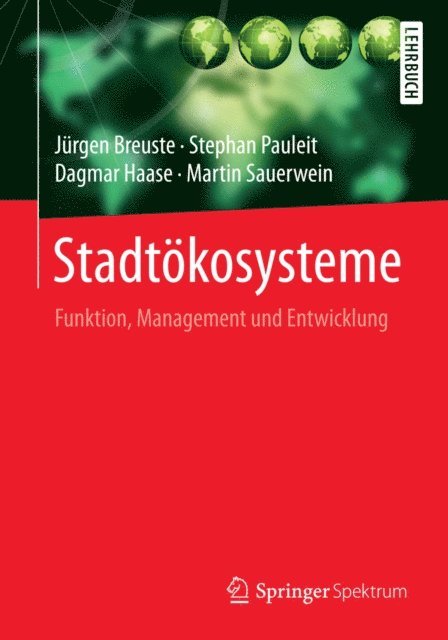
Dieses Lehrbuch zu Stadtökosystemen beantwortet wichtige Fragen, die sich zum ökologischen Aufbau, zu den Funktionen und zur sozial-ökologischen Entwicklung von Städten weltweit stellen. Ausgehend davon, wie sich Städte heute in einer immer stärker urban werdenden Welt entwickeln, werden ökologische Herausforderungen für Städte des 21. Jahrhunderts wie Ressourceneffizienz, Klimawandel, Moderation der Lebensqualität und Resilienz erläutert. Das Buch verbindet Theorien der Stadtentwicklung und Ökologie mit praktischen Anwendungen und Fallbeispielen und spürt auf diese Weise Verbesserungspotenziale sowie und Beispiele guter ökologischer Stadtentwicklung weltweit auf. Es zeigt, dass Städte bei weitem nicht nur Problemräume sind, sondern auch große Potenziale für ein gutes Leben bieten und dass dazu die verschiedenen Stadtökosysteme einen erheblichen Beitrag leisten können. Die „Ökostadt“ ist damit keine Utopie, sondern ein reales Ziel, das schrittweise unter Beachtung des lokalen und regionalen Kontexts gezielt angestrebt werden kann.Vier renommierte Stadtökologen haben ihre spezifischen Erfahrungen in Teilgebieten eingebracht, ohne den Blick für das Ganze dabei außer Acht zu lassen. Jürgen Breuste ist Stadtökologe und arbeitet an der Paris-Lodron-Universität Salzburg, Österreich, zu den Themen Nachhaltige Stadtentwicklung, urbane Biodiversität, Ökosystemdienstleistungen und Ökostädte. Dagmar Haase ist Landschaftsökologin und arbeitet an der Humboldt-Universität zu Berlin zu urbanen Ökosystemdienstleistungen und Themen der Landnutzungsmodellierung. Stephan Pauleit ist Landschaftsplaner und arbeitet an der Technischen Universität München zu Strategien für die nachhaltige Entwicklung von Stadtlandschaften. Martin Sauerwein ist Geograph und arbeitet an der Universität Hildesheim zur Geoökologie in Kulturlandschaften, Geoarchäologie und zum Bodenschutz. Das Lehrbuch spricht ein breites Publikum von Studierenden, Lehrendenund auch Praktikern im Bereich Ökologie, Stadtökologie, Stadtentwicklung, Nachhaltigkeit, Stadtgeographie, Natur- und Landschaftsschutz, Raumplanung, Landschaftsökologie, Sozialwissenschaften und Urbanistik an. Die zahlreichen Fotos und Grafiken, viele davon vierfarbig, sowie übersichtliche Tabellen illustrieren die Sachverhalte. Fallstudien, Beispiele und Erläuterungen erlauben einen vertiefenden Einblick. Fragen am Kapitelende ermöglichen eine Überprüfung des Wissensfortschritts, ein umfassendes Literaturverzeichnis zu jedem Kapitel weitergehende Studien.
882 kr
Skickas inom 10-15 vardagar
This textbook on urban ecosystems answers important questions about the ecological structure, functions and socio-ecological development of cities worldwide. Based on how cities are developing today in an increasingly urbanized world, it explains ecological challenges for cities of the 21st century such as resource efficiency, climate change, moderation of quality of life and resilience. The book combines theories of urban development and ecology with practical applications and case studies, thus identifying potential for improvement and examples of good ecological urban development worldwide. It shows that cities are by far not only problem areas but also offer great potential for a good life and that the various urban ecosystems can make a considerable contribution to this. The "eco-city" is thus not a utopia,but a real goal that can be pursued step by step in a targeted manner, taking into account the local and regional context.Four renowned urban ecologists have contributed their specific experience in sub-areas without losing sight of the big picture. Jürgen Breuste is an urban ecologist and works at the Paris Lodron University in Salzburg, Austria, on the topics of sustainable urban development, urban biodiversity, ecosystem services and eco-cities. Dagmar Haase is Landschaftsökologin and works at the Humboldt University of Berlin on urban ecosystem services and land use modeling. Stephan Pauleit is a landscape planner and works at the Technical University of Munich on strategies for the sustainable development of urban landscapes. Martin Sauerwein is a geographer and works at the University of Hildesheim on geo-ecology in cultural landscapes, geoarchaeology and soil protection.The textbook addresses a broad audience of students, teachersand also to practitioners in the fields of ecology, urban ecology, urban development, sustainability, urban geography, nature and landscape conservation, spatial planning, landscape ecology, socialsciences and urban studies. The numerous photos and graphics, many of them in four colors, as well as clear tables illustrate the facts. Case studies, examples and explanations allow a deeper insight. Questions at the end of each chapter allow the progress of knowledge to be checked, and a comprehensive bibliography for each chapter provides further studies.This book is a translation of the original German 1st edition Stadtökosysteme by Jürgen Breuste published by Springer Fachmedien Wiesbaden GmbH, part of Springer Nature in 2016. The translation was done with the help of artificial intelligence (machine translation by the service DeepL.com). A subsequent human revision was done primarily in terms of content, so that the book will read stylistically differently from a conventional translation. Springer Nature works continuously to further the development of tools for the production of books and on the related technologies to support the authors.This springer essential is a translation of the original German 1st edition essentials,Stadtökosysteme by Jürgen Breuste published by Springer Fachmedien Wiesbaden GmbH, part of Springer Nature in 2016. The translation was done with the help of artificial intelligence (machine translation by the service DeepL.com). A subsequent human revision was done primarily in terms of content, so that the book will read stylistically differently from a conventional translation. Springer Nature works continuously to further the development of tools for the production of books and on the related technologies to support the authors.