Dai-Ming Tang - Böcker
Visar alla böcker från författaren Dai-Ming Tang. Handla med fri frakt och snabb leverans.
3 produkter
3 produkter
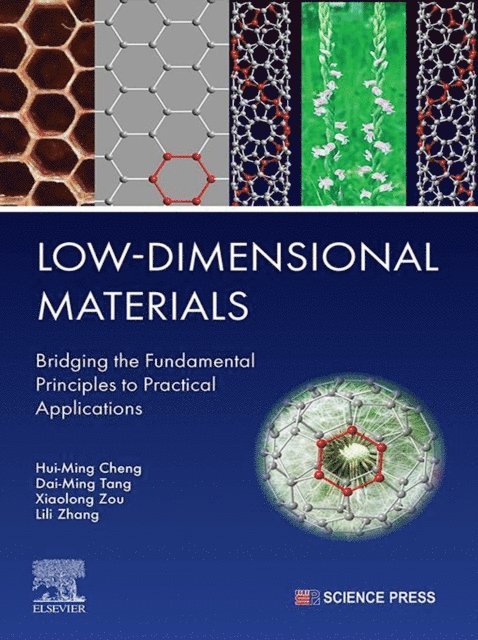
Low-Dimensional Materials
Bridging the Fundamental Principles to Practical Applications
Häftad, Engelska, 2024
2 203 kr
Skickas inom 7-10 vardagar
Low Dimensional Materials: Bridging the Fundamental Principles to Practice Applications provides an overview of research on low-dimensional materials, devices, and their applications. There are seven chapters in the book, starting from the basic quantum theory in chapter one, to the control and characterization of the unique structures (chapters two and four), to the relation of the physical and chemical properties with structures (chapter five), and to the practical and promising applications in energy, information, and health (chapter six), before conclusions and future outlook in chapter seven.Discusses the whole field of low-dimensional materials, from quantum mechanics and low dimensional effects to structure-property relations, various methods of fabrication and assembly techniques, and a characterization of atomic and interface structuresCovers a wide range of topics, making it a 'map' for readers to understand the fundamentals of low-dimensional materialsWritten with a 'bottom-up approach, with a solid foundation of quantum mechanics, thermodynamics, and energy transport in low-dimensional systems
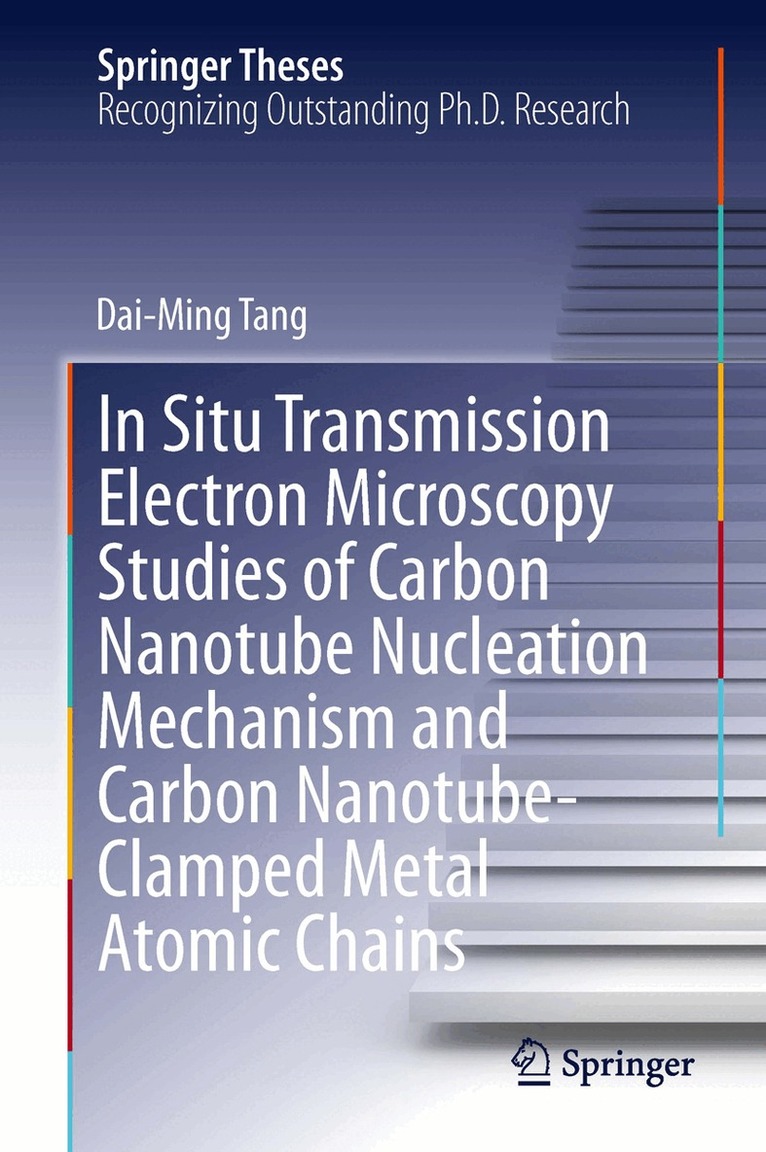
In Situ Transmission Electron Microscopy Studies of Carbon Nanotube Nucleation Mechanism and Carbon Nanotube-Clamped Metal Atomic Chains
Inbunden, Engelska, 2013
1 062 kr
Skickas inom 10-15 vardagar
Using an in situ transmission electron microscopy (TEM) approach to investigate the growth mechanism of carbon nanotubes (CNTs) as well as the fabrication and properties of CNT-clamped metal atomic chains (MACs) is the focus of the research summarized in this thesis. The application of an in situ TEM approach in the above-mentioned research provides not only real-time observation but also monitored machining and structural evolvement at the atomic level. In this thesis, the author introduces a CNT tubular nano furnace that can be operated under TEM for investigation of the CNT nucleation mechanism. By studying the nucleation process of CNTs in the presence of various catalysts, including iron-based metallic catalysts and silicon oxide-based non-metallic catalysts, the physical states of the catalysts as well as the nucleation and growth process of CNTs are revealed. Based on the understanding of the nucleation mechanism, the author proposes a hetero-epitaxial growth strategy of CNTs from boron nitride, which provides a new route for the controllable growth of CNTs. In addition, the author presents an electron beam-assisted nanomachining technique and the fabrication of a CNT-clamped MAC prototype device based on this technique. The formation process of CNT-clamped Fe atomic chains (ACs) can be monitored with atomic resolution. The demonstrated quantized conductance and uninfluenced half-metallic properties of Fe ACs indicate that CNTs can be promising nanoscale electrodes or interconnectors for the linking and assembly of nano and subnano structures.
In Situ Transmission Electron Microscopy Studies of Carbon Nanotube Nucleation Mechanism and Carbon Nanotube-Clamped Metal Atomic Chains
Häftad, Engelska, 2016
1 062 kr
Skickas inom 10-15 vardagar
Using an in situ transmission electron microscopy (TEM) approach to investigate the growth mechanism of carbon nanotubes (CNTs) as well as the fabrication and properties of CNT-clamped metal atomic chains (MACs) is the focus of the research summarized in this thesis. The application of an in situ TEM approach in the above-mentioned research provides not only real-time observation but also monitored machining and structural evolvement at the atomic level. In this thesis, the author introduces a CNT tubular nano furnace that can be operated under TEM for investigation of the CNT nucleation mechanism. By studying the nucleation process of CNTs in the presence of various catalysts, including iron-based metallic catalysts and silicon oxide-based non-metallic catalysts, the physical states of the catalysts as well as the nucleation and growth process of CNTs are revealed. Based on the understanding of the nucleation mechanism, the author proposes a hetero-epitaxial growth strategy of CNTs from boron nitride, which provides a new route for the controllable growth of CNTs. In addition, the author presents an electron beam-assisted nanomachining technique and the fabrication of a CNT-clamped MAC prototype device based on this technique. The formation process of CNT-clamped Fe atomic chains (ACs) can be monitored with atomic resolution. The demonstrated quantized conductance and uninfluenced half-metallic properties of Fe ACs indicate that CNTs can be promising nanoscale electrodes or interconnectors for the linking and assembly of nano and subnano structures.