Dan Maclean - Böcker
Visar alla böcker från författaren Dan Maclean. Handla med fri frakt och snabb leverans.
4 produkter
4 produkter
297 kr
Skickas inom 3-6 vardagar
Alaska has few roads and even fewer trails—only a few hundred miles of maintained footpaths exist outside the cities—so paddling the state's thousands of miles of rivers and lakes is the best way to get off the beaten track. Paddling Alaska describes the best and most accessible routes—thirty-six classics in all, from downtown Anchorage to the Matanuska and Susitna Valleys and the Kenai Peninsula, and from the southern interior north to the Yukon. Carefully chosen to accommodate most beginning-to-intermediate paddlers, each route is within easy driving distance of population centers, providing quick access to wilderness for city residents and visitors alike. Look inside to find:•⊂ Detailed river descriptions•⊂ Maps showing access points and river miles•⊂ Level of difficulty, optimal flows, rapids and other hazards•⊂ Gear and packing recommendations specific to Alaska conditions
233 kr
Skickas inom 5-8 vardagar
R Bioinformatics Cookbook
Use R and Bioconductor to perform RNAseq, genomics, data visualization, and bioinformatic analysis
Häftad, Engelska, 2019
712 kr
Skickas inom 5-8 vardagar
Over 60 recipes to model and handle real-life biological data using modern libraries from the R ecosystemKey FeaturesApply modern R packages to handle biological data using real-world examplesRepresent biological data with advanced visualizations suitable for research and publicationsHandle real-world problems in bioinformatics such as next-generation sequencing, metagenomics, and automating analysesBook DescriptionHandling biological data effectively requires an in-depth knowledge of machine learning techniques and computational skills, along with an understanding of how to use tools such as edgeR and DESeq. With the R Bioinformatics Cookbook, you’ll explore all this and more, tackling common and not-so-common challenges in the bioinformatics domain using real-world examples.This book will use a recipe-based approach to show you how to perform practical research and analysis in computational biology with R. You will learn how to effectively analyze your data with the latest tools in Bioconductor, ggplot, and tidyverse. The book will guide you through the essential tools in Bioconductor to help you understand and carry out protocols in RNAseq, phylogenetics, genomics, and sequence analysis. As you progress, you will get up to speed with how machine learning techniques can be used in the bioinformatics domain. You will gradually develop key computational skills such as creating reusable workflows in R Markdown and packages for code reuse.By the end of this book, you’ll have gained a solid understanding of the most important and widely used techniques in bioinformatic analysis and the tools you need to work with real biological data.What you will learnEmploy Bioconductor to determine differential expressions in RNAseq dataRun SAMtools and develop pipelines to find single nucleotide polymorphisms (SNPs) and IndelsUse ggplot to create and annotate a range of visualizationsQuery external databases with Ensembl to find functional genomics informationExecute large-scale multiple sequence alignment with DECIPHER to perform comparative genomicsUse d3.js and Plotly to create dynamic and interactive web graphicsUse k-nearest neighbors, support vector machines and random forests to find groups and classify dataWho this book is forThis book is for bioinformaticians, data analysts, researchers, and R developers who want to address intermediate-to-advanced biological and bioinformatics problems by learning through a recipe-based approach. Working knowledge of R programming language and basic knowledge of bioinformatics are prerequisites.
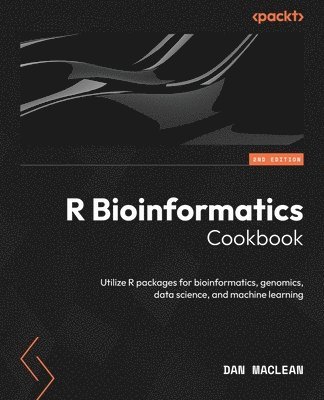
R Bioinformatics Cookbook
Utilize R packages for bioinformatics, genomics, data science, and machine learning
Häftad, Engelska, 2023
494 kr
Skickas inom 5-8 vardagar
Discover over 80 recipes for modeling and handling real-life biological data using modern libraries from the R ecosystemKey FeaturesApply modern R packages to process biological data using real-world examplesRepresent biological data with advanced visualizations and workflows suitable for research and publicationsSolve real-world bioinformatics problems such as transcriptomics, genomics, and phylogeneticsPurchase of the print or Kindle book includes a free PDF eBookBook DescriptionThe updated second edition of R Bioinformatics Cookbook takes a recipe-based approach to show you how to conduct practical research and analysis in computational biology with R. You’ll learn how to create a useful and modular R working environment, along with loading, cleaning, and analyzing data using the most up-to-date Bioconductor, ggplot2, and tidyverse tools.This book will walk you through the Bioconductor tools necessary for you to understand and carry out protocols in RNA-seq and ChIP-seq, phylogenetics, genomics, gene search, gene annotation, statistical analysis, and sequence analysis. As you advance, you'll find out how to use Quarto to create data-rich reports, presentations, and websites, as well as get a clear understanding of how machine learning techniques can be applied in the bioinformatics domain. The concluding chapters will help you develop proficiency in key skills, such as gene annotation analysis and functional programming in purrr and base R. Finally, you'll discover how to use the latest AI tools, including ChatGPT, to generate, edit, and understand R code and draft workflows for complex analyses.By the end of this book, you'll have gained a solid understanding of the skills and techniques needed to become a bioinformatics specialist and efficiently work with large and complex bioinformatics datasets.What you will learnSet up a working environment for bioinformatics analysis with RImport, clean, and organize bioinformatics data using tidyrCreate publication-quality plots, reports, and presentations using ggplot2 and QuartoAnalyze RNA-seq, ChIP-seq, genomics, and next-generation genetics with BioconductorSearch for genes and proteins by performing phylogenetics and gene annotationApply ML techniques to bioinformatics data using mlr3Streamline programmatic work using iterators and functional tools in the base R and purrr packagesUse ChatGPT to create, annotate, and debug code and workflowsWho this book is forThis book is for bioinformaticians, data analysts, researchers, and R developers who want to address intermediate-to-advanced biological and bioinformatics problems by learning via a recipe-based approach. Working knowledge of the R programming language and basic knowledge of bioinformatics are prerequisites.