Daniel DeMenthon – författare
Visar alla böcker från författaren Daniel DeMenthon. Handla med fri frakt och snabb leverans.
3 produkter
3 produkter
Inbunden, Engelska, 2003
1 667 kr
Skickas inom 10-15 vardagar
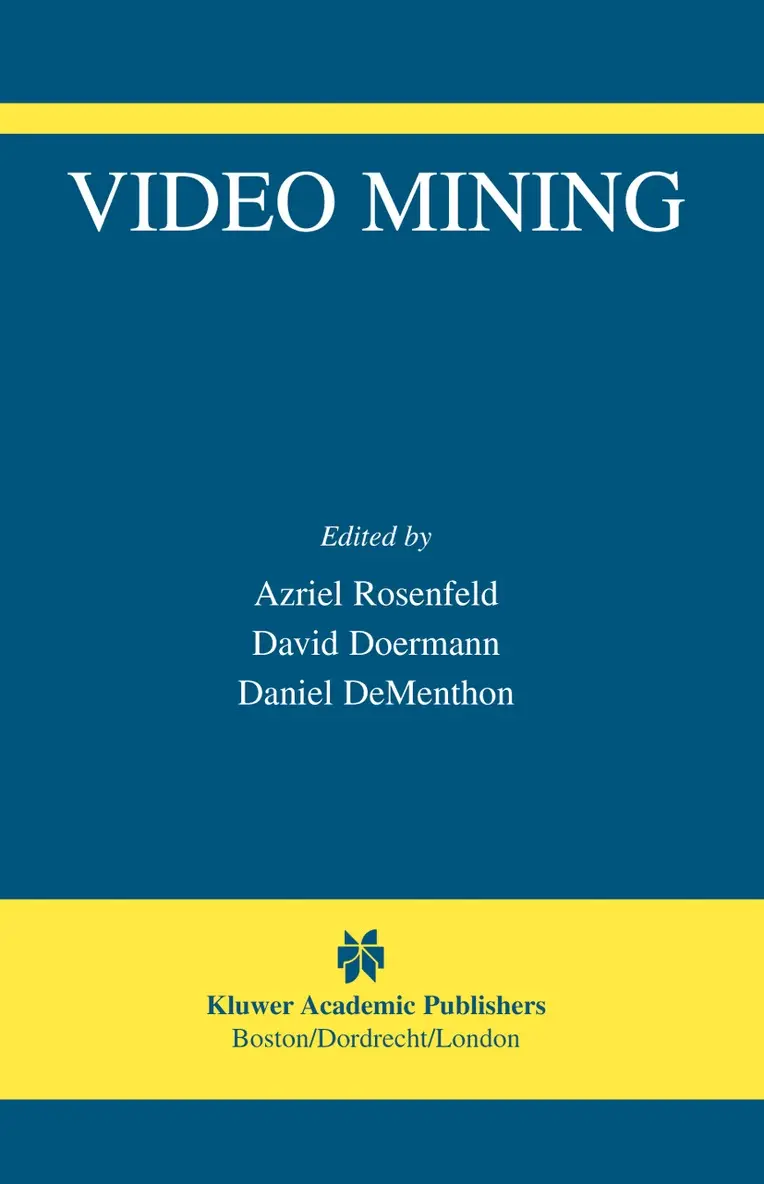
This text aims to be a reference for the practitioners and academicians in the fields of multimedia search engines. Half a terabyte or 9000 hours of motion pictures are produced around the world every year. Furthermore, 3000 television stations broadcasting for twenty-four hours a day produce eight million hours per year, amounting to 24,000 terabytes of data. Although some of the data is labelled at the time of production, an enormous portion remains unindexed. For practical access to such huge amounts of data, there is a great need to develop efficient tools for browsing and retrieving content of interest, so that producers and end users can quickly locate specific video sequences in this ocean of audio-visual data. This text describes the main techniques being developed by the major players in industry and academic research to address this problem.
Häftad, Engelska, 2010
1 619 kr
Skickas inom 10-15 vardagar
Video Mining is an essential reference for the practitioners and academicians in the fields of multimedia search engines. Half a terabyte or 9,000 hours of motion pictures are produced around the world every year. Furthermore, 3,000 television stations broadcasting for twenty-four hours a day produce eight million hours per year, amounting to 24,000 terabytes of data. Although some of the data is labeled at the time of production, an enormous portion remains unindexed. For practical access to such huge amounts of data, there is a great need to develop efficient tools for browsing and retrieving content of interest, so that producers and end users can quickly locate specific video sequences in this ocean of audio-visual data. Video Mining is important because it describes the main techniques being developed by the major players in industry and academic research to address this problem. It is the first time research from these leaders in the field developing the next-generation multimedia search engines is being described in great detail and gathered into a single volume.Video Mining will give valuable insights to all researchers and non-specialists who want to understand the principles applied by the multimedia search engines that are about to be deployed on the Internet, in studios' multimedia asset management systems, and in video-on-demand systems.
E-bok
PDF, Engelska, 20131 977 kr
Läs direkt efter köp
Traditionally, scientific fields have defined boundaries, and scientists work on research problems within those boundaries. However, from time to time those boundaries get shifted or blurred to evolve new fields. For instance, the original goal of computer vision was to understand a single image of a scene, by identifying objects, their structure, and spatial arrangements. This has been referred to as image understanding. Recently, computer vision has gradually been making the transition away from understanding single images to analyzing image sequences, or video Video understanding deals with understanding of video understanding. sequences, e.g., recognition of gestures, activities, facial expressions, etc. The main shift in the classic paradigm has been from the recognition of static objects in the scene to motion-based recognition of actions and events. Video understanding has overlapping research problems with other fields, therefore blurring the fixed boundaries. Computer graphics, image processing, and video databases have obvi ous overlap with computer vision. The main goal of computer graphics is to generate and animate realistic looking images, and videos. Re searchers in computer graphics are increasingly employing techniques from computer vision to generate the synthetic imagery. A good exam pIe of this is image-based rendering and modeling techniques, in which geometry, appearance, and lighting is derived from real images using computer vision techniques. Here the shift is from synthesis to analy sis followed by synthesis. Image processing has always overlapped with computer vision because they both inherently work directly with images.