Daniel Gasman – Författare
Visar alla böcker från författaren Daniel Gasman. Handla med fri frakt och snabb leverans.
5 produkter
5 produkter
700 kr
Skickas inom 10-15 vardagar
The United States' presidential selection process is intricate, constantly evolving, and imperfectly understood by most American voters. The long campaign brings to light conflicting concepts of the role of the president, inherent constraints on his powers, contradictions in the selection process, and possibilities for change or compromise that are at once its strength and its weakness.The Selection and Election of Presidents is based on a series of meetings and seminars organized by a French-American organization concerned with the presidential selection/election process. A varied group of experts ranging from former presidential candidates, to party leaders to professors engaged each other in an informal setting with much give and take between the speakers and questions from participants. The result is a primer on how political parties operate, their relationship to other elements in the American political system, and how eff ectively parties operate in the light of changes or reforms.The exchanges resulting from the seminars that are the basis of this volume provide a still-valuable outline of how the American system works when presidents are selected.
700 kr
Skickas inom 10-15 vardagar
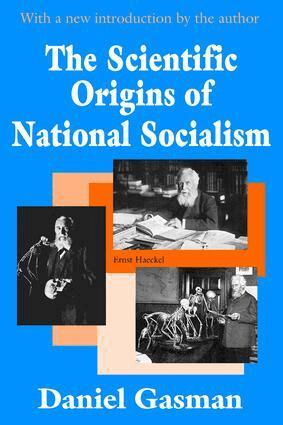
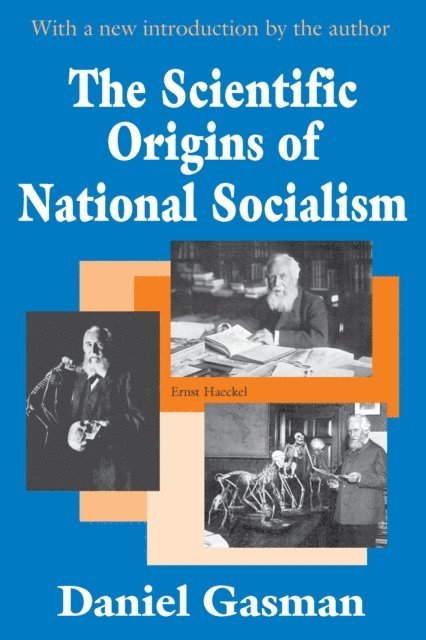
Many studies of the origins of National Socialism claim that the vo;lkisch and proto-Nazi movement arose largely as a reaction to the materialistic ideas of nineteenth-century science and especially to the naturalistic philosophy of Ernst Haeckel and the German Monist League. Using hitherto unexplored material, Daniel Gasman calls this generalization into question. Arguing that the importance of science has been relatively neglected in accounts of the intellectual origins of Nazism, he attempts to show that Haeckel's "scientific" Darwinism, and his movement, the German Monist League, were proto-Nazi in character.Contrary to popular belief, Haeckel's type of social Darwinism actually played a critical role in the formation of National Socialist ideology. In his new introduction, Gasman notes that recent research goes far to confirm Haeckel's role as an ideological progenitor of fascist ideology. This is true not only for Germany, but also for the birth of fascist thought in Italy and France. In general, Gasman claims, the history of science plainly reveals how Haeckel's social Darwinism nourished the roots of fascism no less than avant-garde modernism.When The Scientific Origins of National Socialism initially appeared, the Times Literary Supplement called it a "very well-argued thesis... that is completely successful... and leaves the reader to extract his own moral lessons." Medical History, in its review of The Scientific Origins of National Socialism, said, "His book is essential for understanding modern Germany. It has a general message derived from the events in Germany, where scientific data were permitted to take on a mystical signficiance... with ghastly consequences." Bruce Chatwin, in the New York Review of Books, called the book "brilliant." Now available in paperback, with a new introduction by the author, this seminal work will be of interest to intellectual historians, as well as those interested in twentieth-century Europe.
Del 33 - Studies in Modern European History
Haeckel's Monism and the Birth of Fascist Ideology
Inbunden, Engelska, 1999
1 063 kr
Skickas inom 5-8 vardagar
2 113 kr
Skickas inom 10-15 vardagar
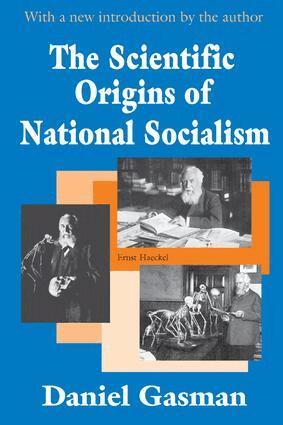
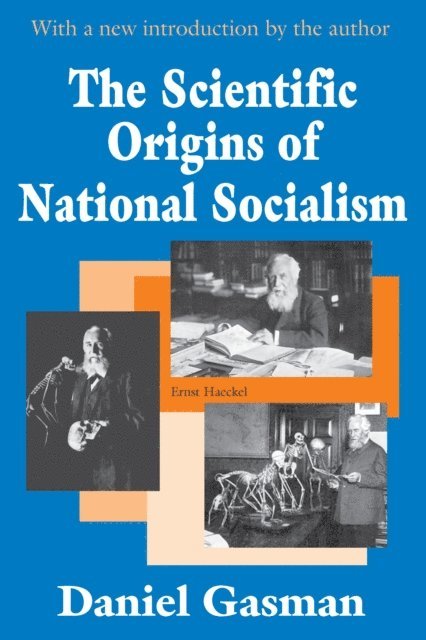
Many studies of the origins of National Socialism claim that the vo;lkisch and proto-Nazi movement arose largely as a reaction to the materialistic ideas of nineteenth-century science and especially to the naturalistic philosophy of Ernst Haeckel and the German Monist League. Using hitherto unexplored material, Daniel Gasman calls this generalization into question. Arguing that the importance of science has been relatively neglected in accounts of the intellectual origins of Nazism, he attempts to show that Haeckel's "scientific" Darwinism, and his movement, the German Monist League, were proto-Nazi in character.Contrary to popular belief, Haeckel's type of social Darwinism actually played a critical role in the formation of National Socialist ideology. In his new introduction, Gasman notes that recent research goes far to confirm Haeckel's role as an ideological progenitor of fascist ideology. This is true not only for Germany, but also for the birth of fascist thought in Italy and France. In general, Gasman claims, the history of science plainly reveals how Haeckel's social Darwinism nourished the roots of fascism no less than avant-garde modernism.When The Scientific Origins of National Socialism initially appeared, the Times Literary Supplement called it a "very well-argued thesis... that is completely successful... and leaves the reader to extract his own moral lessons." Medical History, in its review of The Scientific Origins of National Socialism, said, "His book is essential for understanding modern Germany. It has a general message derived from the events in Germany, where scientific data were permitted to take on a mystical signficiance... with ghastly consequences." Bruce Chatwin, in the New York Review of Books, called the book "brilliant." Now available in paperback, with a new introduction by the author, this seminal work will be of interest to intellectual historians, as well as those interested in twentieth-century Europe.
2 113 kr
Skickas inom 10-15 vardagar
The United States' presidential selection process is intricate, constantly evolving, and imperfectly understood by most American voters. The long campaign brings to light conflicting concepts of the role of the president, inherent constraints on his powers, contradictions in the selection process, and possibilities for change or compromise that are at once its strength and its weakness.The Selection and Election of Presidents is based on a series of meetings and seminars organized by a French-American organization concerned with the presidential selection/election process. A varied group of experts ranging from former presidential candidates, to party leaders to professors engaged each other in an informal setting with much give and take between the speakers and questions from participants. The result is a primer on how political parties operate, their relationship to other elements in the American political system, and how eff ectively parties operate in the light of changes or reforms.The exchanges resulting from the seminars that are the basis of this volume provide a still-valuable outline of how the American system works when presidents are selected.