Daniel Kaufman – författare
Visar alla böcker från författaren Daniel Kaufman. Handla med fri frakt och snabb leverans.
3 produkter
3 produkter
E-bok
Engelska, 2020137 kr
Läs direkt efter köp
A collection of essays by fifteen philosophers presenting a thoughtful, introductory guide to choosing a philosophy for living an examined and meaningful life. A VINTAGE ORIGINALSocrates famously said "the unexamined life is not worth living," but what does it mean to truly live philosophically?This thought-provoking, wide-ranging collection brings together essays by fifteen leading philosophers reflecting on what it means to live according to a philosophy of life. From Eastern philosophies (Daoism, Confucianism, and Buddhism) and classical Western philosophies (such as Aristotelianism and Stoicism), to the four major religions, as well as contemporary philosophies (such as existentialism and effective altruism), each contributor offers a lively, personal account of how they find meaning in the practice of their chosen philosophical tradition.Together, the pieces in How to Live a Good Life provide not only a beginner''s guide to choosing a life philosophy but also a timely portrait of what it means to live an examined life in the twenty-first century.
Inbunden, Engelska, 1999
1 059 kr
Skickas inom 10-15 vardagar
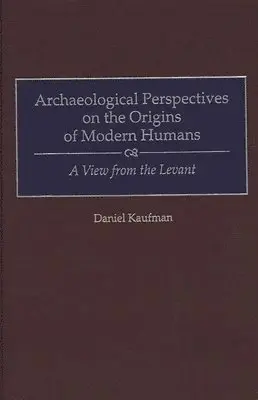
Most of the literature dealing with the origins of modern humans concentrates on the European sequence, where the Levant is referred to in passing as being problematic because it does not fit with the sequence of events documented in Europe. This is the first book that attempts to examine the issues specifically from the Levant, viewing it as central rather than peripheral to the problem. It also discusses in some depth the ramifications of possible interactions between the different hominids in the region.Rather than viewing the transition from the Middle to Upper Paleolithic as the time at which fully modern adaptive systems came to the forefront, emphasis is placed on the Middle Paleolithic itself in order to test hypotheses that hominids of this period were culturally archaic. Through an analysis of the archaeological evidence, it is concluded that by at least 100,000 years ago people of the period, usually regarded as being somewhat less than human were, on the contrary, fully modern in terms of their behavioral and cultural systems. This conclusion applies to both the Neanderthals and their anatomically modern contemporaries. The author further concludes that the cultural and behavioral differences between the two types were minimal and that there was a potential for interaction and acculturation between them. The possibility is raised that the Near East is the region in which modern human cultural adaptation arose and then dispersed to other regions.
Häftad, Engelska, 2020
154 kr
Skickas inom 5-8 vardagar