Daniel Kusswurm – författare
Visar alla böcker från författaren Daniel Kusswurm. Handla med fri frakt och snabb leverans.
5 produkter
5 produkter
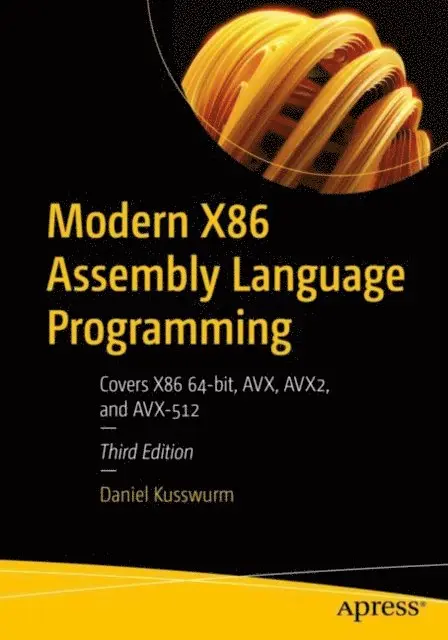
Modern X86 Assembly Language Programming
Covers X86 64-bit, AVX, AVX2, and AVX-512
Häftad, Engelska, 2023
650 kr
Skickas inom 5-8 vardagar
This book is an instructional text that will teach you how to code x86-64 assembly language functions. It also explains how you can exploit the SIMD capabilities of an x86-64 processor using x86-64 assembly language and the AVX, AVX2, and AVX-512 instruction sets.This updated edition’s content and organization are designed to help you quickly understand x86-64 assembly language programming and the unique computational capabilities of x86 processors. The source code is structured to accelerate learning and comprehension of essential x86-64 assembly language programming constructs and data structures. Modern X86 Assembly Language Programming, Third Edition includes source code for both Windows and Linux. The source code elucidates current x86-64 assembly language programming practices, run-time calling conventions, and the latest generation of software development tools.What You Will LearnUnderstand important details of the x86-64 processor platform, including its core architecture, data types, registers, memory addressing modes, and the basic instruction setUse the x86-64 instruction set to create assembly language functions that are callable from C++Create assembly language code for both Windows and Linux using modern software development tools including MASM (Windows) and NASM (Linux)Employ x86-64 assembly language to efficiently manipulate common data types and programming constructs including integers, text strings, arrays, matrices, and user-defined structuresExplore indispensable elements of x86 SIMD architectures, register sets, and data types.Master x86 SIMD arithmetic and data operations using both integer and floating-point operandsHarness the AVX, AVX2, and AVX-512 instruction sets to accelerate the performance of computationally-intense calculations in machine learning, image processing, signal processing, computer graphics, statistics, and matrix arithmetic applicationsApply leading-edge coding strategies to optimally exploit the AVX, AVX2, and AVX-512 instruction sets for maximum possible performanceWho This Book Is ForSoftware developers who are creating programs for x86 platforms and want to learn how to code performance-enhanced algorithms using the core x86-64 instruction set; developers who need to learn how to write SIMD functions or accelerate the performance of existing code using the AVX, AVX2, and AVX-512 instruction sets; and computer science/engineering students or hobbyists who want to learn or better understand x86-64 assembly language programming and the AVX, AVX2, and AVX-512 instruction sets.
Modern Arm Assembly Language Programming
Covers Armv8-A 32-bit, 64-bit, and SIMD
Häftad, Engelska, 2020
609 kr
Skickas inom 10-15 vardagar
Gain the fundamentals of Armv8-A 32-bit and 64-bit assembly language programming. This book emphasizes Armv8-A assembly language topics that are relevant to modern software development. It is designed to help you quickly understand Armv8-A assembly language programming and the computational resources of Arm’s SIMD platform. It also contains an abundance of source code that is structured to accelerate learning and comprehension of essential Armv8-A assembly language constructs and SIMD programming concepts. After reading this book, you will be able to code performance-optimized functions and algorithms using Armv8- A 32-bit and 64-bit assembly language. Modern Arm Assembly Language Programming accentuates the coding of Armv8-A 32-bit and 64-bit assembly language functions that are callable from C++. Multiple chapters are also devoted to Armv8-A SIMD assembly language programming. These chapters discuss how to code functions that are used in computationally intense applications such as machine learning, image processing, audio and video encoding, and computer graphics. The source code examples were developed using the GNU toolchain (g++, gas, and make) and tested on a Raspberry Pi 4 Model B running Raspbian (32-bit) and Ubuntu Server (64-bit). It is important to note that this is a book about Armv8-A assembly language programming and not the Raspberry Pi. What You Will LearnSee essential details about the Armv8-A 32-bit and 64-bit architectures including data types, general purpose registers, floating-point and SIMD registers, and addressing modesUse the Armv8-A 32-bit and 64-bit instruction sets to create performance-enhancing functions that are callable from C++ Employ Armv8-A assembly language to efficiently manipulate common data types and programming constructs including integers, arrays, matrices, and user-defined structuresCreate assembly language functions that perform scalar floating-point arithmetic using the Armv8-A 32-bit and 64-bit instruction setsHarness the Armv8-A SIMD instruction sets to significantly accelerate the performance of computationally intense algorithms in applications such as machine learning, image processing, computer graphics, mathematics, and statistics.Apply leading-edge coding strategies and techniques to optimally exploit the Armv8-A 32-bit and 64-bit instruction sets for maximum possible performance Who This Book Is ForSoftware developers who are creating programs for Armv8-A platforms and want to learn how to code performance-enhancing algorithms and functions using the Armv8-A 32-bit and 64-bit instruction sets. Readers should have previous high-level language programming experience and a basic understanding of C++.
Modern Parallel Programming with C++ and Assembly Language
X86 SIMD Development Using AVX, AVX2, and AVX-512
Häftad, Engelska, 2022
659 kr
Skickas inom 10-15 vardagar
Learn the fundamentals of x86 Single instruction multiple data (SIMD) programming using C++ intrinsic functions and x86-64 assembly language. This book emphasizes x86 SIMD programming topics and technologies that are relevant to modern software development in applications which can exploit data level parallelism, important for the processing of big data, large batches of data and related important in data science and much more.Modern Parallel Programming with C++ and Assembly Language is an instructional text that explains x86 SIMD programming using both C++ and assembly language. The book’s content and organization are designed to help you quickly understand and exploit the SIMD capabilities of x86 processors. It also contains an abundance of source code that is structured to accelerate learning and comprehension of essential SIMD programming concepts and algorithms. After reading this book, you will be able to code performance-optimized AVX, AVX2, andAVX-512 algorithms using either C++ intrinsic functions or x86-64 assembly language. What You Will LearnUnderstand the essential details about x86 SIMD architectures and instruction sets including AVX, AVX2, and AVX-512.Master x86 SIMD data types, arithmetic instructions, and data management operations using both integer and floating-point operands.Code performance-enhancing functions and algorithms that fully exploit the SIMD capabilities of a modern x86 processor.Employ C++ intrinsic functions and x86-64 assembly language code to carry out arithmetic calculations using common programming constructs including arrays, matrices, and user-defined data structures.Harness the x86 SIMD instruction sets to significantly accelerate the performance of computationally intense algorithms in applications such as machine learning, image processing, computer graphics, statistics, and matrix arithmetic.Apply leading-edge coding strategies and techniques to optimally exploit the x86 SIMD instruction sets for maximum possible performance. Who This Book Is ForIntermediate to advanced programmers/developers in general. Readers of this book should have previous programming experience with modern C++ (i.e., ANSI C++11 or later) and Assembly. Some familiarity with Microsoft’s Visual Studio or the GNU toolchain will be helpful. The target audience for Modern X86 SIMD Programming are experienced software developers, programmers and maybe some hobbyists.
934 kr
Skickas inom 3-6 vardagar
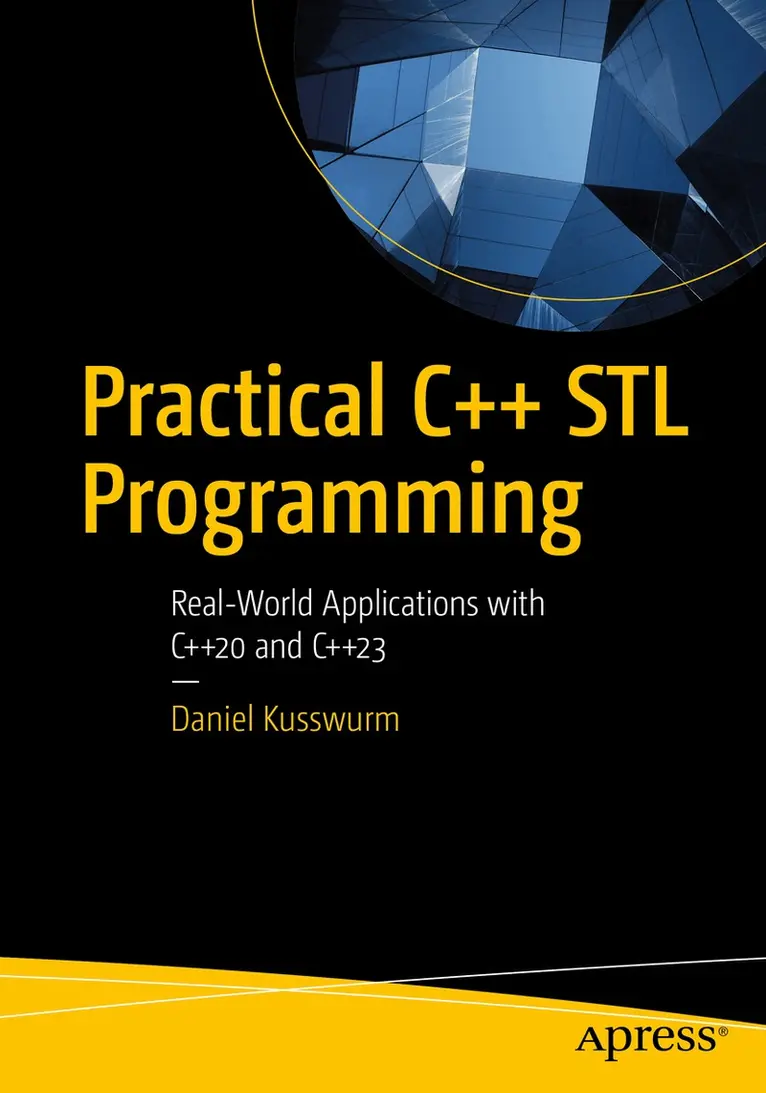
Learn how to use the classes, algorithms, and other programming constructs of C++ STL. This comprehensive and practical guide covers a broad range of STL programming topics and highlights numerous programming constructs from the C++20 and C++23 standards.Mastering use of STL can be daunting for both new and experienced C++ programmers. It doesn’t help that the ISO C++ specification documents are meticulous and verbose. This book is organized to help you quickly understand C++ STL programming, focusing on the real-world aspects of its usage. Rather than spend time providing extensive explanations of the inner workings of STL, author Daniel Kusswurm judiciously explores these intricacies only when they advance the reader’s understanding of a particular topic.This book is accompanied by over 100 source code examples, designed to accelerate learning by emphasizing practical use cases. It coincides with the C++20 and C++23 standards and works with any OS platform that supports these standards including Windows (Visual C++), Linux (GNU C++) and macOS (clang). After reading Practical C++ STL Programming, you’ll be able to exploit the computational capabilities of STL to implement a wide variety of software algorithms and solve unique programming challenges.What You Will Learn Explore STL capabilities, including how to generate formatted output, utilize sequence containers, apply utility classes, exploit smart pointers, manipulate associative containers, and exercise container adaptors.Apply algorithms and iterators to perform a wide variety of container operations including sorts, searches, insertions, removals, and erasures.Utilize ranges and range iterators, adaptors, views, compositions, projections, and factories.Perform file and directory operations using STL’s file system classes.Execute chronological calculations and formatting using the time classes.Employ STL’s random number generation and distribution classes.Implement numerical processing algorithms using STL’s std::valarray and std:complex classes.Accelerate program performance using STL’s concurrency classes and algorithm execution policies.Who This Book Is For Software developers and programmers who understand the basic syntax and semantics of C++ and want/need to learn how to use STL’s classes and algorithms, or programmers who have experience using STL as specified by the C++11/14/17 standards and are interested in learning how to use the new STL classes and algorithms of C++20/23. Computer science/engineering students or hobbyists who want to learn about or better understand the capabilities of STL.
Raspberry Pi Pico Programming Using C++
High-Performance Software for Pico-Series Microcontrollers
Häftad, Engelska, 2027
607 kr
Kommande
Raspberry Pi Pico Programming Using C++ is an instructional text that teaches the reader how to create C++ programs for the Pico. The book encompasses two principal themes. First, it explicates a subset of the C++ programming language that is most useful for microcontroller software development. Second, it elucidates essential particulars of Pico programming, including hardware peripherals, C/C++ SDK usage, and control of common electronic devices (e.g., actuators, displays, motors, sensors, servos, etc.).The source code that accompanies Raspberry Pi Pico Programming Using C++ is structured to accelerate learning and comprehension of the aforementioned themes. Each source code example is a complete program that can be executed on a Linux/Mac/Windows computer (C++ instructive examples) or actual Pico hardware (Pico application examples). The reader can also utilize freely available third-party software development tools to modify or experiment with the source code. After reading this book, the reader will be able to create programs for the Pico that are both high-performance and resource efficient.What You'll LearnProgram Pico peripherals: A/D converters, GPIO, I2C, SPI, PWM, timers, alarms, and UARTsControl devices like actuators, LCDs, GPS modules, LEDs, motors, sensors, and servosDevelop multicore programs using atomics, mutexes, and semaphoresLearn to use the Pico C/C++ SDK effectively for high-performance codeWho This Book Is ForThis book is for professional programmers, makers, students, and anyone who wants to develop high-performance, resource-efficient C++ programs for the Raspberry Pi Pico. It’s also ideal for those looking to learn the basics of C++ and related development tools for microcontrollers.