Daniel Lindvall - Böcker
Visar alla böcker från författaren Daniel Lindvall. Handla med fri frakt och snabb leverans.
3 produkter
3 produkter
675 kr
Kommande
This book explores the challenges climate change poses to the endurance of democracy, situating this theme within the context of the decline in global freedom documented since the early 21st century. It discusses how disaster events have historically affected human reasoning and agency and how the climate crisis is likely to influence democratic development in the future.Climate extreme events can provide opportunities for autocratic leaders to curtail rights and freedoms, but they can also create critical junctures where the social and political discourse within society is reshaped and where incumbent regimes are contested. The book illustrates how climate change may generate food insecurity, economic recessions and deepen socioeconomic inequalities. These effects may contribute to democratic backsliding but can also create new conditions for social mobilization. The democratic consequences of climate change are thus not primarily determined by the forces of nature, but by human responses and the social, economic and political conditions of the affected country. In the long-term perspective, however, climate change will have several negative effects on democratic stability. The book concludes that for human freedom and democracy to endure, modern society needs to be brought into balance with nature.This volume will be of great interest to students and scholars of climate governance, environmental politics, energy policy and global development.The Open Access version of this book, available at http://www.taylorfrancis.com, has been made available under a Creative Commons [Attribution-Non Commercial-No Derivatives (CC BY-NC-ND)] 4.0 license.
1 977 kr
Skickas inom 10-15 vardagar
This book explores the challenges climate change poses to the endurance of democracy, situating this theme within the context of the decline in global freedom documented since the early 21st century. It discusses how disaster events have historically affected human reasoning and agency and how the climate crisis is likely to influence democratic development in the future.Climate extreme events can provide opportunities for autocratic leaders to curtail rights and freedoms, but they can also create critical junctures where the social and political discourse within society is reshaped and where incumbent regimes are contested. The book illustrates how climate change may generate food insecurity, economic recessions and deepen socioeconomic inequalities. These effects may contribute to democratic backsliding but can also create new conditions for social mobilization. The democratic consequences of climate change are thus not primarily determined by the forces of nature, but by human responses and the social, economic and political conditions of the affected country. In the long-term perspective, however, climate change will have several negative effects on democratic stability. The book concludes that for human freedom and democracy to endure, modern society needs to be brought into balance with nature.This volume will be of great interest to students and scholars of climate governance, environmental politics, energy policy and global development.The Open Access version of this book, available at http://www.taylorfrancis.com, has been made available under a Creative Commons [Attribution-Non Commercial-No Derivatives (CC BY-NC-ND)] 4.0 license.
The limits of the European vision in Bosnia and Herzegovina : An analysis of the police reform negotiations
Häftad, Engelska, 2015
164 kr
Skickas inom 5-8 vardagar
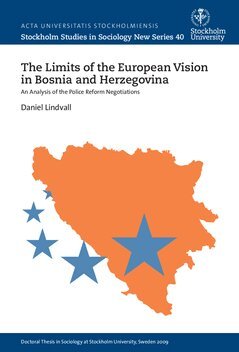
From the beginning of 2000 the European accession process was placed at the centre of peace-building in Bosnia and Herzegovina. The prospect of EU membership provided a common vision that encouraged different segments of society and the political elites to bridge ethnic divergences and engage in authentic post-war reconciliation. As pre-accession criterion the European Union required Bosnia and Herzegovina to unify its fragmented policing system at the level of the state. This requirement proved, however, to be a step too far, resulting in a protracted and ultimately unsuccessful process of political negotiations that lasted from 2004 to 2007. The European Union´s insistence on placing law enforcement authority at the state level came to be viewed as an identity threat, which affected interethnic group dynamics in a negative way. From this premise, this study assesses the impact of the negotiating process on the political discourse in Bosnia and Herzegovina and on public notions of societal security and illustrates the background and rationale of the European Union´s strategy.