
Daniel McFadden – författare
Visar alla böcker från författaren . Handla med fri frakt och snabb leverans.
2 produkter
2 produkter
E-bok
PDF, Engelska, 2014807 kr
Läs direkt efter köp
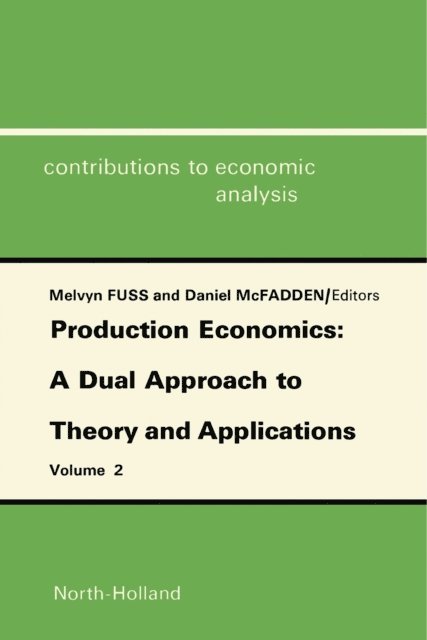
Contributions to Economic Analysis: Production Economics: A Dual Approach to Theory and Applications, Volume 2 focuses on the theory of production from the standpoint of the "dual", the relationships between economic observables which are dual to physical technology. The selection first ponders on duality, intermediate inputs and value-added, Hicks'' aggregation theorem and the existence of a real value-added function, and homotheticity and real value-added in Canadian manufacturing. Discussions focus on real value-added and the production structure, estimation of the production structure, double deflation and real value-added, measurement of total productivity, and duality between direct and conditional indirect utility functions. The book then examines the estimation techniques for the elasticity of substitution and other production parameters and measurement of the elasticity of factor substitution and bias of technical change. The publication takes a look at the identification of technical change in the electricity generating industry, factor substitution in electricity generation, and the effectiveness of rate-of-return regulation. Topics include statistical tests of regulatory effectiveness, profit function for a regulated firm, tests of the structure of technology, identification problems in the measurement of technical change, and measurement of disembodied technical change. The selection is a valuable source of information for economists and researchers interested in production economics.
Inbunden, Engelska, 2017
2 273 kr
Skickas inom 5-8 vardagar
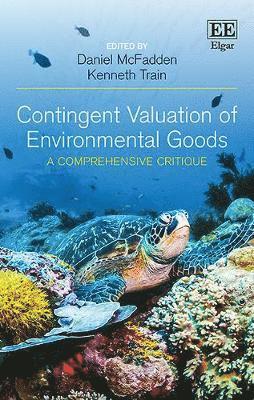
Contingent valuation is a survey-based procedure that attempts to estimate how much households are willing to pay for specific programs that improve the environment or prevent environmental degradation. For decades, the method has been the center of debate regarding its reliability: does it really measure the value that people place on environmental changes? Bringing together leading voices in the field, this timely book tells a unified story about the interrelated features of contingent valuation and how those features affect its reliability. Through empirical analysis and review of past studies, the authors identify important deficiencies in the procedure, raising questions about the technique's continued use. Individual chapters investigate how respondents answer questions in contingent valuation surveys, with a particular focus on how the procedure's estimates change based on the costs that the researcher specifies, the payment mechanism, and the scope of the environmental improvement. Other issues covered include whether the survey respondents make trade-offs between the program costs and benefits; and whether corrections can be applied to account for any misunderstanding of the questions by respondents and for the hypothetical nature of the survey. This book will appeal to environmental economists and students in environmental and resource economics. Government staff at environmental agencies and survey researchers will benefit from the close analysis of previous applications.Contributors include: J. Burrows, H.M. Chan, L. Daniel, W. Desvousges, P. Dixon, H.Foster, J. Genser, B. Israel, M. Kemp, E. Leamer, J. Lustig, D. McFadden, D. MacNair, J. Martin, K. Mathews, K. Myers, R. Newman, G. Parsons, J. Plewes, J. Schneider, K. Smith Fayne, T. Tomasi, K. Train