Daniel R. Cahoy - Böcker
Visar alla böcker från författaren Daniel R. Cahoy. Handla med fri frakt och snabb leverans.
4 produkter
4 produkter
1 655 kr
Skickas inom 7-10 vardagar
Within the complex global economy, patents function as indispensable tools for fostering and protecting innovation. This fascinating volume offers a comprehensive perspective on the US patent system, detailing its many uses and outlining several critical legislative, administrative and judicial reforms that impact business strategy.The expert contributors to this book provide an overview of how the US patent system functions today and describe how recent changes affect firms and individual inventors. Topics discussed include the drivers of intellectual property policy; recent revisions to the patent application process in terms of the new first-to-file regime, inequitable conduct, and allowable subject matter; and changes to patent enforcement and infringement related to the Federal Circuit's special role and post-grant review. Contributors address recent legislation such as the 2011 America Invents Act, which enacted some of the most significant patent reforms in decades.This examination of the US patent system highlights some of the most important issues for business. It will serve as an important tool for both policymakers and business leaders, and will also interest students and professors of business and management studies, innovation studies and business law.Contributors: C. Aceves, T.L. Anenson, D.L. Baumer, R.C. Bird, D.R. Cahoy, W.M. Chumney, J. Gehman, D.M. Gitter, Z. Lei, G. Mark, S.J. Marsnik, D. Orozco, L.J. Oswald, R.B. Sawyers, R.E. Thomas
1 730 kr
Skickas inom 7-10 vardagar
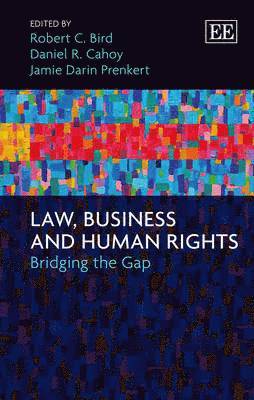
Multinational corporations have the potential to bring economic and social benefits to emerging economies, but also social and political upheaval that can suppress fundamental human rights. This book synthesizes views from multinational corporations and civil society groups to find areas of common ground and raise issues of future potential conflict.The authors draw on their academic specializations in business and law to examine important human rights questions from legal, ethical, and business perspectives. The first part of the book focuses on the role of the multinational corporation in respecting human rights. It follows with an examination of the rights of vulnerable stakeholders and their erosion via direct or indirect corporate activity. Integrating John Ruggie's 'Protect, Respect, and Remedy' framework and the UN's 'Guiding Principles of Business and Human Rights', this book expands upon initial dialogue on the role of business in international human rights at this vital moment in history.Law, Business and Human Rights provides unity in a broad range of issues from a variety of perspectives that should interest scholars, teachers, students, and practitioners alike.Contributors: R.C. Bird, N. Bishara, D.R. Cahoy, L.J. Dhooge, D. Hess, J.S. Hiller, S.S. Hiller, R. Mares,K. McGarry, D. Orozco, M.A. Pagnattaro, S.K. Park, L.Pierre-Louis, J.D. Prenkert
987 kr
Skickas inom 10-15 vardagar
Law and the Transition to Business Sustainability
1 296 kr
Skickas inom 5-8 vardagar
This book expands on law-related research by examining the legal aspects of sustainability with a focus on the impact on business strategies. It recognizes that firms must adopt an integrated approach to law and sustainability, considering multiple disciplines and goals, and serve as a forum for bringing together scholarship from fields such as environmental law, energy, government regulation and intellectual property. Firms increasingly have an interest in transitioning to sustainable business practices that take into consideration the fact that global resources are finite and will be increasingly scarce. They acknowledge that current actions have social, economic and environmental consequences and employ options to ensure that future generations have the same options and benefits. Examples of sustainable practices increasingly employed by firms include the institutionalization of “whole life-cycle” analysis in marketing and product design, utilization of sustainable inputs and energy sources, tracking and reporting sustainability performance, attempting the valuation of future generation prosperity and happiness as a discounting mechanism, and integrating sustainability into firm culture and management goals. It is clear that law and regulation have an extremely important role to play in the transition to more sustainable business practices. Broadly stated, law can provide structure for firms responding to forces that pull transition by enabling sustainability leadership and competitive advantage through funding models, intellectual property rights and collaboration means. Additionally, law can work to push transition by compelling firms to act through regulatory structures, accounting and governance mechanisms.