Daniel T. Jones – författare
Visar alla böcker från författaren Daniel T. Jones. Handla med fri frakt och snabb leverans.
10 produkter
10 produkter
Häftad, Engelska, 2003
181 kr
Skickas
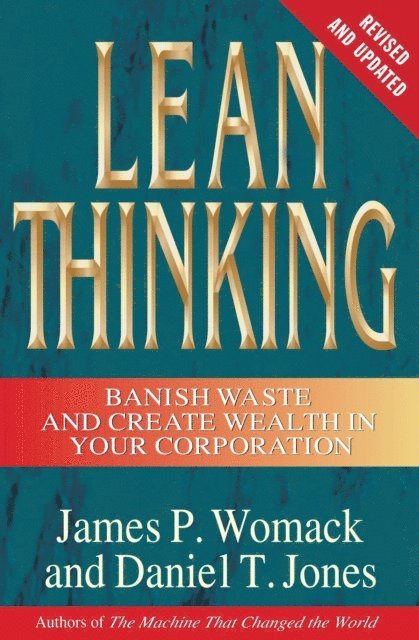
Lean Thinking was launched in the fall of 1996, just in time for the recession of 1997. It told the story of how American, European, and Japanese firms applied a simple set of principles called 'lean thinking' to survive the recession of 1991 and grow steadily in sales and profits through 1996. Even though the recession of 1997 never happened, companies were starving for information on how to make themselves leaner and more efficient. Now we are dealing with the recession of 2001 and the financial meltdown of 2002. So what happened to the exemplar firms profiled in Lean Thinking? In the new fully revised edition of this bestselling book those pioneering lean thinkers are brought up to date. Authors James Womack and Daniel Jones offer new guidelines for lean thinking firms and bring their groundbreaking practices to a brand new generation of companies that are looking to stay one step ahead of the competition.
Inbunden, Engelska, 2003
390 kr
Skickas inom 3-6 vardagar
Häftad, Engelska, 2015
298 kr
Skickas inom 3-6 vardagar
202 kr
Läs direkt efter köp
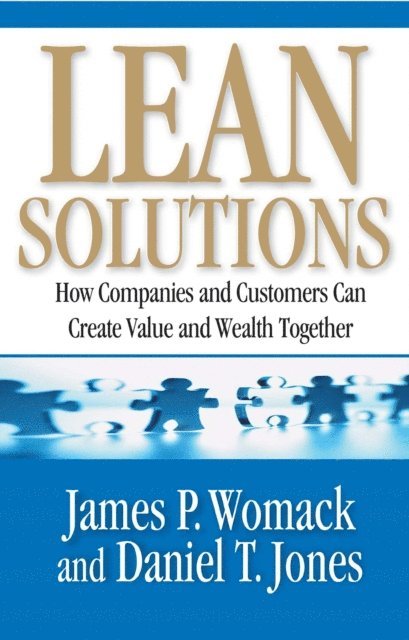
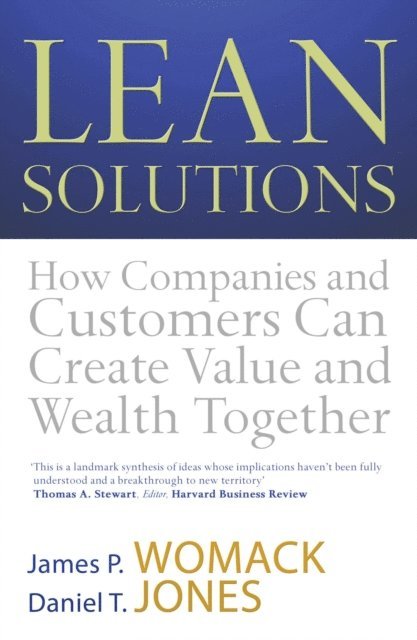
Womack and Jones deconstruct the broken producer-consumer model and show businesses how to repair it, by providing the full value consumers desire from products without wasting time or effort.Why is it that, when our computers or our cell phones fail to satisfy our needs, virtually every interaction with help lines, support centers, or any organization providing service is marked with wasted time and extra hassle? In their bestselling business classic Lean Thinking, James Womack and Daniel Jones introduced the world to the principles of lean production—principles for eliminating waste during production. Now, in Lean Solutions, the authors establish the groundbreaking principles of lean consumption, showing companies how to eliminate inefficiency during consumption. Lean Solutions is full of surprising success stories: Fujitsu, a leading service company for technology, has transformed the way call centers solve problems—learning how to eliminate the underlying cause of current problems rather than fixing them again and again. An extremely successful car dealership has adopted lean principles to streamline its business, making for dramatically reduced wait time, fewer return trips, and greater satisfaction for customers—and a far more lucrative enterprise. Lean Solutions will inspire managers to take the first steps toward perfecting their company''s process of giving consumers what they really want.
Ljudbok
Engelska, 2003248 kr
Lyssna direkt efter köp
Expanded, updated, and more relevant than ever, this bestselling business classic by two internationally renowned management analysts describes a business system for the twenty-first century.Expanded, updated, and more relevant than ever, this bestselling business classic by two internationally renowned management analysts describes a business system for the twenty-first century that supersedes the mass production system of Ford, the financial control system of Sloan, and the strategic system of Welch and GE. It is based on the Toyota (lean) model, which combines operational excellence with value-based strategies to produce steady growth through a wide range of economic conditions. In contrast with the crash-and-burn performance of companies trumpeted by business gurus in the 1990s, the firms profiled in Lean Thinking -- from tiny Lantech to midsized Wiremold to niche producer Porsche to gigantic Pratt & Whitney -- have kept on keeping on, largely unnoticed, along a steady upward path through the market turbulence and crushed dreams of the early twenty-first century. Meanwhile, the leader in lean thinking -- Toyota -- has set its sights on leadership of the global motor vehicle industry in this decade. Instead of constantly reinventing business models, lean thinkers go back to basics by asking what the customer really perceives as value. (It''s often not at all what existing organizations and assets would suggest.) The next step is to line up value-creating activities for a specific product along a value stream while eliminating activities (usually the majority) that don''t add value. Then the lean thinker creates a flow condition in which the design and the product advance smoothly and rapidly at the pull of the customer (rather than the push of the producer). Finally, as flow and pull are implemented, the lean thinker speeds up the cycle of improvement in pursuit of perfection. The first part of this book describes each of these concepts and makes them come alive with striking examples. Lean Thinking clearly demonstrates that these simple ideas can breathe new life into any company in any industry in any country. But most managers need guidance on how to make the lean leap in their firm. Part II provides a step-by-step action plan, based on in-depth studies of more than fifty lean companies in a wide range of industries across the world. Even those readers who believe they have embraced lean thinking will discover in Part III that another dramatic leap is possible by creating an extended lean enterprise for each of their product families that tightly links value-creating activities from raw materials to customer. In Part IV, an epilogue to the original edition, the story of lean thinking is brought up-to-date with an enhanced action plan based on the experiences of a range of lean firms since the original publication of Lean Thinking. Lean Thinking does not provide a new management "program" for the one-minute manager. Instead, it offers a new method of thinking, of being, and, above all, of doing for the serious long-term manager -- a method that is changing the world.
Ljudbok
Engelska, 2005248 kr
Lyssna direkt efter köp
A massive disconnect exists between consumers and providers today. Consumers have a greater selection of higher quality goods to choose from and can obtain these items from a growing number of sources. Computers, cars, and even big-box retail sites promise to solve our every need. So why aren''t consumers any happier? Because everything surrounding the process of obtaining and using all these products causes us frustration and disappointment. Why is it that, when our computers or our cell phones fail to satisfy our needs, virtually every interaction with help lines, support centers, or any organization providing service is marked with wasted time and extra hassle? And who among us hasn''t spent countless hours in the waiting room at the doctor''s office, or driven away from the mechanic only to have the "fix engine" light go on? In their bestselling business classic Lean Thinking, James Womack and Daniel Jones introduced the world to the principles of lean production -- principles for eliminating waste during production. Now, in Lean Solutions, the authors establish the groundbreaking principles of lean consumption, showing companies how to eliminate inefficiency during consumption. The problem is neither that companies don''t care nor that the people trying to fix our broken products are inept. Rather, it''s that few companies today see consumption as a process -- a series of linked goods and services, all of which must occur seamlessly for the consumer to be satisfied. Buying a home computer, for example, involves researching, purchasing, integrating, maintaining, upgrading, and, ultimately, replacing it. Across all industries, companies that apply the principles of lean consumption will learn how to provide the full value consumers desire from products without wasting time or effort -- theirs or the consumers'' -- and as a result these companies will be more profitable and competitive. Lean Solutions is full of surprising success stories: Fujitsu, a leading service company for technology, has transformed the way call centers solve problems -- learning how to eliminate the underlying cause of current problems rather than fixing them again and again. An extremely successful car dealership has adopted lean principles to streamline its business, making for dramatically reduced wait time, fewer return trips, and greater satisfaction for customers -- and a far more lucrative enterprise. Lean Solutions will inspire managers to take the first steps toward perfecting their company''s process of giving consumers what they really want.
E-bok
Engelska, 2007202 kr
Läs direkt efter köp
The classic, nationally bestselling book that first articulated the principles of lean production, with a new foreword and afterword by the authors.When The Machine That Changed the World was first published in 1990, Toyota was half the size of General Motors. Twenty years later Toyota passed GM as the world’s largest auto maker. This management classic was the first book to reveal Toyota’s lean production system that is the basis for its enduring success. Authors Womack, Jones, and Roos provided a comprehensive description of the entire lean system. They exhaustively documented its advantages over the mass production model pioneered by General Motors and predicted that lean production would eventually triumph. Indeed, they argued that it would triumph not just in manufacturing but in every value-creating activity from health care to retail to distribution. Today The Machine That Changed the World provides enduring and essential guidance to managers and leaders in every industry seeking to transform traditional enterprises into exemplars of lean success.
E-bok
Engelska, 2010253 kr
Läs direkt efter köp
Expanded, updated, and more relevant than ever, this bestselling business classic by two internationally renowned management analysts describes a business system for the twenty-first century that supersedes the mass production system of Ford, the financial control system of Sloan, and the strategic system of Welch and GE. It is based on the Toyota (lean) model, which combines operational excellence with value-based strategies to produce steady growth through a wide range of economic conditions.In contrast with the crash-and-burn performance of companies trumpeted by business gurus in the 1990s, the firms profiled in Lean Thinking -- from tiny Lantech to midsized Wiremold to niche producer Porsche to gigantic Pratt & Whitney -- have kept on keeping on, largely unnoticed, along a steady upward path through the market turbulence and crushed dreams of the early twenty-first century. Meanwhile, the leader in lean thinking -- Toyota -- has set its sights on leadership of the global motor vehicle industry in this decade.Instead of constantly reinventing business models, lean thinkers go back to basics by asking what the customer really perceives as value. (It''s often not at all what existing organizations and assets would suggest.) The next step is to line up value-creating activities for a specific product along a value stream while eliminating activities (usually the majority) that don''t add value. Then the lean thinker creates a flow condition in which the design and the product advance smoothly and rapidly at the pull of the customer (rather than the push of the producer). Finally, as flow and pull are implemented, the lean thinker speeds up the cycle of improvement in pursuit of perfection. The first part of this book describes each of these concepts and makes them come alive with striking examples.Lean Thinking clearly demonstrates that these simple ideas can breathe new life into any company in any industry in any country. But most managers need guidance on how to make the lean leap in their firm. Part II provides a step-by-step action plan, based on in-depth studies of more than fifty lean companies in a wide range of industries across the world.Even those readers who believe they have embraced lean thinking will discover in Part III that another dramatic leap is possible by creating an extended lean enterprise for each of their product families that tightly links value-creating activities from raw materials to customer.In Part IV, an epilogue to the original edition, the story of lean thinking is brought up-to-date with an enhanced action plan based on the experiences of a range of lean firms since the original publication of Lean Thinking.Lean Thinking does not provide a new management "program" for the one-minute manager. Instead, it offers a new method of thinking, of being, and, above all, of doing for the serious long-term manager -- a method that is changing the world.
Häftad, Engelska, 2007
172 kr
Skickas inom 3-6 vardagar
When James Womack, Daniel Jones, and Daniel Roos wrote THE MACHINE THAT CHANGED THE WORLD in 1990, Japanese automakers, and Toyota in particular, were making a strong showing by applying the principles of lean production. However, the full power of lean principles was unproven, and they had not been applied outside of the auto industry. Today, the power of lean production has been conclusively proved by Toyota's unparalleled success, and the concepts have been widely applied in many industries. Based on MIT's pioneering global study of industrial competition, THE MACHINE THAT CHANGED THE WORLD offers a groundbreaking analysis of the entire lean business system, including product development, supplier management, sales, service, and production - an analysis even more relevant today as GM and Ford struggle to survive and a wide range of British abd American companies embrace lean production. A new Foreword by the authors brings the story up to date and details how their predictions were right. As a result, this reissue of a classic is as insightful and instructive today as when it was first published.
Häftad, Engelska, 2007
84 kr
Tillfälligt slut
A massive disconnect exists today between consumers and providers. As consumers, we have a greater selection of higher quality goods and services to choose from, yet our experience of obtaining and using these items is more frustrating than ever. At the same time, companies find themselves with declining customer loyalty, greater challenges in fulfilling orders, and a general sense of dissatisfaction in connecting with their customers. In LEAN SOLUTIONS, lean production experts Womack and Jones show consumers and companies alike how they can align their goals to achieve greater value with less waste.