Daniel TrA¶hler – författare
654 kr
Läs direkt efter köp
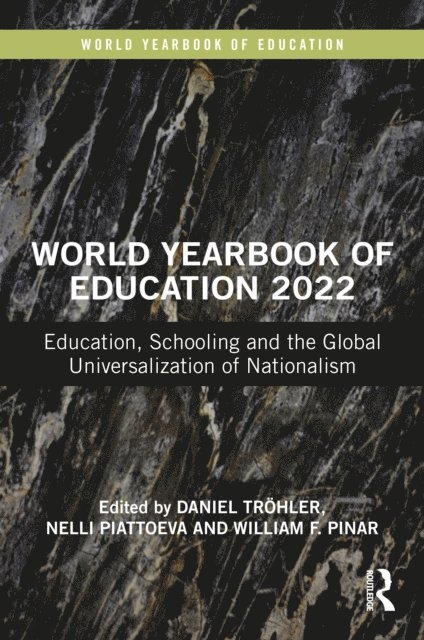
The latest volume in the World Yearbook of Education Series explores the relationship between education and the globally prevalent principle of nationalism. This book identifies the diverse ways in which educational policies, discourses, curricula and pedagogy embed and promote the concept of "the nation" both historically and in the age of globalization. By challenging accounts owed to the discourse of "globalization" which conceal the presence of national epistemologies and interests in education, this book offers important insights into the role of education in making nationalism one of the most enduring and yet easily obscured forces of our time.
Organized into four sections, this book looks at the following main issues:
Historical (re)production of the nation considers how countries consider and reproduce their national identity and how this is built on their history Hegemonic aspirations and interventions examines how instruction technologies developed during the Cold War have been propagated and disseminated around the world, how the development of educational policy based on the human capital theory emerged, and analyzes the extent to which tech companies are intent on establishing an imperial order of learning Imperial policies and resurgences of nationalisms explores how global or imperial policies have been indulged in different parts of the world and how new forms of nationalism have been emerging Paradoxes, inconsistencies, and a self-reflection focuses on nations acting imperially as sites of domestic injustices, addresses unresolved paradoxes between the global and the national and includes a historically informed critical review of the World Yearbooks of EducationBringing together the voices of researchers from around the globe, The World Yearbook of Education 2022 is ideal reading for anyone interested in learning how nationalism has affected the expansion of education systems and how its imperial aspirations are currently affecting education policy and practice.
Chapter 5 of this book is freely available as a downloadable Open Access PDF at http://www.taylorfrancis.com under a Creative Commons Attribution (CC-BY) 4.0 license.
654 kr
Läs direkt efter köp
The latest volume in the World Yearbook of Education Series explores the relationship between education and the globally prevalent principle of nationalism. This book identifies the diverse ways in which educational policies, discourses, curricula and pedagogy embed and promote the concept of "the nation" both historically and in the age of globalization. By challenging accounts owed to the discourse of "globalization" which conceal the presence of national epistemologies and interests in education, this book offers important insights into the role of education in making nationalism one of the most enduring and yet easily obscured forces of our time.
Organized into four sections, this book looks at the following main issues:
Historical (re)production of the nation considers how countries consider and reproduce their national identity and how this is built on their history Hegemonic aspirations and interventions examines how instruction technologies developed during the Cold War have been propagated and disseminated around the world, how the development of educational policy based on the human capital theory emerged, and analyzes the extent to which tech companies are intent on establishing an imperial order of learning Imperial policies and resurgences of nationalisms explores how global or imperial policies have been indulged in different parts of the world and how new forms of nationalism have been emerging Paradoxes, inconsistencies, and a self-reflection focuses on nations acting imperially as sites of domestic injustices, addresses unresolved paradoxes between the global and the national and includes a historically informed critical review of the World Yearbooks of EducationBringing together the voices of researchers from around the globe, The World Yearbook of Education 2022 is ideal reading for anyone interested in learning how nationalism has affected the expansion of education systems and how its imperial aspirations are currently affecting education policy and practice.
Chapter 5 of this book is freely available as a downloadable Open Access PDF at http://www.taylorfrancis.com under a Creative Commons Attribution (CC-BY) 4.0 license.
686 kr
Läs direkt efter köp
This book is a comparative history that explores the social, cultural, and political formation of the modern nation through the construction of public schooling. It asks how modern school systems arose in a variety of different republics and non-republics across four continents during the period from the late eighteenth century to the early twentieth century. The authors begin with the republican preoccupation with civic virtue – the need to overcome self-interest in order to take up the common interest – which requires a form of education that can produce individuals who are capable of self-guided rational action for the public good. They then ask how these educational preoccupations led to the emergence of modern school systems in a disparate array of national contexts, even those that were not republican.
By examining historical changes in republicanism across time and space, the authors explore central epistemologies that connect the modern individual to community and citizenship through the medium of schooling. Ideas of the individual were reformulated in the nineteenth century in reaction to new ideas about justice, social order, and progress, and the organization and pedagogy of the school turned these changes into a way to transform the self into the citizen.
686 kr
Läs direkt efter köp
This book is a comparative history that explores the social, cultural, and political formation of the modern nation through the construction of public schooling. It asks how modern school systems arose in a variety of different republics and non-republics across four continents during the period from the late eighteenth century to the early twentieth century. The authors begin with the republican preoccupation with civic virtue – the need to overcome self-interest in order to take up the common interest – which requires a form of education that can produce individuals who are capable of self-guided rational action for the public good. They then ask how these educational preoccupations led to the emergence of modern school systems in a disparate array of national contexts, even those that were not republican.
By examining historical changes in republicanism across time and space, the authors explore central epistemologies that connect the modern individual to community and citizenship through the medium of schooling. Ideas of the individual were reformulated in the nineteenth century in reaction to new ideas about justice, social order, and progress, and the organization and pedagogy of the school turned these changes into a way to transform the self into the citizen.
899 kr
Läs direkt efter köp
In this landmark contribution to the study of the formation of the modern school, Daniel Tröhler applies one of the most recognized methods of historical research to an analysis of the "language" of the academic discipline of education. Arguing the value of looking at languages rather than arguments--langues rather than paroles--this method of historical research is used to examine the background of different philosophies, theories, or arguments of education, specifically republicanism and Protestantism. Tröhler’s argument is that such analysis is essential to tracing back educational arguments to the ideological core of their concerns, and thus to understanding in international perspective the historical development of education systems and organizations and to evaluating their different theoretical and political approaches and claims. Elegantly written, with the historian’s attention to archival material, this book enables the reader to understand the complex and different social, cultural, religious, and political context factors embedded in the "thought" of schooling and its objects of scrutiny--its notions of the child and teacher. Languages of Education is essential reading for scholars and students across the fields of history and philosophy of education, curriculum studies, and comparative education.
948 kr
Läs direkt efter köp
As contemporary education becomes increasingly tied to global economic power, national school systems attempting to influence one another inevitably confront significant tensions caused by differences in heritage, politics, and formal structures. Trajectories in the Development of Modern School Systems provides a comprehensive theoretical and empirical critique of the reform movements that seek to homogenize schooling around the world. Informed by historical and sociological insight into a variety of nations and eras, these in-depth case studies reveal how and why sweeping, convergent reform agendas clash with specific institutional policies, practices, and curricula. Countering current theoretical models which fail to address the potential pressures born from these challenging isomorphic developments, this book illuminates the cultural idiosyncrasies that both produce and problematize global reform efforts and offers a new way of understanding curriculum as a manifestation of national identity.
948 kr
Läs direkt efter köp
As contemporary education becomes increasingly tied to global economic power, national school systems attempting to influence one another inevitably confront significant tensions caused by differences in heritage, politics, and formal structures. Trajectories in the Development of Modern School Systems provides a comprehensive theoretical and empirical critique of the reform movements that seek to homogenize schooling around the world. Informed by historical and sociological insight into a variety of nations and eras, these in-depth case studies reveal how and why sweeping, convergent reform agendas clash with specific institutional policies, practices, and curricula. Countering current theoretical models which fail to address the potential pressures born from these challenging isomorphic developments, this book illuminates the cultural idiosyncrasies that both produce and problematize global reform efforts and offers a new way of understanding curriculum as a manifestation of national identity.