Daniel W. Conway - Böcker
Visar alla böcker från författaren Daniel W. Conway. Handla med fri frakt och snabb leverans.
5 produkter
5 produkter
21 325 kr
Skickas inom 10-15 vardagar
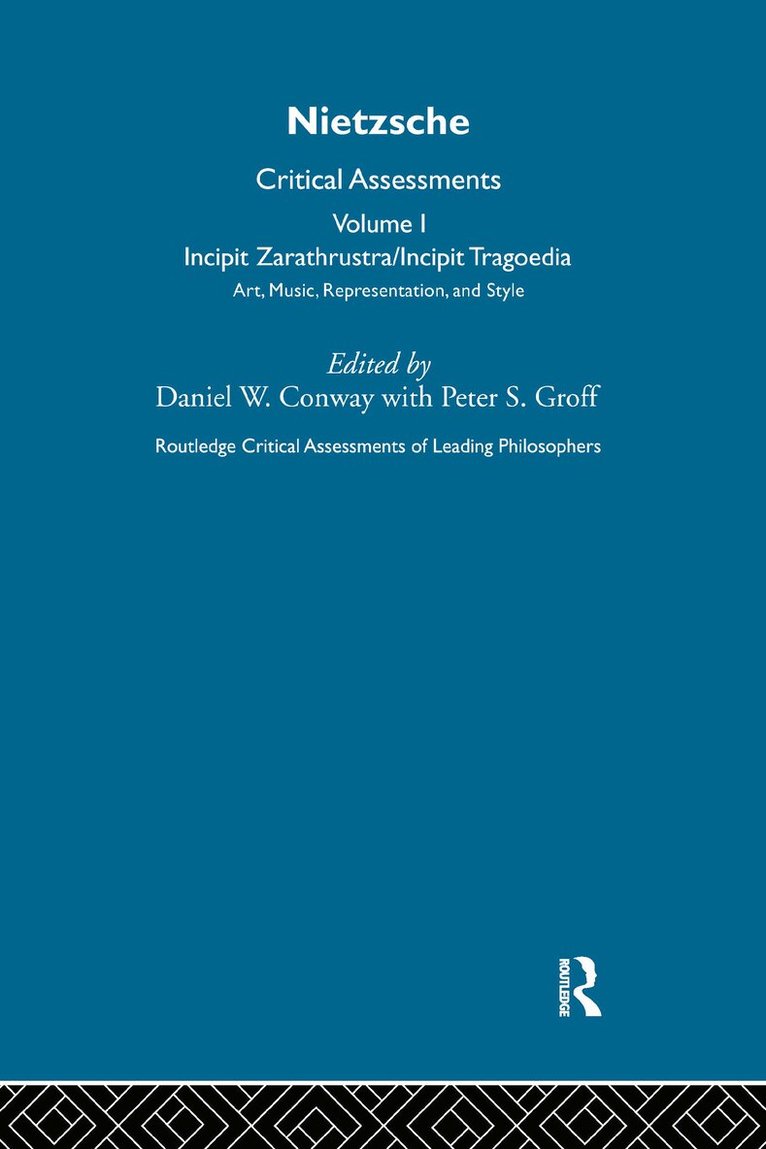
Nietzsche: Critical Assessments collects together the very best scholarship available on Nietzsche's multi-dimensional thought.Nietzsche's writings are now considered seminal to a number of scholarly disciplines, including philosophy, political theory, depth psychology, jurisprudence, rhetoric, anthropology, sociology, and comparative literature. This recent explosion of scholarship is matched only by the rapid profusion of academic and popular interest in Nietzsche's philosophy.Nietzsche's current readership is drawn from various and disparate academic backgrounds and his chequered reception means that scholars have arrived at his work from diverse critical standpoints.The articles included in this set are written by leading Nietzsche scholars and demonstrate the serious reconsideration of his thought as a whole, in a number of academic fields and disciplines over the last thirty years.* Volume One covers Metaphysics and Ontology* Volume Two covers Epistemology and Psychology* Volume Three covers Ethics and Political Philosophy* Volume Four covers Rhetoric, Poetry and Literary Style
10 704 kr
Skickas inom 11-20 vardagar
Søren Kierkegaard (1813-1855) is widely recognized as a leading figure in the Western tradition of philosophy. Especially well known are his seminal contributions to existentialism, philosophy of religion, and cultural criticism. His novel experiments with pseudonymy, irony, satire, allegory and self-erasure have influenced the development of various strands of 'post-structuralist' and 'post-modern' thought in the twentieth century. The secondary literature devoted to his thought is consequently distributed across a number of academic disciplines, including philosophy, literature, religion, political theory and history. These volumes are designed to allow current debates on key themes to be followed through in depth without having to seek additional sources, while giving readers an appreciation of the diversity of philosophical approaches and interpretive strategies which characterize recent Kierkegaard scholarship.
626 kr
Skickas inom 7-10 vardagar
Nietzsche's writings have shaped much contemporary reflection on the relation between philosophy and art. This book brings together a number of distinguished contributors to examine his aesthetic account of the origins and ends of philosophy. They discuss the transformative power which Nietzsche ascribes to aesthetic activity, including his aesthetic justification of existence and its fusion of social and personal existence, and they investigate his experiments with an 'aesthetic politics' and a politicisation of aesthetics. Together their essays set out the ground for future debate about the inter-relation between art, philosophy, and value.
1 034 kr
Skickas inom 7-10 vardagar
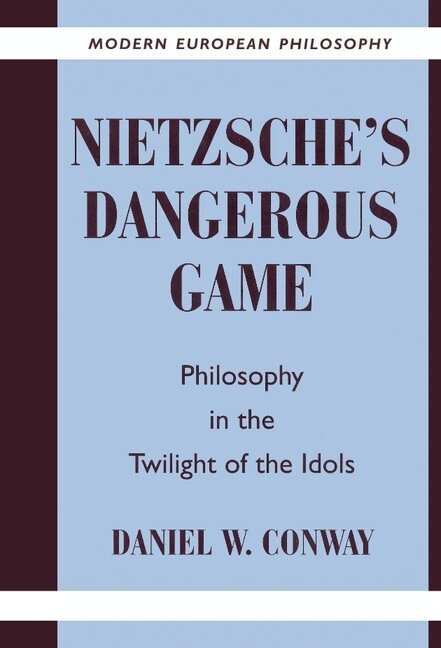
This 1997 work is a book-length treatment of the unique nature and development of Nietzsche's post-Zarathustran political philosophy. This later political philosophy is set in the context of the critique of modernity that Nietzsche advances in the years 1885-1888, in such texts as Beyond Good and Evil, On the Genealogy of Morals, Twilight of the Idols, The Antichrist, The Case of Wagner, and Ecce Homo. In this light Nietzsche's own diagnosis of the ills of modernity is subject to the same criticism that he himself levelled against previous philosophies; that it is an involuntary symptom of the age it represents. Nietzsche is seen to be aware of his own decadence and of his complicity with the very tendencies that he dissects and deplores. By relating the political philosophy, the critique of modernity and the theory of decadence Daniel Conway has written a powerful book about Nietzsche's own appreciation of the limitations of both his writing style and of his famous prophetic 'stance'.
448 kr
Skickas inom 7-10 vardagar
This 1997 work is a book-length treatment of the unique nature and development of Nietzsche's post-Zarathustran political philosophy. This later political philosophy is set in the context of the critique of modernity that Nietzsche advances in the years 1885-1888, in such texts as Beyond Good and Evil, On the Genealogy of Morals, Twilight of the Idols, The Antichrist, The Case of Wagner, and Ecce Homo. In this light Nietzsche's own diagnosis of the ills of modernity is subject to the same criticism that he himself levelled against previous philosophies; that it is an involuntary symptom of the age it represents. Nietzsche is seen to be aware of his own decadence and of his complicity with the very tendencies that he dissects and deplores. By relating the political philosophy, the critique of modernity and the theory of decadence Daniel Conway has written a powerful book about Nietzsche's own appreciation of the limitations of both his writing style and of his famous prophetic 'stance'.