Daniel Wikler – författare
Visar alla böcker från författaren Daniel Wikler. Handla med fri frakt och snabb leverans.
5 produkter
5 produkter
Inbunden, Engelska, 2020
959 kr
Skickas inom 5-8 vardagar
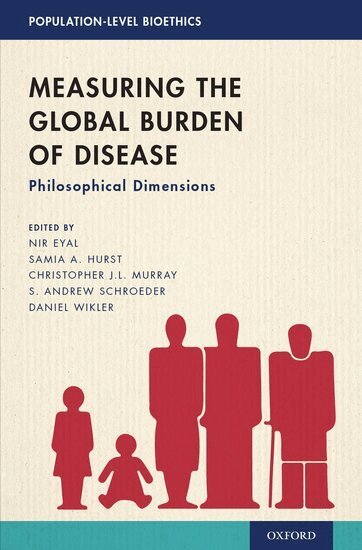
The Global Burden of Disease Study (GBD) is one of the largest-scale research collaborations in global health, distilling a wide range of health information to provide estimates and projections for more than 350 diseases, injuries, and risk factors in 195 countries. Its results are a critical tool informing researchers, policy-makers, and others working to promote health around the globe. A study like the GBD is, of course, extremely complex from an empirical perspective. But it also raises a large number of complex ethical and philosophical questions that have been explored in a series of collaborations over the past twenty years among epidemiologists, philosophers, economists, and policy scholars. The essays in this volume address issues of current and urgent concern to the GBD and other epidemiological studies, including rival understandings of causation, the aggregation of complex health data, temporal discounting, age-weighting, and the valuation of health states. The volume concludes with a set of chapters discussing how epidemiological data should and should not be used. Better appreciating the philosophical dimensions of a study like the GBD can make possible a more sophisticated interpretation of its results, and it can improve epidemiological studies in the future, so that they are better suited to produce results that can help us to improve global health.
E-bok
PDF, Engelska, 2020790 kr
Läs direkt efter köp
The Global Burden of Disease Study (GBD) is one of the largest-scale research collaborations in global health, distilling a wide range of health information to provide estimates and projections for more than 350 diseases, injuries, and risk factors in 195 countries. Its results are a critical tool informing researchers, policy-makers, and others working to promote health around the globe.A study like the GBD is, of course, extremely complex from an empirical perspective. But it also raises a large number of complex ethical and philosophical questions that have been explored in a series of collaborations over the past twenty years among epidemiologists, philosophers, economists, and policy scholars. The essays in this volume address issues of current and urgent concern to the GBD and other epidemiological studies, including rival understandings of causation, the aggregation of complex health data, temporal discounting, age-weighting, and the valuation of health states. The volume concludes with a set of chapters discussing how epidemiological data should and should not be used.Better appreciating the philosophical dimensions of a study like the GBD can make possible a more sophisticated interpretation of its results, and it can improve epidemiological studies in the future, so that they are better suited to produce results that can help us to improve global health.
E-bok
Engelska, 2020790 kr
Läs direkt efter köp
The Global Burden of Disease Study (GBD) is one of the largest-scale research collaborations in global health, distilling a wide range of health information to provide estimates and projections for more than 350 diseases, injuries, and risk factors in 195 countries. Its results are a critical tool informing researchers, policy-makers, and others working to promote health around the globe.A study like the GBD is, of course, extremely complex from an empirical perspective. But it also raises a large number of complex ethical and philosophical questions that have been explored in a series of collaborations over the past twenty years among epidemiologists, philosophers, economists, and policy scholars. The essays in this volume address issues of current and urgent concern to the GBD and other epidemiological studies, including rival understandings of causation, the aggregation of complex health data, temporal discounting, age-weighting, and the valuation of health states. The volume concludes with a set of chapters discussing how epidemiological data should and should not be used.Better appreciating the philosophical dimensions of a study like the GBD can make possible a more sophisticated interpretation of its results, and it can improve epidemiological studies in the future, so that they are better suited to produce results that can help us to improve global health.
Häftad, Engelska, 2001
477 kr
Skickas
This book, written by four internationally renowned bioethicists and first published in 2000, was the first systematic treatment of the fundamental ethical issues underlying the application of genetic technologies to human beings. Probing the implications of the remarkable advances in genetics, the authors ask how should these affect our understanding of distributive justice, equality of opportunity, the rights and obligations as parents, the meaning of disability, and the role of the concept of human nature in ethical theory and practice. The book offers a historical context to contemporary debate over the use of these technologies by examining the eugenics movement of the late nineteenth and early twentieth centuries. The questions raised in this book will be of interest to any reflective reader concerned about science and society and the rapid development of biotechnology, as well as to professionals in such areas as philosophy, bioethics, medical ethics, health management, law, and political science.
E-bok
PDF, Engelska, 2001657 kr
Läs direkt efter köp
This book, written by four internationally renowned bioethicists and first published in 2000, was the first systematic treatment of the fundamental ethical issues underlying the application of genetic technologies to human beings. Probing the implications of the remarkable advances in genetics, the authors ask how should these affect our understanding of distributive justice, equality of opportunity, the rights and obligations as parents, the meaning of disability, and the role of the concept of human nature in ethical theory and practice. The book offers a historical context to contemporary debate over the use of these technologies by examining the eugenics movement of the late nineteenth and early twentieth centuries. The questions raised in this book will be of interest to any reflective reader concerned about science and society and the rapid development of biotechnology, as well as to professionals in such areas as philosophy, bioethics, medical ethics, health management, law, and political science.