Daniela Dragoman – författare
1 944 kr
Skickas inom 10-15 vardagar
2 435 kr
Läs direkt efter köp
This book explores emerging topics in atomic- and nano-scale electronics after the era of Moore’s Law, covering both the physical principles behind, and technological implementations for many devices that are now expected to become key elements of the future of nanoelectronics beyond traditional complementary metal-oxide semiconductors (CMOS). Moore’s law is not a physical law itself, but rather a visionary prediction that has worked well for more than 50 years but is rapidly coming to its end as the gate length of CMOS transistors approaches the length-scale of only a few atoms. Thus, the key question here is: “What is the future for nanoelectronics beyond CMOS?”
The possible answers are found in this book. Introducing novel quantum devices such as atomic–scale electronic devices, ballistic devices, memristors, superconducting devices, this book also presents the reader with the physical principles underlying new ways of computing, as well as their practical implementation. Topics such as quantum computing, neuromorphic computing are highlighted here as some of the most promising candidates for ushering in a new era of atomic-scale electronics beyond CMOS.
1 944 kr
Skickas inom 10-15 vardagar
1 189 kr
Skickas inom 10-15 vardagar
1 519 kr
Läs direkt efter köp
This book is dedicated to the new two-dimensional one-atomic-layer-thick materials such as graphene, metallic chalcogenides, silicene and other 2D materials. The book describes their main physical properties and applications in nanoelctronics, photonics, sensing and computing. A large part of the book deals with graphene and its amazing physical properties. Another important part of the book deals with semiconductor monolayers such as MoS2 with impressive applications in photonics, and electronics. Silicene and germanene are the atom-thick counterparts of silicon and germanium with impressive applications in electronics and photonics which are still unexplored. Consideration of two-dimensional electron gas devices conclude the treatment. The physics of 2DEG is explained in detail and the applications in THz and IR region are discussed.Both authors are working currently on these 2D materials developing theory and applications.
1 189 kr
Skickas inom 10-15 vardagar
1 077 kr
Skickas inom 5-8 vardagar
2 156 kr
Skickas inom 10-15 vardagar
1 082 kr
Skickas inom 10-15 vardagar
2 156 kr
Skickas inom 10-15 vardagar
1 619 kr
Skickas inom 10-15 vardagar
1 977 kr
Läs direkt efter köp
1 619 kr
Skickas inom 10-15 vardagar
2 741 kr
Läs direkt efter köp
1 367 kr
Läs direkt efter köp
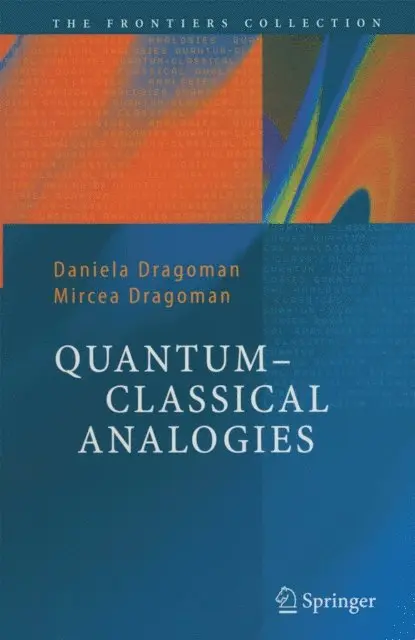
It is unanimously accepted that the quantum and the classical descriptions of the physical reality are very different, although any quantum process is "mysteriously" transformed through measurement into an observable classical event. Beyond the conceptual differences, quantum and classical physics have a lot in common. And, more important, there are classical and quantum phenomena that are similar although they occur in completely different contexts. For example, the Schrödinger equation has the same mathematical form as the Helmholtz equation, there is an uncertainty relation in optics very similar to that in quantum mechanics, and so on; the list of examples is very long. Quantum-classical analogies have been used in recent years to study many quantum laws or phenomena at the macroscopic scale, to design and simulate mesoscopic devices at the macroscopic scale, to implement quantum computer algorithms with classical means, etc. On the other hand, the new forms of light – localized light, frozen light – seem to have more in common with solid state physics than with classical optics. So these analogies are a valuable tool in the quest to understand quantum phenomena and in the search for new (quantum or classical) applications, especially in the area of quantum devices and computing.