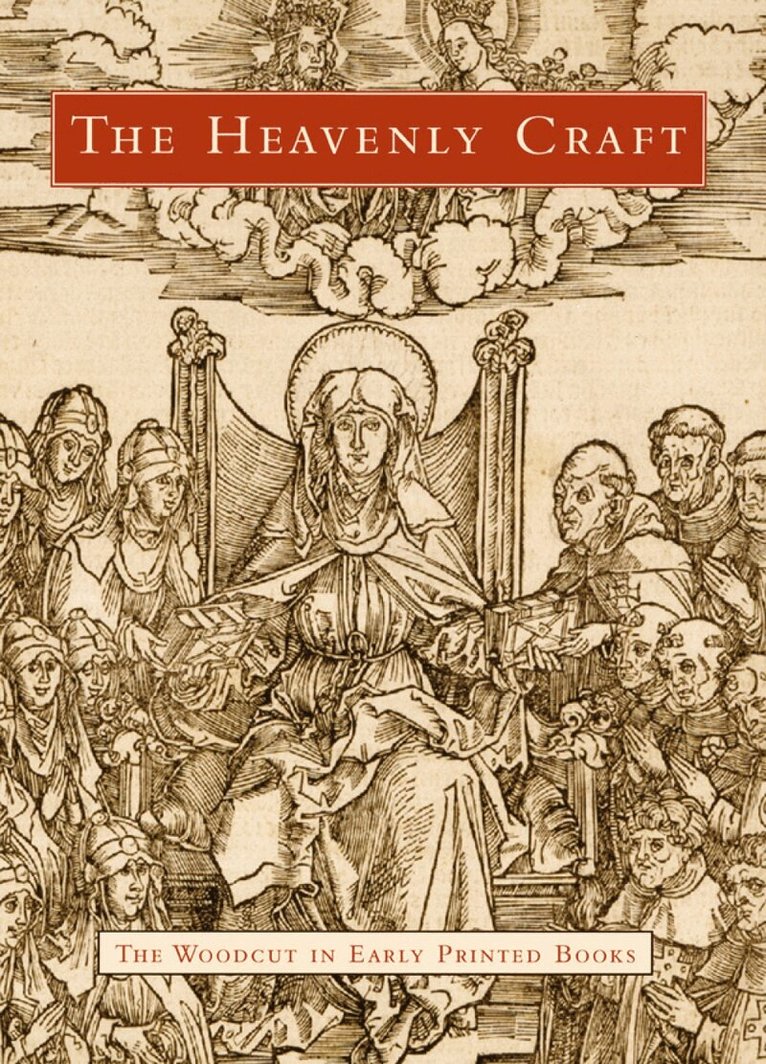
The combination of the woodcut - a print method devised early in the fifteenth century - with Johannes Gutenberg's revolutionary invention of printing with moveable type resulted in a powerful explosion of information and ideas. For the first time, it was possible to use a mechanised system to print identical copies of books containing both text and images. Featured in A Heavenly Craft are the earliest surviving examples of these books from throughout Western Europe, all printed within the first century after Gutenberg's invention.The contributors bring these rare books to life, exploring the evolution of the technique, composition and colouration of the woodcut beginning with the earliest publications.Many of the woodcut designs grew out of the tradition of manuscript illumination, in which book illustrations were painstakingly executed by hand. The authors also present the distinguishing features of national style and taste, treating the reader to examples from Germany, Italy, France, Spain and the Netherlands.In addition, A Heavenly Craft describes the provenance of these volumes, providing an account of how Lessing J. Rosenwald purchased them from the heir to the Lea and Perrins fortune and later donated them to the Library of Congress in Washington D.C.These early printed volumes are the predecessors of today's illustrated books. A Heavenly Craft celebrates these origins, making these early publications available to bibliophiles and print lovers.
Eleonore von Aquitanien ist eine Persönlichkeit, deren Lebensgeschichte bis heute von bemerkenswertem Reiz geblieben ist. Im Laufe der Geschichte hat ihre Gestalt unterschiedliche Auslegungen in Legende und Geschichtsschreibung erfahren. Die historiographische Untersuchung deckt diese Vielfalt auf, weist sie an Beispielen aus Volkstum und Literatur nach und sucht nach ihren Ursachen. Die Arbeit hat ihren Schwerpunkt im Mittelalter, gibt aber ebenso einen Überblick bis in die Gegenwart.
The combination of the woodcut - a print method devised early in the fifteenth century - with Johannes Gutenberg's revolutionary invention of printing with moveable type resulted in a powerful explosion of information and ideas. For the first time, it was possible to use a mechanised system to print identical copies of books containing both text and images. Featured in A Heavenly Craft are the earliest surviving examples of these books from throughout Western Europe, all printed within the first century after Gutenberg's invention.The contributors bring these rare books to life, exploring the evolution of the technique, composition and colouration of the woodcut beginning with the earliest publications.Many of the woodcut designs grew out of the tradition of manuscript illumination, in which book illustrations were painstakingly executed by hand. The authors also present the distinguishing features of national style and taste, treating the reader to examples from Germany, Italy, France, Spain and the Netherlands.In addition, A Heavenly Craft describes the provenance of these volumes, providing an account of how Lessing J. Rosenwald purchased them from the heir to the Lea and Perrins fortune and later donated them to the Library of Congress in Washington D.C.These early printed volumes are the predecessors of today's illustrated books. A Heavenly Craft celebrates these origins, making these early publications available to bibliophiles and print lovers.
Eleonore von Aquitanien ist eine Persönlichkeit, deren Lebensgeschichte bis heute von bemerkenswertem Reiz geblieben ist. Im Laufe der Geschichte hat ihre Gestalt unterschiedliche Auslegungen in Legende und Geschichtsschreibung erfahren. Die historiographische Untersuchung deckt diese Vielfalt auf, weist sie an Beispielen aus Volkstum und Literatur nach und sucht nach ihren Ursachen. Die Arbeit hat ihren Schwerpunkt im Mittelalter, gibt aber ebenso einen Überblick bis in die Gegenwart.