Dariusz WA³jcik – författare
Visar alla böcker från författaren Dariusz WA³jcik. Handla med fri frakt och snabb leverans.
7 produkter
7 produkter
E-bok
PDF, Engelska, 20181 769 kr
Läs direkt efter köp
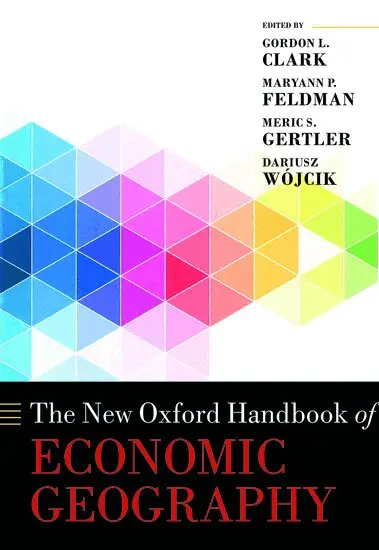
The first fifteen years of the 21st century have thrown into sharp relief the challenges of growth, equity, stability, and sustainability facing the world economy. In addition, they have exposed the inadequacies of mainstream economics in providing answers to these challenges. This volume gathers over 50 leading scholars from around the world to offer a forward-looking perspective of economic geography to understanding the various building blocks, relationships, and trajectories in the world economy. The perspective is at the same time grounded in theory and in the experiences of particular places. Reviewing state-of-the-art of economic geography, setting agendas, and with illustrations and empirical evidence from all over the world, the book should be an essential reference for students, researchers, as well as strategists and policy makers.Building on the success of the first edition, this volume offers a radically revised, updated, and broader approach to economic geography. With the backdrop of the global financial crisis, finance is investigated in chapters on financial stability, financial innovation, global financial networks, the global map of savings and investments, and financialization. Environmental challenges are addressed in chapters on resource economies, vulnerability of regions to climate change, carbon markets, and energy transitions. Distribution and consumption feature alongside more established topics on the firm, innovation, and work. The handbook also captures the theoretical and conceptual innovations of the last fifteen years, including evolutionary economic geography and the global production networks approach. Addressing the dangers of inequality, instability, and environmental crisis head-on, the volume concludes with strategies for growth and new ways of envisioning the spatiality of economy for the future.
E-bok
Engelska, 20181 769 kr
Läs direkt efter köp
The first fifteen years of the 21st century have thrown into sharp relief the challenges of growth, equity, stability, and sustainability facing the world economy. In addition, they have exposed the inadequacies of mainstream economics in providing answers to these challenges. This volume gathers over 50 leading scholars from around the world to offer a forward-looking perspective of economic geography to understanding the various building blocks, relationships, and trajectories in the world economy. The perspective is at the same time grounded in theory and in the experiences of particular places. Reviewing state-of-the-art of economic geography, setting agendas, and with illustrations and empirical evidence from all over the world, the book should be an essential reference for students, researchers, as well as strategists and policy makers.Building on the success of the first edition, this volume offers a radically revised, updated, and broader approach to economic geography. With the backdrop of the global financial crisis, finance is investigated in chapters on financial stability, financial innovation, global financial networks, the global map of savings and investments, and financialization. Environmental challenges are addressed in chapters on resource economies, vulnerability of regions to climate change, carbon markets, and energy transitions. Distribution and consumption feature alongside more established topics on the firm, innovation, and work. The handbook also captures the theoretical and conceptual innovations of the last fifteen years, including evolutionary economic geography and the global production networks approach. Addressing the dangers of inequality, instability, and environmental crisis head-on, the volume concludes with strategies for growth and new ways of envisioning the spatiality of economy for the future.
E-bok
PDF, Engelska, 2011504 kr
Läs direkt efter köp
Why do some companies stay out of stock markets? How crucial are stock markets for competition between financial centres? How can local information help investors outperform the market? Whilst mainstream financial economics treats stock markets as consisting of anonymous actors interacting in space, with no consideration of the friction caused by distance or geography, this book offers a comprehensive and up-to-date picture of the global stock market by focusing on the relationships between issuers, investors, and intermediaries, and how these relationships impact on the performance of stock markets and the economy of cities, countries, and the world. The book uses rich data and global case studies to examine the rise of emerging markets, the impact of the global financial crisis, the revolution in the stock exchange business model, and the continued dominance of London and New York as stock market centres. Drawing on economic geography, financial economics, sociology, history, and globalization studies, the book explores the geographical constitution and footprint of stock markets and contributes to the broader debate on the role of stock markets in the global economy. Its conclusions are relevant to investors, companies issuing stocks, exchanges, analysts, investment banks, and policy-makers.
E-bok
PDF, Engelska, 20181 150 kr
Läs direkt efter köp
This is an open access title available under the terms of a CC BY-NC-ND 4.0 International licence. It is free to read on the Oxford Academic platform and offered as a free PDF download from OUP and selected open access locations.As well as marking the tenth anniversary of the collapse of Lehman Brothers and the consequent unleashing of the global financial crisis, 2018 is also the year of negotiations on the terms of the UK''s exit from the European Union. Within a decade the banking world has witnessed two epochal events with potential to redraw the map of international financial centres: but how much has this map actually changed since 2008, and how is it likely to change in the near future?International Financial Centres after the Global Financial Crisis and Brexit gathers together leading economic historians, geographers, and other social scientists to focus on the post-2008 developments in key international financial centres. It focuses on the shifting hierarchies of New York, London, Paris, Geneva, Zurich, Frankfurt, Singapore, Hong Kong, Beijing, Shanghai, and Tokyo to question whether Asian financial centres have taken advantage of the crisis in the West. It alsoexamines the medium-effects of the crisis, the level of regulation, and the rise of new technology (fintech). By exploring these crucial changes, it questions whether shifts in the financial industry and the global landscape will render these centres unnecessary for the functioning of the global economy, andwhich cities are likely to emerge as hubs of new financial technology.
E-bok
Engelska, 20181 079 kr
Läs direkt efter köp
This is an open access title available under the terms of a CC BY-NC-ND 4.0 International licence. It is free to read on the Oxford Academic platform and offered as a free PDF download from OUP and selected open access locations.As well as marking the tenth anniversary of the collapse of Lehman Brothers and the consequent unleashing of the global financial crisis, 2018 is also the year of negotiations on the terms of the UK''s exit from the European Union. Within a decade the banking world has witnessed two epochal events with potential to redraw the map of international financial centres: but how much has this map actually changed since 2008, and how is it likely to change in the near future?International Financial Centres after the Global Financial Crisis and Brexit gathers together leading economic historians, geographers, and other social scientists to focus on the post-2008 developments in key international financial centres. It focuses on the shifting hierarchies of New York, London, Paris, Geneva, Zurich, Frankfurt, Singapore, Hong Kong, Beijing, Shanghai, and Tokyo to question whether Asian financial centres have taken advantage of the crisis in the West. It alsoexamines the medium-effects of the crisis, the level of regulation, and the rise of new technology (fintech). By exploring these crucial changes, it questions whether shifts in the financial industry and the global landscape will render these centres unnecessary for the functioning of the global economy, andwhich cities are likely to emerge as hubs of new financial technology.
Inbunden, Engelska, 2018
2 094 kr
Skickas inom 5-8 vardagar
The first fifteen years of the 21st century have thrown into sharp relief the challenges of growth, equity, stability, and sustainability facing the world economy. In addition, they have exposed the inadequacies of mainstream economics in providing answers to these challenges. This volume gathers over 50 leading scholars from around the world to offer a forward-looking perspective of economic geography to understanding the various building blocks, relationships, and trajectories in the world economy. The perspective is at the same time grounded in theory and in the experiences of particular places. Reviewing state-of-the-art of economic geography, setting agendas, and with illustrations and empirical evidence from all over the world, the book should be an essential reference for students, researchers, as well as strategists and policy makers.Building on the success of the first edition, this volume offers a radically revised, updated, and broader approach to economic geography. With the backdrop of the global financial crisis, finance is investigated in chapters on financial stability, financial innovation, global financial networks, the global map of savings and investments, and financialization. Environmental challenges are addressed in chapters on resource economies, vulnerability of regions to climate change, carbon markets, and energy transitions. Distribution and consumption feature alongside more established topics on the firm, innovation, and work. The handbook also captures the theoretical and conceptual innovations of the last fifteen years, including evolutionary economic geography and the global production networks approach. Addressing the dangers of inequality, instability, and environmental crisis head-on, the volume concludes with strategies for growth and new ways of envisioning the spatiality of economy for the future.
Inbunden, Engelska, 2007
1 664 kr
Skickas inom 5-8 vardagar
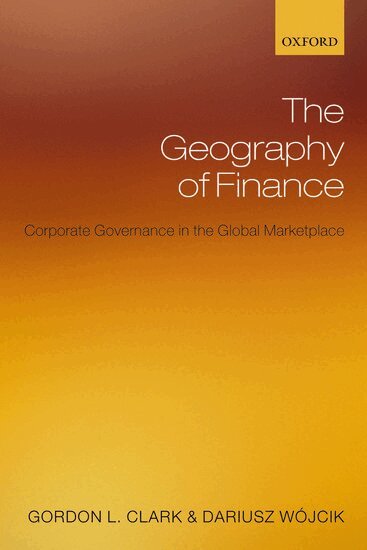
The Geography of Finance tackles crucial issues regarding the emerging global market for corporate governance. The authors describe and explain the transformation of European corporate governance in the light of the imperatives driving global financial markets, using an innovative analytical framework. The authors chart the response of corporate managers to the interest of global portfolio managers in transparent and accountable modes of corporate governance. In doing so, the authors provide an innovative perspective on a rapidly changing environment; and a challenge to those who ignore the gathering momentum of global financial markets.