Darja Reuschke - Böcker
Visar alla böcker från författaren Darja Reuschke. Handla med fri frakt och snabb leverans.
4 produkter
4 produkter
1 979 kr
Skickas inom 7-10 vardagar
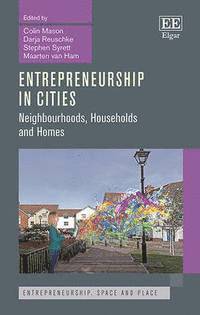
Entrepreneurship in Cities focuses on the neglected role of the home and the residential neighbourhood context for entrepreneurship and businesses within cities. The overall objective of the book is to develop a new interdisciplinary perspective that links entrepreneurship research with neighbourhood and urban studies. A key contribution is to show that entrepreneurship in cities is more than agglomeration economies and high-tech clusters.This is the first book to connect entrepreneurship with neighbourhoods and homes, recognising that business activity in the city is not confined to central business districts, high streets and industrial estates but is also increasingly found in residential neighbourhoods. It highlights the importance of home-based businesses for the economy of cities. These often overlooked types of businesses and workers significantly contribute to the 'buzz' that makes cities favourable places to live and work.Including interdisciplinary and international perspectives, this will be an invaluable resource for researchers and Masters students in entrepreneurship, urban studies, geography, and planning, as well as practitioners involved in urban planning and development.Contributors: N. Bailey, B. Baldauf, S.-A. Barnes, H. Behle, S. Carter, W.A.V. Clark, M. de Hoyos, C. Ekinsmyth, I. Fischer-Krapohl, F. Flogel, S. Gartner, A. Green, H. Hanhörster, C. Mason, G. Mollenhorst, S. Mwaura, D. Reuschke, V. Schutjens, A. Southern, S. Syrett, M. van Ham, H. Verrest, B. Volker, S. Weck, G. Whittam
Entrepreneurial Neighbourhoods
Towards an Understanding of the Economies of Neighbourhoods and Communities
Inbunden, Engelska, 2017
2 091 kr
Skickas inom 7-10 vardagar
Despite the growing evidence on the importance of the neighbourhood, entrepreneurship studies have largely neglected the role of neighbourhoods. This book addresses the nexus between entrepreneurship, neighbourhoods and communities, confirming not only the importance of `the local' in entrepreneurship, but also filling huge gaps in the knowledge base regarding this tripartite relationship. Interdisciplinary chapters explore the importance of the neighbourhood and local social networks for individual entrepreneurs, highlighting the importance of `the local' in entrepreneurship across several countries. Considering entrepreneurship as a community-based, rather than individual, effort, key contributions explore how entrepreneurship can influence neighbourhoods and communities, in particular through entrepreneurial actions of residents joining forces. The book critically examines the ways in which entrepreneurship can benefit, shape and transform neighbourhoods, particularly those areas affected by social deprivation and poverty. Finally, it outlines a research agenda to further extend the scientific and policy-relevant knowledge on the relationships between entrepreneurship, neighbourhoods and communities. As a response to the international call for an interdisciplinary approach to entrepreneurship research and neighbourhood and community studies, this book will engage scholars and researchers from entrepreneurship studies, urban geography, housing studies, political studies, sociology and urban planning.Contributors include: N. Bailey, I. Capdevila, E. Casper-Futterman, J. Chrisman, M. de Beer, J. DeFilippis, R. Kleinhans, J. Lendrum, C. Mason, A.M. Peredo, D. Reuschke, E. Rijshouwer, V. Schutjens, E. Stam, S. Swider, S. Syrett, J. Uitermark, V. van de Vrande, M. van Ham, D. Varady, B. Volker, C. Williams, N. Williams
698 kr
Skickas inom 10-15 vardagar
Ausgehend von der Erkenntnis, dass Raum nicht nach einem Container-Modell als Behalter unabhangig von Menschen und Objekten existiert und stattdessen die Konstitution von Raum durch gesellschaftliche Prozesse erfolgt, widmet sich der vorliegende Sammelband dem Wohnen als ein gesellschaftlich determiniertes Phanomen, dessen baulich-physische Raumstrukturen (Grosse und raumliche Verteilung von Wohngebauden, Wohnungszuschnitt usw. ) nur im Kontext - sellschaftlicher Entwicklungen zu verstehen sind. Neben der Bedeutung des Alters und der Haushaltsform fur das Verstandnis des Wohnverhaltens von In- viduen und Haushalten hat eine inzwischen grosse Vielzahl von Veroffentlich- gen der Frauen- und Geschlechterforschung unterschiedlicher Fachdisziplinen und der geschlechterdifferenzierenden Wohnforschung die zentrale Bedeutung der wechselseitigen Beziehungen zwischen Wohnen und Geschlecht theoretisiert und empirisch belegt.Wie gesellschaftliche Kontexte und Entwicklungen auf der gesellschaftlichen Makroebene das Wohnen der Geschlechter beeinflussen, wie sich der gesellschaftliche Wandel und die damit verbundenen Veranderungen der Geschlechterverhaltnisse auf das Wohnen auswirken und welche geschlechtss- zifischen Differenzen im Wohnen bestehen das sind die zentralen Fragest- lungen, denen dieser Sammelband nachgeht. Wohnen ist ein existentielles Grundbedurfnis des Menschen. In diesem Sinn ist die Wohnung als ein Ort der Existenzsicherung zu begreifen. Aber Wohnen ist nicht nur die Behausung die Wo hnung, das Haus, die Wohnungseinrichtung im engeren physischen Sinne, sondern Wohnen umfasst auch die bauli- raumlichen und sozial-raumlichen Strukturen, die die alltagliche Lebensgest- tung und Lebensfuhrung von Individuen und Haushalten pragen.
Multilokales Wohnen
Raum-zeitliche Muster multilokaler Wohnarrangements von Shuttles und Personen in einer Fernbeziehung
Häftad, Tyska, 2010
600 kr
Skickas inom 10-15 vardagar
In dem Buch wird das multilokale Leben und Wohnen von Personen mit einem beruflich genutzten Zweitwohnsitz (Shuttles) und von Personen in einer Partnerschaft mit getrennten Haushalten über große Distanzen (Fernbeziehungen) im Kontext beruflicher Mobilitätsanforderungen und des sozialen Wandels empirisch untersucht. Die Ergebnisse der Arbeit beruhen auf einer standardisierten Befragung von zufällig ausgewählten Zugezogenen in vier deutschen Großstädten und vertiefenden qualitativen Interviews. Besonderheiten multilokaler Lebens- und Wohnformen werden in Bezug auf sozialstrukturelle Merkmale, Wohnbedingungen und Wohnbedürfnisse mittels Vergleichsgruppenanalysen untersucht.