David A. Bader - Böcker
Visar alla böcker från författaren David A. Bader. Handla med fri frakt och snabb leverans.
6 produkter
6 produkter
935 kr
Skickas inom 10-15 vardagar
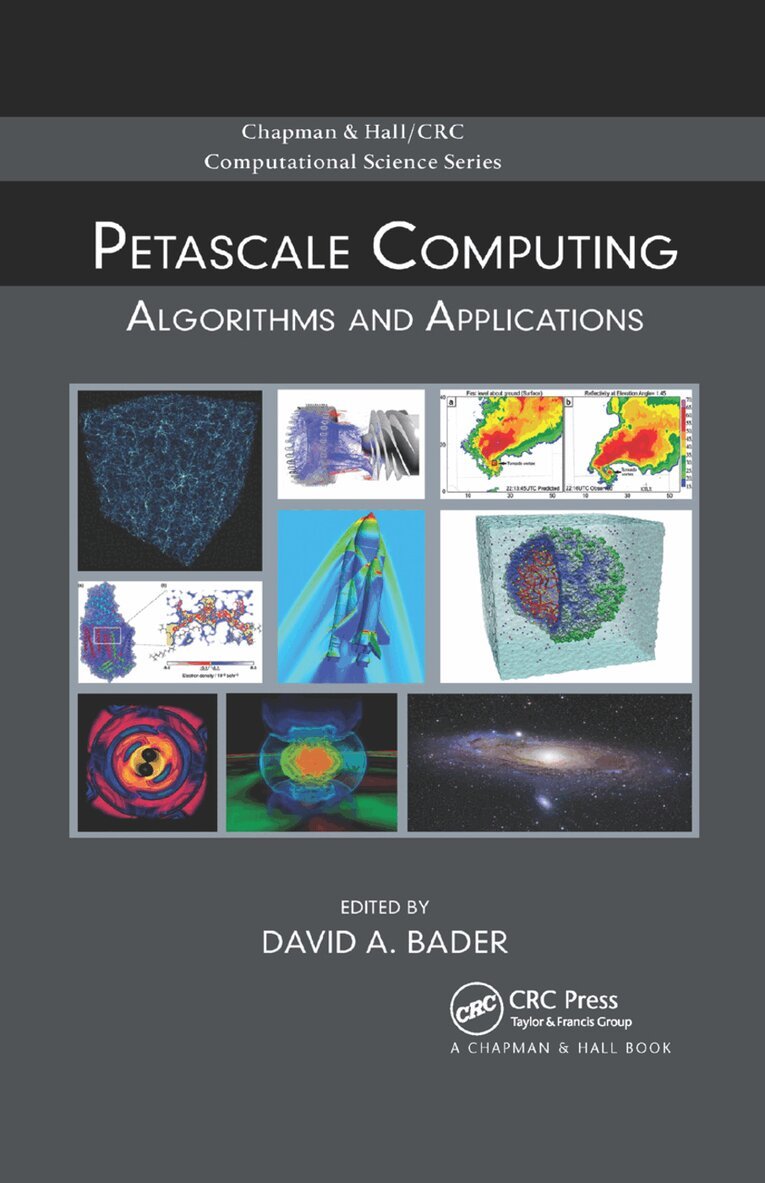
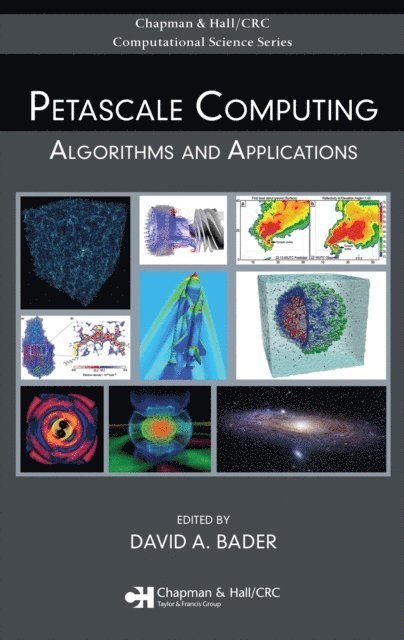
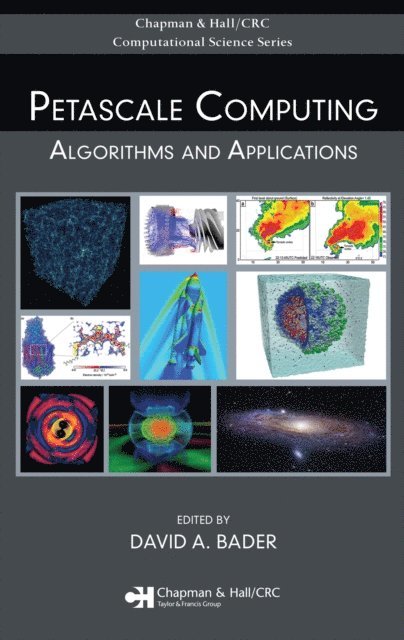
Although the highly anticipated petascale computers of the near future will perform at an order of magnitude faster than today’s quickest supercomputer, the scaling up of algorithms and applications for this class of computers remains a tough challenge. From scalable algorithm design for massive concurrency toperformance analyses and scientific visualization, Petascale Computing:Algorithms and Applications captures the state of the art in high-performance computing algorithms and applications. Featuring contributions from the world’s leading experts in computational science, this edited collection explores the use of petascale computers for solving the most difficult scientific and engineering problems of the current century.Covering a wide range of important topics, the book illustrates how petascale computing can be applied to space and Earth science missions, biological systems, weather prediction, climate science, disasters, black holes, and gamma ray bursts. It details the simulation of multiphysics, cosmological evolution, molecular dynamics, and biomolecules. The book also discusses computational aspects that include the Uintah framework, Enzo code, multithreaded algorithms, petaflops, performance analysis tools, multilevel finite element solvers, finite element code development, Charm++, and the Cactus framework. Supplying petascale tools, programming methodologies, and an eight-page color insert, this volume addresses the challenging problems of developing application codes that can take advantage of the architectural features of the new petascale systems in advance of their first deployment.
2 026 kr
Skickas inom 10-15 vardagar
"Graphs. Such a simple idea. Map a problem onto a graph then solve it by searching over the graph or by exploring the structure of the graph. What could be easier? Turns out, however, that working with graphs is a vast and complex field. Keeping up is challenging. To help keep up, you just need an editor who knows most people working with graphs, and have that editor gather nearly 70 researchers to summarize their work with graphs. The result is the book Massive Graph Analytics." — Timothy G. Mattson, Senior Principal Engineer, Intel CorpExpertise in massive-scale graph analytics is key for solving real-world grand challenges from healthcare to sustainability to detecting insider threats, cyber defense, and more. This book provides a comprehensive introduction to massive graph analytics, featuring contributions from thought leaders across academia, industry, and government.Massive Graph Analytics will be beneficial to students, researchers, and practitioners in academia, national laboratories, and industry who wish to learn about the state-of-the-art algorithms, models, frameworks, and software in massive-scale graph analytics.
1 058 kr
Skickas inom 10-15 vardagar
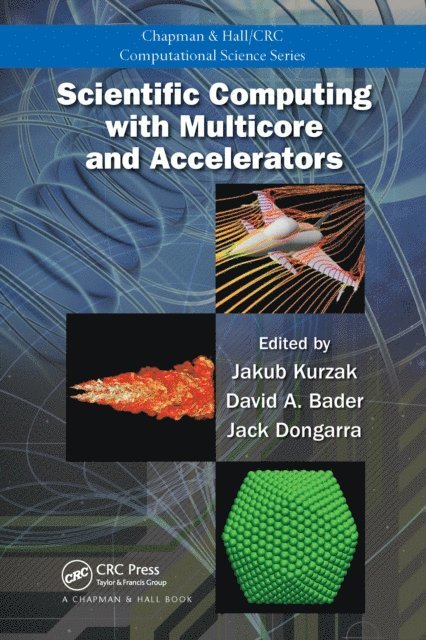
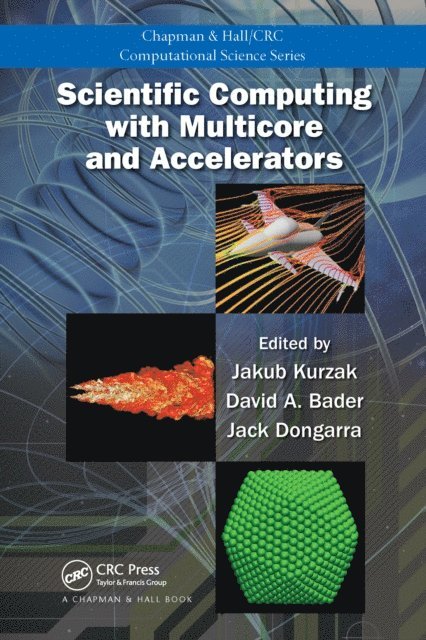
The hybrid/heterogeneous nature of future microprocessors and large high-performance computing systems will result in a reliance on two major types of components: multicore/manycore central processing units and special purpose hardware/massively parallel accelerators. While these technologies have numerous benefits, they also pose substantial performance challenges for developers, including scalability, software tuning, and programming issues. Researchers at the Forefront Reveal Results from Their Own State-of-the-Art WorkEdited by some of the top researchers in the field and with contributions from a variety of international experts, Scientific Computing with Multicore and Accelerators focuses on the architectural design and implementation of multicore and manycore processors and accelerators, including graphics processing units (GPUs) and the Sony Toshiba IBM (STI) Cell Broadband Engine (BE) currently used in the Sony PlayStation 3. The book explains how numerical libraries, such as LAPACK, help solve computational science problems; explores the emerging area of hardware-oriented numerics; and presents the design of a fast Fourier transform (FFT) and a parallel list ranking algorithm for the Cell BE. It covers stencil computations, auto-tuning, optimizations of a computational kernel, sequence alignment and homology, and pairwise computations. The book also evaluates the portability of drug design applications to the Cell BE and illustrates how to successfully exploit the computational capabilities of GPUs for scientific applications. It concludes with chapters on dataflow frameworks, the Charm++ programming model, scan algorithms, and a portable intracore communication framework.Explores the New Computational Landscape of Hybrid Processors By offering insight into the process of constructing and effectively using the technology, this volume provides a thorough and practical introduction to the area of hybrid computing. It discusses introductory concepts and simple examples of parallel computing, logical and performance debugging for parallel computing, and advanced topics and issues related to the use and building of many applications.
3 049 kr
Skickas inom 10-15 vardagar
The hybrid/heterogeneous nature of future microprocessors and large high-performance computing systems will result in a reliance on two major types of components: multicore/manycore central processing units and special purpose hardware/massively parallel accelerators. While these technologies have numerous benefits, they also pose substantial performance challenges for developers, including scalability, software tuning, and programming issues. Researchers at the Forefront Reveal Results from Their Own State-of-the-Art WorkEdited by some of the top researchers in the field and with contributions from a variety of international experts, Scientific Computing with Multicore and Accelerators focuses on the architectural design and implementation of multicore and manycore processors and accelerators, including graphics processing units (GPUs) and the Sony Toshiba IBM (STI) Cell Broadband Engine (BE) currently used in the Sony PlayStation 3. The book explains how numerical libraries, such as LAPACK, help solve computational science problems; explores the emerging area of hardware-oriented numerics; and presents the design of a fast Fourier transform (FFT) and a parallel list ranking algorithm for the Cell BE. It covers stencil computations, auto-tuning, optimizations of a computational kernel, sequence alignment and homology, and pairwise computations. The book also evaluates the portability of drug design applications to the Cell BE and illustrates how to successfully exploit the computational capabilities of GPUs for scientific applications. It concludes with chapters on dataflow frameworks, the Charm++ programming model, scan algorithms, and a portable intracore communication framework.Explores the New Computational Landscape of Hybrid Processors By offering insight into the process of constructing and effectively using the technology, this volume provides a thorough and practical introduction to the area of hybrid computing. It discusses introductory concepts and simple examples of parallel computing, logical and performance debugging for parallel computing, and advanced topics and issues related to the use and building of many applications.
2 026 kr
Skickas inom 10-15 vardagar
Although the highly anticipated petascale computers of the near future will perform at an order of magnitude faster than today’s quickest supercomputer, the scaling up of algorithms and applications for this class of computers remains a tough challenge. From scalable algorithm design for massive concurrency toperformance analyses and scientific visualization, Petascale Computing:Algorithms and Applications captures the state of the art in high-performance computing algorithms and applications. Featuring contributions from the world’s leading experts in computational science, this edited collection explores the use of petascale computers for solving the most difficult scientific and engineering problems of the current century.Covering a wide range of important topics, the book illustrates how petascale computing can be applied to space and Earth science missions, biological systems, weather prediction, climate science, disasters, black holes, and gamma ray bursts. It details the simulation of multiphysics, cosmological evolution, molecular dynamics, and biomolecules. The book also discusses computational aspects that include the Uintah framework, Enzo code, multithreaded algorithms, petaflops, performance analysis tools, multilevel finite element solvers, finite element code development, Charm++, and the Cactus framework. Supplying petascale tools, programming methodologies, and an eight-page color insert, this volume addresses the challenging problems of developing application codes that can take advantage of the architectural features of the new petascale systems in advance of their first deployment.
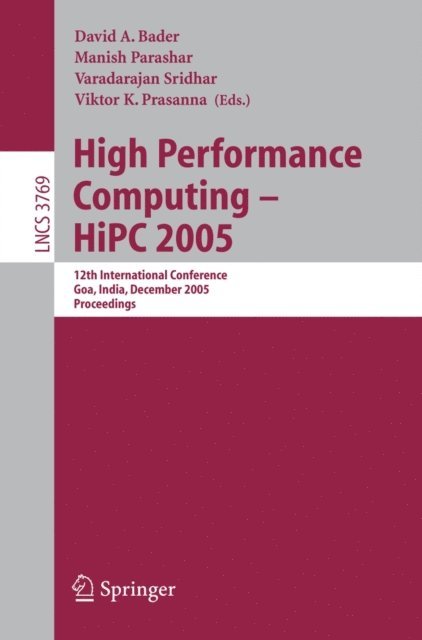
High Performance Computing – HiPC 2005
12th International Conference, Goa, India, December 18-21, 2005, Proceedings
Häftad, Engelska, 2005
556 kr
Skickas inom 10-15 vardagar
to acknowledge the dedicated effort put forth by the Vice-Chairs: Michael A. Bender (Algorithms), Zhiwei Xu (Applications), Jose ' Duato (Architecture),M. Cristina Pinotti (Communication Networks), and Satoshi Matsuoka (System Software). Without their help and timely work, the quality of this program would not be as high nor would the process have run so smoothly. I thank the other organizers who have contributed to assembling this program, - cludingthose who organizedthe keynotes,tutorials, workshops,awards, poster session, industry exhibits, and those who performed the administrative functions that have been essential to the success of this conference. The work of Sushil K. Prasad in putting - gethertheconferenceproceedingsisalsoacknowledged,aswell asthesupportprovided by Kamesh Madduri and Vaddadi Chandu, Ph.D. students at Georgia Institute of Te- nology,and Vipin Sachdeva,M.S. student at the Universityof New Mexico, in assisting with the EDAS online paper submission and evaluation software. Last, but certainly not least, I express heart-felt thanks to our General Co-chairs, Manish Parashar and V.Sridhar; Steering Chair, Viktor Prasanna; and to the Vice-General Chair, Rajendra V. Boppana; for all their useful advice. Lastly, I thank the Conference General Co-chairs for allowing me to serve our c- munity as the Program Chair of this high-quality international conference. It has been my pleasure to correspond with so many of you, and I personally welcome you to Goa.