David Bakstein – författare
Visar alla böcker från författaren David Bakstein. Handla med fri frakt och snabb leverans.
6 produkter
6 produkter
E-bok
PDF, Engelska, 2008950 kr
Läs direkt efter köp
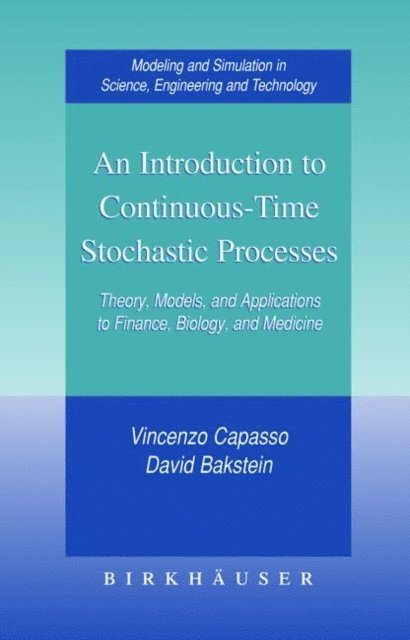
This book is a systematic, rigorous, and self-consistent introduction to the theory of continuous-time stochastic processes. But it is neither a tract nor a recipe book as such; rather, it is an account of fundamental concepts as they appear in relevant modern applications and literature. We make no pretense of it being complete. Indeed, we have omitted many results, which we feel are notdirectly relatedtothemain themeorthatare availablein easilyaccessible sources. (Thosereaderswhoareinterestedinthehistoricaldevelopmentofthe subject cannot ignore the volume edited by Wax (1954). ) Proofs are often omitted as technicalities might distract the reader from a conceptual approach. They are produced whenever they may serve as a guide to the introduction of new concepts and methods towards the app- cations; otherwise, explicit references to standard literature are provided. A mathematically oriented student may ?nd it interesting to consider proofs as exercises. The scope of the book is profoundly educational, related to modeling re- world problems with stochastic methods. The reader becomes critically aware oftheconceptsinvolvedincurrentappliedliterature,andismoreoverprovided with a ?rm foundation of the mathematical techniques. Intuition is always supported by mathematical rigor. Our book addresses three main groups: ?rst, mathematicians working in a di?erent ?eld; second, other scientists and professionals from a business or academic background; third, graduate or advanced undergraduate students of a quantitative subject related to stochastic theory and/or applications.
E-bok
PDF, Engelska, 20121 306 kr
Läs direkt efter köp
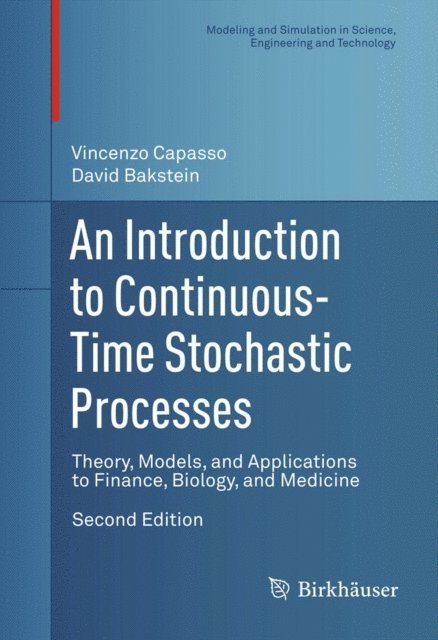
Expanding on the first edition of An Introduction to Continuous-Time Stochastic Processes, this concisely written book is a rigorous and self-contained introduction to the theory of continuous-time stochastic processes. A balance of theory and applications, the work features concrete examples of modeling real-world problems from biology, medicine, industrial applications, finance, and insurance using stochastic methods. No previous knowledge of stochastic processes is required.
E-bok
PDF, Engelska, 2015870 kr
Läs direkt efter köp
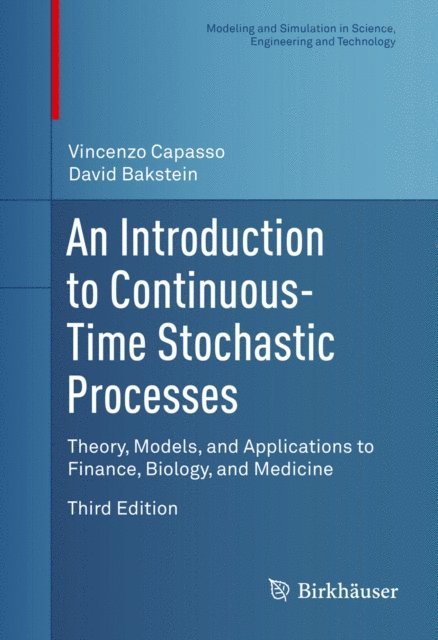
This textbook, now in its third edition, offers a rigorous and self-contained introduction to the theory of continuous-time stochastic processes, stochastic integrals, and stochastic differential equations. Expertly balancing theory and applications, the work features concrete examples of modeling real-world problems from biology, medicine, industrial applications, finance, and insurance using stochastic methods. No previous knowledge of stochastic processes is required. Key topics include: Markov processes Stochastic differential equations Arbitrage-free markets and financial derivatives Insurance risk Population dynamics, and epidemics Agent-based models New to the Third Edition: Infinitely divisible distributions Random measures Levy processes Fractional Brownian motion Ergodic theory Karhunen-Loeve expansion Additional applications Additional exercises Smoluchowski approximation of Langevin systems An Introduction to Continuous-Time Stochastic Processes, Third Edition will be ofinterest to a broad audience of students, pure and applied mathematicians, and researchers and practitioners in mathematical finance, biomathematics, biotechnology, and engineering. Suitable as a textbook for graduate or undergraduate courses, as well as European Masters courses (according to the two-year-long second cycle of the “Bologna Scheme”), the work may also be used for self-study or as a reference. Prerequisites include knowledge of calculus and some analysis; exposure to probability would be helpful but not required since the necessary fundamentals of measure and integration are provided. From reviews of previous editions: "The book is ... an account of fundamental concepts as they appear in relevant modern applications and literature. ... The book addresses three main groups: first, mathematicians working in a different field; second, other scientists and professionals from a business or academic background; third, graduate or advanced undergraduate students of a quantitative subject related to stochastic theory and/or applications." -Zentralblatt MATH
Inbunden, Engelska, 2021
812 kr
Skickas inom 10-15 vardagar
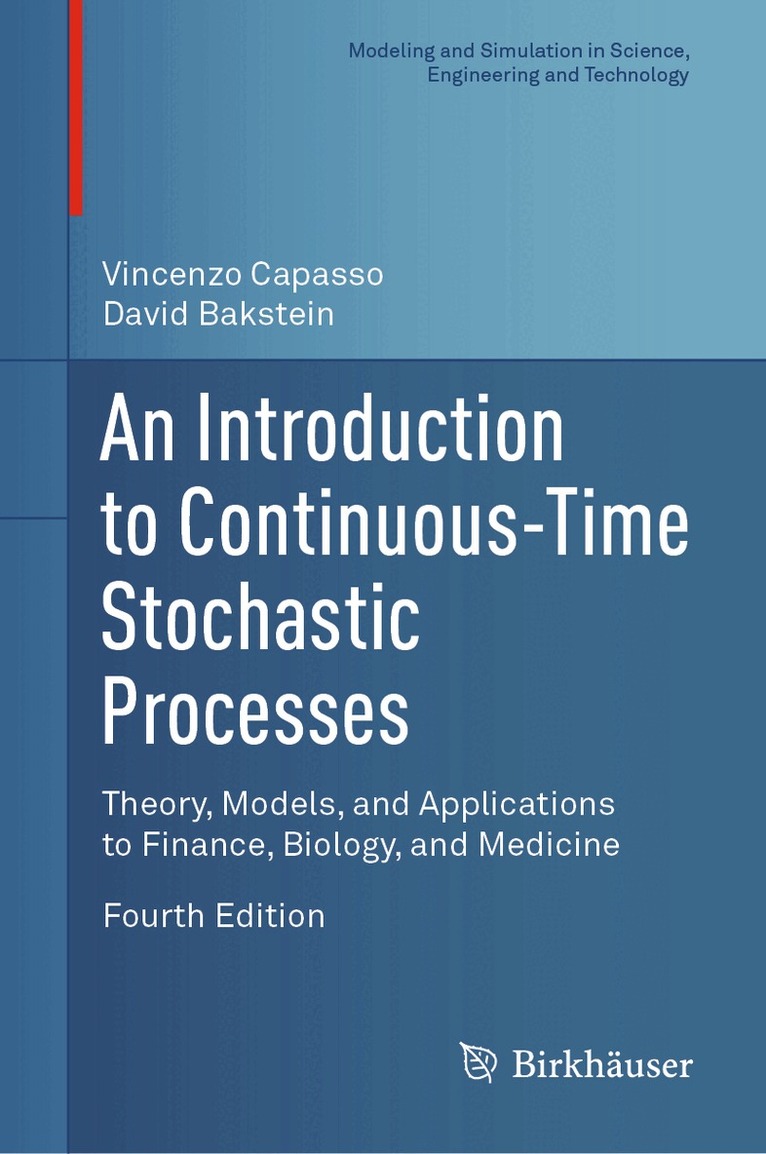
This textbook, now in its fourth edition, offers a rigorous and self-contained introduction to the theory of continuous-time stochastic processes, stochastic integrals, and stochastic differential equations. Expertly balancing theory and applications, it features concrete examples of modeling real-world problems from biology, medicine, finance, and insurance using stochastic methods. No previous knowledge of stochastic processes is required. Unlike other books on stochastic methods that specialize in a specific field of applications, this volume examines the ways in which similar stochastic methods can be applied across different fields.Beginning with the fundamentals of probability, the authors go on to introduce the theory of stochastic processes, the Itô Integral, and stochastic differential equations. The following chapters then explore stability, stationarity, and ergodicity. The second half of the book is dedicated to applications to a variety of fields, including finance, biology, and medicine. Some highlights of this fourth edition include a more rigorous introduction to Gaussian white noise, additional material on the stability of stochastic semigroups used in models of population dynamics and epidemic systems, and the expansion of methods of analysis of one-dimensional stochastic differential equations.An Introduction to Continuous-Time Stochastic Processes, Fourth Edition is intended for graduate students taking an introductory course on stochastic processes, applied probability, stochastic calculus, mathematical finance, or mathematical biology. Prerequisites include knowledge of calculus and some analysis; exposure to probability would be helpful but not required since the necessary fundamentals of measure and integration are provided. Researchers and practitioners in mathematical finance, biomathematics, biotechnology, and engineering will also find this volume to be of interest, particularlythe applications explored in the second half of the book.
E-bok
Engelska, 2021791 kr
Läs direkt efter köp
This textbook, now in its fourth edition, offers a rigorous and self-contained introduction to the theory of continuous-time stochastic processes, stochastic integrals, and stochastic differential equations. Expertly balancing theory and applications, it features concrete examples of modeling real-world problems from biology, medicine, finance, and insurance using stochastic methods. No previous knowledge of stochastic processes is required. Unlike other books on stochastic methods that specialize in a specific field of applications, this volume examines the ways in which similar stochastic methods can be applied across different fields.Beginning with the fundamentals of probability, the authors go on to introduce the theory of stochastic processes, the Itô Integral, and stochastic differential equations. The following chapters then explore stability, stationarity, and ergodicity. The second half of the book is dedicated to applications to a variety of fields, including finance, biology, and medicine. Some highlights of this fourth edition include a more rigorous introduction to Gaussian white noise, additional material on the stability of stochastic semigroups used in models of population dynamics and epidemic systems, and the expansion of methods of analysis of one-dimensional stochastic differential equations.An Introduction to Continuous-Time Stochastic Processes, Fourth Edition is intended for graduate students taking an introductory course on stochastic processes, applied probability, stochastic calculus, mathematical finance, or mathematical biology. Prerequisites include knowledge of calculus and some analysis; exposure to probability would be helpful but not required since the necessary fundamentals of measure and integration are provided. Researchers and practitioners in mathematical finance, biomathematics, biotechnology, and engineering will also find this volume to be of interest, particularlythe applications explored in the second half of the book.
Häftad, Engelska, 2022
598 kr
Skickas inom 10-15 vardagar
This textbook, now in its fourth edition, offers a rigorous and self-contained introduction to the theory of continuous-time stochastic processes, stochastic integrals, and stochastic differential equations. Expertly balancing theory and applications, it features concrete examples of modeling real-world problems from biology, medicine, finance, and insurance using stochastic methods. No previous knowledge of stochastic processes is required. Unlike other books on stochastic methods that specialize in a specific field of applications, this volume examines the ways in which similar stochastic methods can be applied across different fields.Beginning with the fundamentals of probability, the authors go on to introduce the theory of stochastic processes, the Itô Integral, and stochastic differential equations. The following chapters then explore stability, stationarity, and ergodicity. The second half of the book is dedicated to applications to a variety of fields, including finance, biology, and medicine. Some highlights of this fourth edition include a more rigorous introduction to Gaussian white noise, additional material on the stability of stochastic semigroups used in models of population dynamics and epidemic systems, and the expansion of methods of analysis of one-dimensional stochastic differential equations.An Introduction to Continuous-Time Stochastic Processes, Fourth Edition is intended for graduate students taking an introductory course on stochastic processes, applied probability, stochastic calculus, mathematical finance, or mathematical biology. Prerequisites include knowledge of calculus and some analysis; exposure to probability would be helpful but not required since the necessary fundamentals of measure and integration are provided. Researchers and practitioners in mathematical finance, biomathematics, biotechnology, and engineering will also find this volume to be of interest, particularlythe applications explored in the second half of the book.