David Blake Willis – författare
Visar alla böcker från författaren David Blake Willis. Handla med fri frakt och snabb leverans.
5 produkter
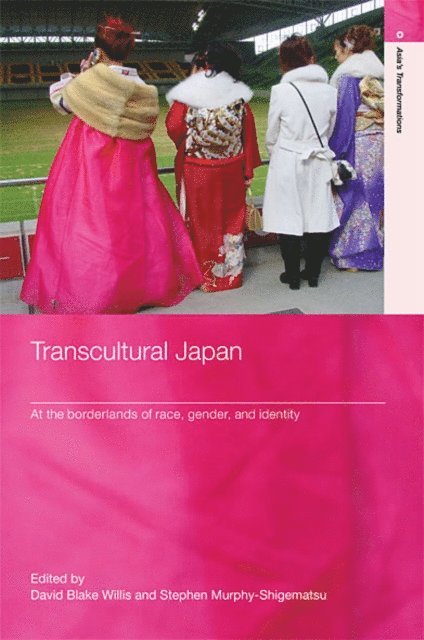
Transcultural Japan
At the Borderlands of Race, Gender and Identity
Av David Blake Willis, Stephen Murphy-Shigematsu
Inbunden, 2007
2744 kr
Lägg i varukorg
Transcultural Japan provides a critical examination of being Other in Japan. Portraying the multiple intersections of race, ethnicity, class, and gender, the book suggests ways in which the transcultural borderlands of Japan reflect globalization in this island nation. The authors show the …
Transcultural Japan
At the Borderlands of Race, Gender and Identity
Av David Blake Willis, Stephen Murphy-Shigematsu
Häftad, 2009
910 kr
Lägg i varukorg
Historically Japan has alternated between periods of celebration of a diverse, multicultural society and severe spells of xenophobia and persecution of the Other. This collection of multidisciplinary essays re-introduces the idea of Japan as a multicultural society and reflects a rapidly changing …
Transcultural Japan
At the Borderlands of Race, Gender and Identity
Av Stephen Murphy-Shigematsu, David Blake Willis
E-bok, 2007
1051 kr
Lägg i varukorg
Transcultural Japan provides a critical examination of being Other in Japan. Portraying the multiple intersections of race, ethnicity, class, and gender, the book suggests ways in which the transcultural borderlands of Japan reflect globalization in this island nation. The authors show the …
Transcultural Japan
At the Borderlands of Race, Gender and Identity
Av Stephen Murphy-Shigematsu, David Blake Willis
E-bok, 2007
1074 kr
Lägg i varukorg
Transcultural Japan provides a critical examination of being Other in Japan. Portraying the multiple intersections of race, ethnicity, class, and gender, the book suggests ways in which the transcultural borderlands of Japan reflect globalization in this island nation. The authors show the …
Toward a New Art of Border Crossing
Av Ananta Kumar Giri, Arnab Roy Chowdhury m. fl.
Inbunden, 2024
1318 kr
Lägg i varukorg
Boundaries, borders and margins are related concepts and realities, and each of these can be conceptualized and organized in closed or open ways—with degrees of closure or openness. The logics of stasis and closure, as well as cults of exclusivist and exclusionary sovereignty, are reflected and …