David Brodzinsky - Böcker
Visar alla böcker från författaren David Brodzinsky. Handla med fri frakt och snabb leverans.
3 produkter
3 produkter
Del 38 - Developmental Clinical Psychology and Psychiatry
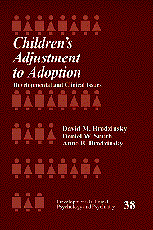
Children's Adjustment to Adoption
Developmental and Clinical Issues
Häftad, Engelska, 1998
2 239 kr
Skickas inom 3-6 vardagar
This recent volume is an important resource for instructors, researchers, and clinicians interested in the development of children who have been adopted. Brodzinsky, Smith, and Brodzinsky offer an up-to-date and accessible review of the history of adoption, theoretical perspectives that are used to organize thinking about adoption, and research that has evaluated the adjustment of children who have been adopted. —Journal of Marriage and the Family "The style is confident and authoritative . . . . this is a useful digest which, . . . . provides academics and practitioners with a neat, solid guide to key research in the field." —David Howe, in Child and Family Social Work A significant contribution to understanding the effects of adoption, ChildrenÆs Adjustment to Adoption presents major issues that affect both the process and outcome of adoption for children and their parents. It begins with a historical and contemporary perspective on adoption and then focuses on the various theories that have addressed the issue of psychological risk associated with adoption. Extensive coverage is provided on the adjustment of children and parents to adoption itself and on the psychological development including adjustment and maladjustment over the course of childhood and adolescence. Children whose adoptions emerge from such circumstances as child abuse, parental drug use, and parental HIV are closely examined as are adoptions across racial and cultural lines. This volume offers extensive coverage of theory and research on children and families and the contextual issues pertinent to the adoption process, with clinical vignettes punctuating key points. The authors close with a discussion of intervention and assessment issues that commonly arise when working with adoptees and their families. ChildrenÆs Adjustment to Adoption is a welcome addition to the current literature on the psychological issues associated with adoption. It will be valuable for professionals in the fields of clinical and counseling psychology, developmental psychology, nursing, social work, health services, and family studies.
227 kr
Skickas inom 7-10 vardagar
This Element overviews recent research on children's adjustment to adoption and its relevance for key questions addressed in developmental science. First, a historical perspective on trends in adoption practice and adoptive family life is offered. Second, research on children's adjustment to adoption is reviewed, including the impact of early adversity on their development, as well as biological and social factors related to their recovery from adversity. Third, factors impacting adoptive identity development are examined, followed by research on open adoption and adoption by sexual minority adults. Fourth, different types of postadoption support and services that facilitate family stability and children's emotional well-being are analyzed. Finally, conclusions are drawn, and recommendations for future research and practice are offered.
731 kr
Skickas inom 7-10 vardagar
This Element overviews recent research on children's adjustment to adoption and its relevance for key questions addressed in developmental science. First, a historical perspective on trends in adoption practice and adoptive family life is offered. Second, research on children's adjustment to adoption is reviewed, including the impact of early adversity on their development, as well as biological and social factors related to their recovery from adversity. Third, factors impacting adoptive identity development are examined, followed by research on open adoption and adoption by sexual minority adults. Fourth, different types of postadoption support and services that facilitate family stability and children's emotional well-being are analyzed. Finally, conclusions are drawn, and recommendations for future research and practice are offered.