David Ellwood – författare
Visar alla böcker från författaren David Ellwood. Handla med fri frakt och snabb leverans.
9 produkter
Shock of America
Europe and the Challenge of the Century
E-bok, 2012
370 kr
Lägg i varukorg
The Shock of America is based on the proposition that whenever Europeans of the last 100 years or more contemplated those margins of their experience where change occurred, there, sooner or later, they would find America. How Europeans have come to terms over the decades with this dynamic force in …
Shock of America
Europe and the Challenge of the Century
E-bok, 2012
370 kr
Lägg i varukorg
The Shock of America is based on the proposition that whenever Europeans of the last 100 years or more contemplated those margins of their experience where change occurred, there, sooner or later, they would find America. How Europeans have come to terms over the decades with this dynamic force in …
The Shock of America
Europe and the Challenge of the Century
Inbunden, 2012
1291 kr
Lägg i varukorg
The Shock of America is based on the proposition that whenever Europeans contemplated those margins of their experience where change occurred over the last 100 years or more, there, sooner or later, they would find America. How Europeans have come to terms over the decades with this dynamic force …
The Shock of America
Europe and the Challenge of the Century
Häftad, 2016
536 kr
Lägg i varukorg
The Shock of America is based on the proposition that whenever Europeans of the last 100 years or more contemplated those margins of their experience where change occurred, there, sooner or later, they would find America. How Europeans have come to terms over the decades with this dynamic force in …
Poor Support
Poverty In The American Family
Häftad, 1989
311 kr
Lägg i varukorg
The subject of a New York Times Magazine cover story of December 8, 1996, David Ellwood is one of the country's leading experts on poverty. In this book he describes who the poor are, explains why they are poor, and suggests new policies for helping them. Poor Support is a major reinterpretation of …
Motives, Quantum Field Theory and Pseudodifferential Operators
Av Alan Carey, David Ellwood m. fl.
Häftad, 2011
1382 kr
Lägg i varukorg
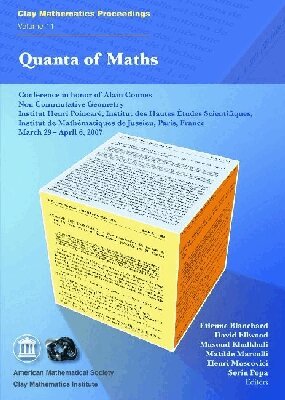
Quanta of Maths
Av Etienne Blanchard, David Ellwood m. fl.
Häftad, 2011
1840 kr
Lägg i varukorg
The work of Alain Connes has cut a wide swath across several areas of mathematics and physics. Reflecting its broad spectrum and profound impact on the contemporary mathematical landscape, this collection of articles covers a wealth of topics at the forefront of research in operator algebras, …
Evolution Equations
Av David Ellwood, Igor Rodnianski m. fl.
Häftad, 2013
1994 kr
Lägg i varukorg
This volume is a collection of notes from lectures given at the 2008 Clay Mathematics Institute Summer School, held in Zurich, Switzerland. The lectures were designed for graduate students and mathematicians within five years of the Ph.D., and the main focus of the programme was on recent progress …
Resolution of Singular Algebraic Varieties
Av David Ellwood, Herwig Hauser m. fl.
Häftad, 2014
1378 kr
Lägg i varukorg
Resolution of Singularities has long been considered as being a difficult to access area of mathematics. The more systematic and simpler proofs that have appeared in the last few years in zero characteristic now give us a much better understanding of singularities. They reveal the aesthetics of …