David Gelernter – författare
Visar alla böcker från författaren . Handla med fri frakt och snabb leverans.
17 produkter
17 produkter
E-bok
Engelska, 1993391 kr
Läs direkt efter köp
Technology doesn''t flow smoothly; it''s the big surprises that matter, and Yale computer expert David Gelernter sees one such giant leap right on the horizon. Today''s small scale software programs are about to be joined by vast public software works that will revolutionize computing and transform society as a whole. One such vast program is the "Mirror World." Imagine looking at your computer screen and seeing reality--an image of your city, for instance, complete with moving traffic patterns, or a picture that sketches the state of an entire far-flung corporation at this second. These representations are called Mirror Worlds, and according to Gelernter they will soon be available to everyone. Mirror Worlds are high-tech voodoo dolls: by interacting with the images, you interact with reality. Indeed, Mirror Worlds will revolutionize the use of computers, transforming them from (mere) handy tools to crystal balls which will allow us to see the world more vividly and see into it more deeply. Reality will be replaced gradually, piece-by-piece, by a software imitation; we will live inside the imitation; and the surprising thing is--this will be a great humanistic advance. We gain control over our world, plus a huge new measure of insight and vision. In this fascinating book--part speculation, part explanation--Gelernter takes us on a tour of the computer technology of the near future. Mirror Worlds, he contends, will allow us to explore the world in unprecedented depth and detail without ever changing out of our pajamas. A hospital administrator might wander through an entire medical complex via a desktop computer. Any citizen might explore the performance of the local schools, chat electronically with teachers and other Mirror World visitors, plant software agents to report back on interesting topics; decide to run for the local school board, hire a campaign manager, and conduct the better part of the campaign itself--all by interacting with the Mirror World. Gelernter doesn''t just speculate about how this amazing new software will be used--he shows us how it will be made, explaining carefully and in detail how to build a Mirror World using technology already available. We learn about "disembodied machines," "trellises," "ensembles," and other computer components which sound obscure, but which Gelernter explains using familiar metaphors and terms. (He tells us that a Mirror World is a microcosm just like a Japanese garden or a Gothic cathedral, and that a computer program is translated by the computer in the same way a symphony is translated by a violinist into music.) Mirror Worlds offers a lucid and humanistic account of the coming software revolution, told by a computer scientist at the cutting edge of his field.
Häftad, Engelska, 1993
374 kr
Skickas inom 5-8 vardagar
In this fascinating book - part speculation, part explanation, Gelernter takes us on a tour of the computer technology of the near future. Mirror Worlds, he contends, will allow us to explore the world in unprecedented depth and detail without ever changing out of our pyjamas! Gelernter does much more than just speculate about how this amazing new software will be used - he shows us how it will be made, explaining carefully and in detail how to build a mirror world using technology already available. Mirror Worlds offers a lucid and humanistic account of the coming software revolution, told by a computer scientist at the cutting edge of his field.
E-bok
PDF, Engelska, 1993408 kr
Läs direkt efter köp
Technology doesn''t flow smoothly; it''s the big surprises that matter, and Yale computer expert David Gelernter sees one such giant leap right on the horizon. Today''s small scale software programs are about to be joined by vast public software works that will revolutionize computing and transform society as a whole. One such vast program is the "Mirror World." Imagine looking at your computer screen and seeing reality--an image of your city, for instance, complete with moving traffic patterns, or a picture that sketches the state of an entire far-flung corporation at this second. These representations are called Mirror Worlds, and according to Gelernter they will soon be available to everyone. Mirror Worlds are high-tech voodoo dolls: by interacting with the images, you interact with reality. Indeed, Mirror Worlds will revolutionize the use of computers, transforming them from (mere) handy tools to crystal balls which will allow us to see the world more vividly and see into it more deeply. Reality will be replaced gradually, piece-by-piece, by a software imitation; we will live inside the imitation; and the surprising thing is--this will be a great humanistic advance. We gain control over our world, plus a huge new measure of insight and vision. In this fascinating book--part speculation, part explanation--Gelernter takes us on a tour of the computer technology of the near future. Mirror Worlds, he contends, will allow us to explore the world in unprecedented depth and detail without ever changing out of our pajamas. A hospital administrator might wander through an entire medical complex via a desktop computer. Any citizen might explore the performance of the local schools, chat electronically with teachers and other Mirror World visitors, plant software agents to report back on interesting topics; decide to run for the local school board, hire a campaign manager, and conduct the better part of the campaign itself--all by interacting with the Mirror World. Gelernter doesn''t just speculate about how this amazing new software will be used--he shows us how it will be made, explaining carefully and in detail how to build a Mirror World using technology already available. We learn about "disembodied machines," "trellises," "ensembles," and other computer components which sound obscure, but which Gelernter explains using familiar metaphors and terms. (He tells us that a Mirror World is a microcosm just like a Japanese garden or a Gothic cathedral, and that a computer program is translated by the computer in the same way a symphony is translated by a violinist into music.) Mirror Worlds offers a lucid and humanistic account of the coming software revolution, told by a computer scientist at the cutting edge of his field.
E-bok
Engelska, 200774 kr
Läs direkt efter köp
What does it mean to “believe” in America? Why do we always speak of our country as having a mission or purpose that is higher than other nations?Modern liberals have invested a great deal in the notion that America was founded as a secular state, with religion relegated to the private sphere. David Gelernter argues that America is not secular at all, but a powerful religious idea—indeed, a religion in its own right.Gelernter argues that what we have come to call “Americanism” is in fact a secular version of Zionism. Not the Zionism of the ancient Hebrews, but that of the Puritan founders who saw themselves as the new children of Israel, creating a new Jerusalem in a new world. Their faith-based ideals of liberty, equality, and democratic governance had a greater influence on the nation’s founders than the Enlightenment.Gelernter traces the development of the American religion from its roots in the Puritan Zionism of seventeenth-century New England to the idealistic fighting faith it has become, a militant creed dedicated to spreading freedom around the world. The central figures in this process were Abraham Lincoln, Teddy Roosevelt, and Woodrow Wilson, who presided over the secularization of the American Zionist idea into the form we now know as Americanism.If America is a religion, it is a religion without a god, and it is a global religion. People who believe in America live all over the world. Its adherents have included oppressed and freedom-loving peoples everywhere—from the patriots of the Greek and Hungarian revolutions to the martyred Chinese dissidents of Tiananmen Square.Gelernter also shows that anti-Americanism, particularly the virulent kind that is found today in Europe, is a reaction against this religious conception of America on the part of those who adhere to a rival religion of pacifism and appeasement.A startlingly original argument about the religious meaning of America and why it is loved—and hated—with so much passion at home and abroad.
E-bok
Engelska, 2010169 kr
Läs direkt efter köp
A leading mind in the world of artificial intelligence answers the provocative question: “Can we introduce emotion into the computer?”Can we introduce emotion into the computer? David Gelernter, one of the leading lights in artificial intelligence today, begins The Muse in the Machine with this provocative question. In providing an answer, he not only points to a future revolution in computers, but radically changes our views of the human mind itself. Bringing together insights from computer science, cognitive psychology, philosophy of mind, and literary theory, David Gelernter presents what is sure to be a much debated view of how humans have thought, how we think today, and how computers will learn to think in the future.
E-bok
Engelska, 2013212 kr
Läs direkt efter köp
America-Lite (where we all live) is just like America, only turned into an amusement park or a video game or a supersized Pinkberry, where the past and future are blank and there is only a big NOW. How did we come to expect no virtue and so much cynicism from our culture, our leaders—and each other?In this refreshingly judgmental book, David Gelernter connects the historical dots to reveal a stealth revolution carried out by post-religious globalist intellectuals who, by and large, “can’t run their own universities or scholarly fields, but are very sure they can run you.” These imperial academics have deployed their students into the top echelon of professions once monopolized by staid and steady WASPs. In this simple way, they have installed themselves as the new designated drivers of American culture.Imperial academics live in a world of theory; they preach disdain for mere facts and for old-fashioned fact-based judgments like true or false. Schoolchildren are routinely taught theories about history instead of actual history—they learn, for example, that all nations are equally nice except for America, which is nearly always nasty.With academic experts to do our thinking for us, we’ve politely shut up and let second-raters take the wheel. In fact, we have handed the keys to the star pupil and teacher’s pet of the post-religious globalist intellectuals, whose election to the presidency of the United States constituted the ultimate global group hug.How do we finally face the truth and get back into the driver’s seat? America-Lite ends with a one-point plan.
Häftad, Engelska, 1992
561 kr
Skickas inom 10-15 vardagar
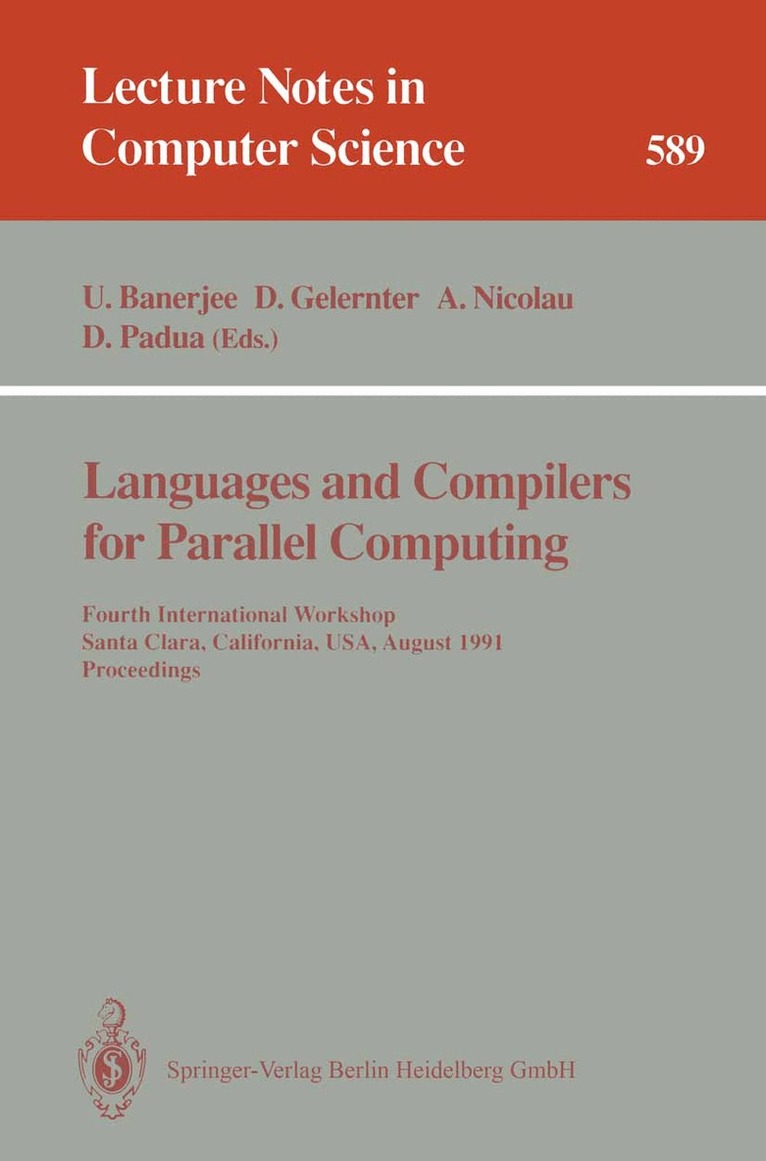
This volume contains the proceedings of the Fourth Workshopon Languages andCompilers for Parallel Computing, held inSanta Clara, California, in August1991. The purpose of theworkshop, held every year since 1988, is to bring togetherthe leading researchers on parallel programming languagedesignand compilation techniques for parallel computers.The papers in this book cover several important topicsincluding: (1) languages and structures to representprograms internally in the compiler, (2) techniques toanalyzeand manipulate sequential loops in order to generatea parallel version, (3)techniques to detect and extractfine-grain parallelism, (4) scheduling and memory-managementissues in automatically generated parallel programs, (5)parallel programming language designs, and (6) compilationof explicitly parallel programs.Together, the papers give a good overview of the researchprojects underway in 1991 in this field.
Häftad, Engelska, 1993
561 kr
Skickas inom 10-15 vardagar
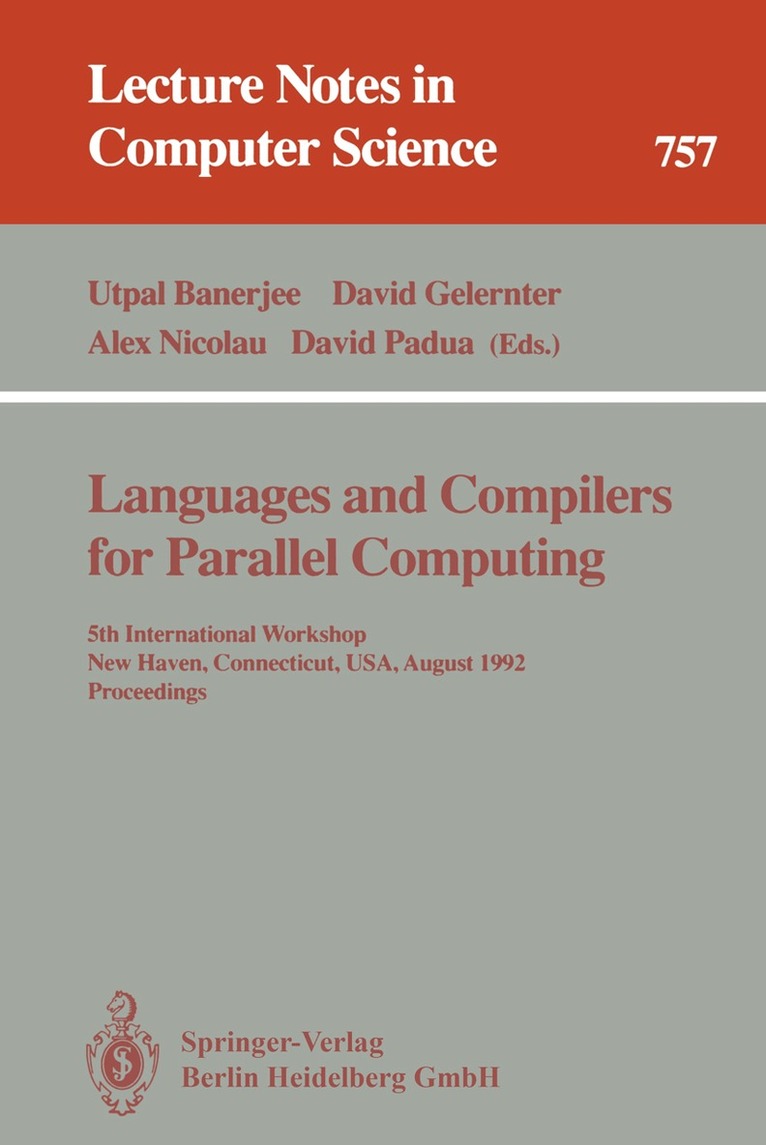
The articles in this volume are revised versions of the bestpapers presented at the Fifth Workshop on Languages andCompilers for Parallel Computing, held at Yale University,August 1992. The previous workshops in this series were heldin Santa Clara (1991), Irvine (1990), Urbana (1989), andIthaca (1988). As in previous years, a reasonablecross-section of some of the best work in the field ispresented. The volume contains 35 papers, mostly by authorsworking in the U.S. or Canada but also by authors fromAustria, Denmark, Israel, Italy, Japan and the U.K.
Häftad, Engelska, 1994
1 116 kr
Skickas inom 10-15 vardagar
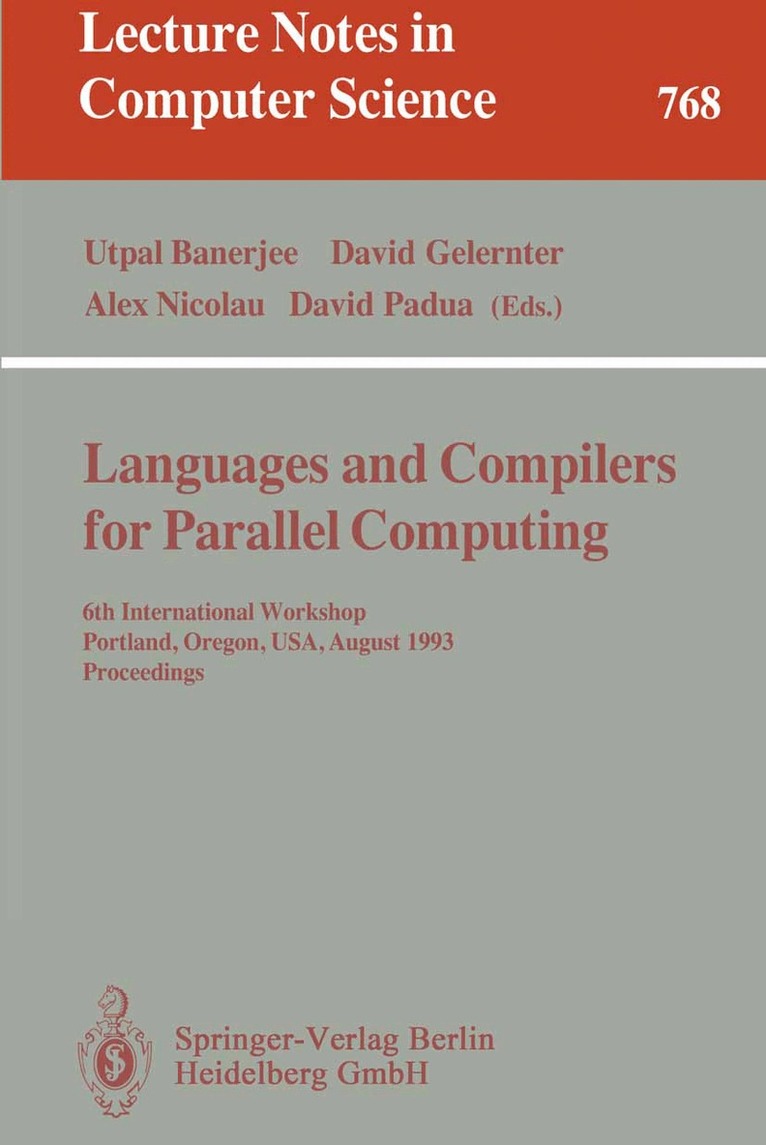
This book contains papers selected for presentation at theSixth Annual Workshop on Languages and Compilers forParallel Computing. The workshop washosted by the OregonGraduate Institute of Science and Technology. All the majorresearch efforts in parallel languages and compilers arerepresented in this workshop series.The 36 papers in the volume aregrouped under nine headings:dynamic data structures, parallel languages, HighPerformance Fortran, loop transformation, logic and dataflowlanguage implementations, fine grain parallelism, scalaranalysis, parallelizing compilers, and analysis of parallelprograms. The book represents a valuable snapshot of thestate of research in the field in 1993.
Häftad, Engelska, 1995
561 kr
Skickas inom 10-15 vardagar
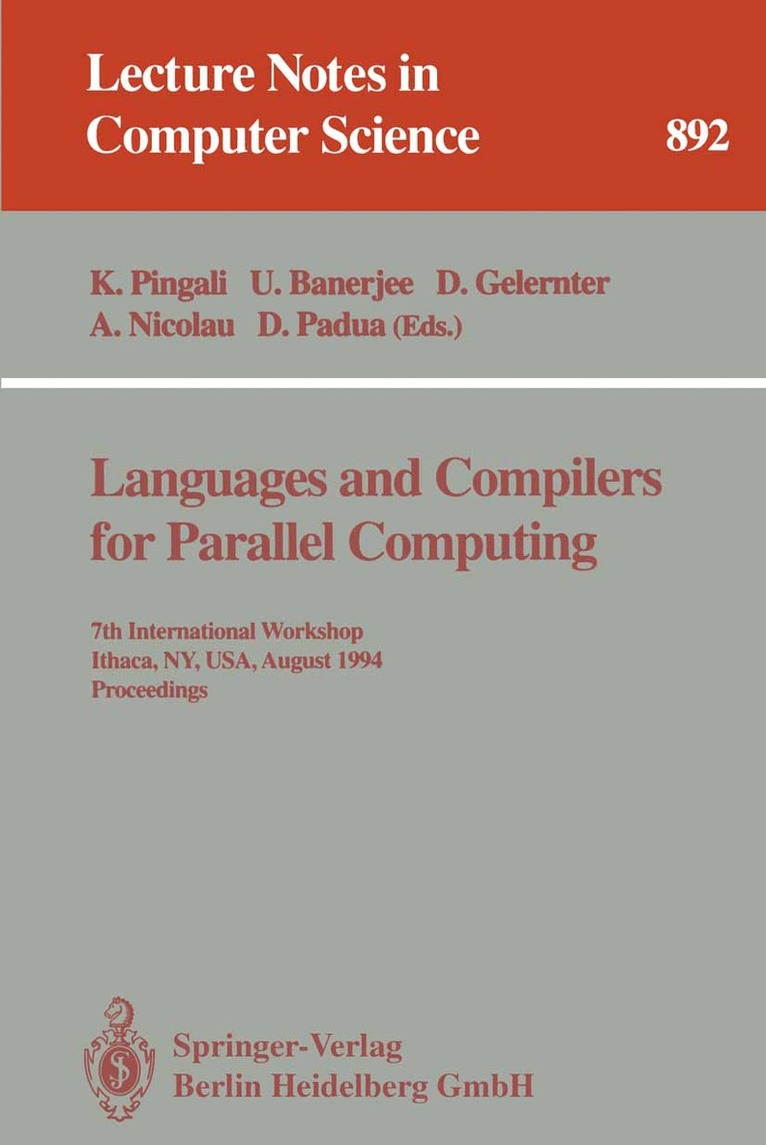
This volume presents revised versions of the 32 papers accepted for the Seventh Annual Workshop on Languages and Compilers for Parallel Computing, held in Ithaca, NY in August 1994.The 32 papers presented report on the leading research activities in languages and compilers for parallel computing and thus reflect the state of the art in the field. The volume is organized in sections on fine-grain parallelism, align- ment and distribution, postlinear loop transformation, parallel structures, program analysis, computer communication, automatic parallelization, languages for parallelism, scheduling and program optimization, and program evaluation.
Häftad, Engelska, 1996
1 116 kr
Skickas inom 10-15 vardagar
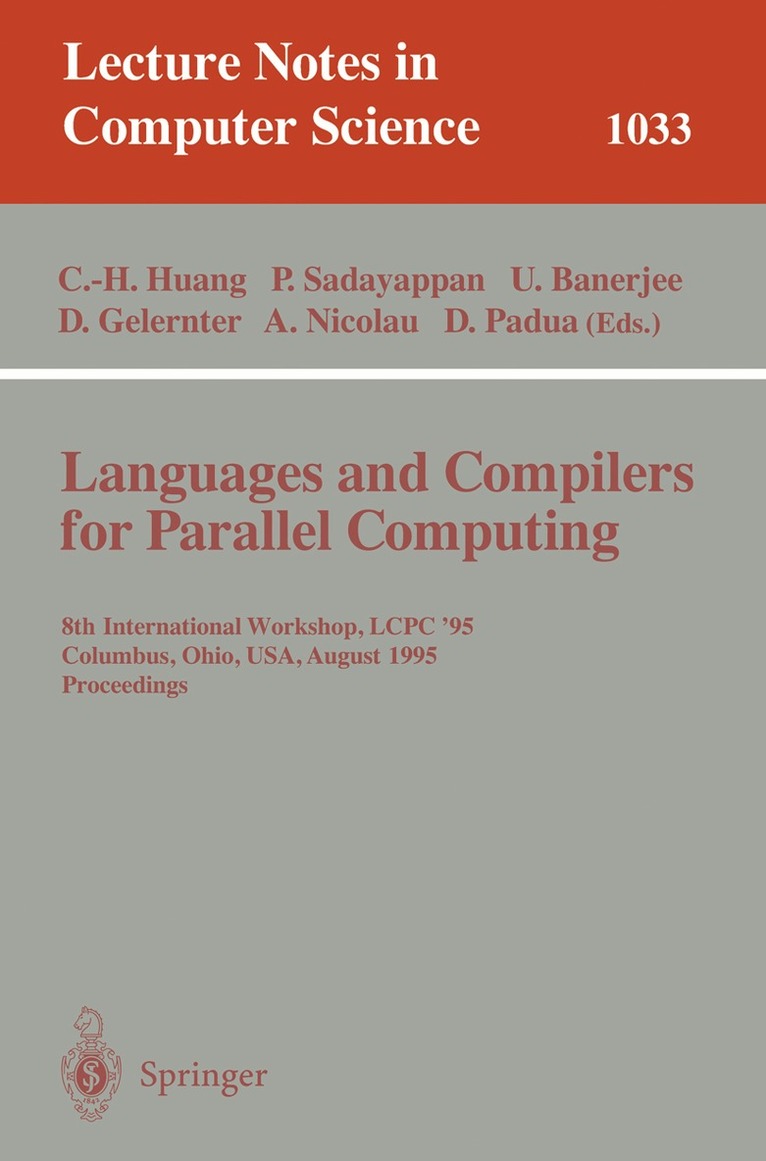
This book presents the refereed proceedings of the Eighth Annual Workshop on Languages and Compilers for Parallel Computing, held in Columbus, Ohio in August 1995.The 38 full revised papers presented were carefully selected for inclusion in the proceedings and reflect the state of the art of research and advanced applications in parallel languages, restructuring compilers, and runtime systems. The papers are organized in sections on fine-grain parallelism, interprocedural analysis, program analysis, Fortran 90 and HPF, loop parallelization for HPF compilers, tools and libraries, loop-level optimization, automatic data distribution, compiler models, irregular computation, object-oriented and functional parallelism.
Häftad, Engelska, 1997
1 116 kr
Skickas inom 10-15 vardagar
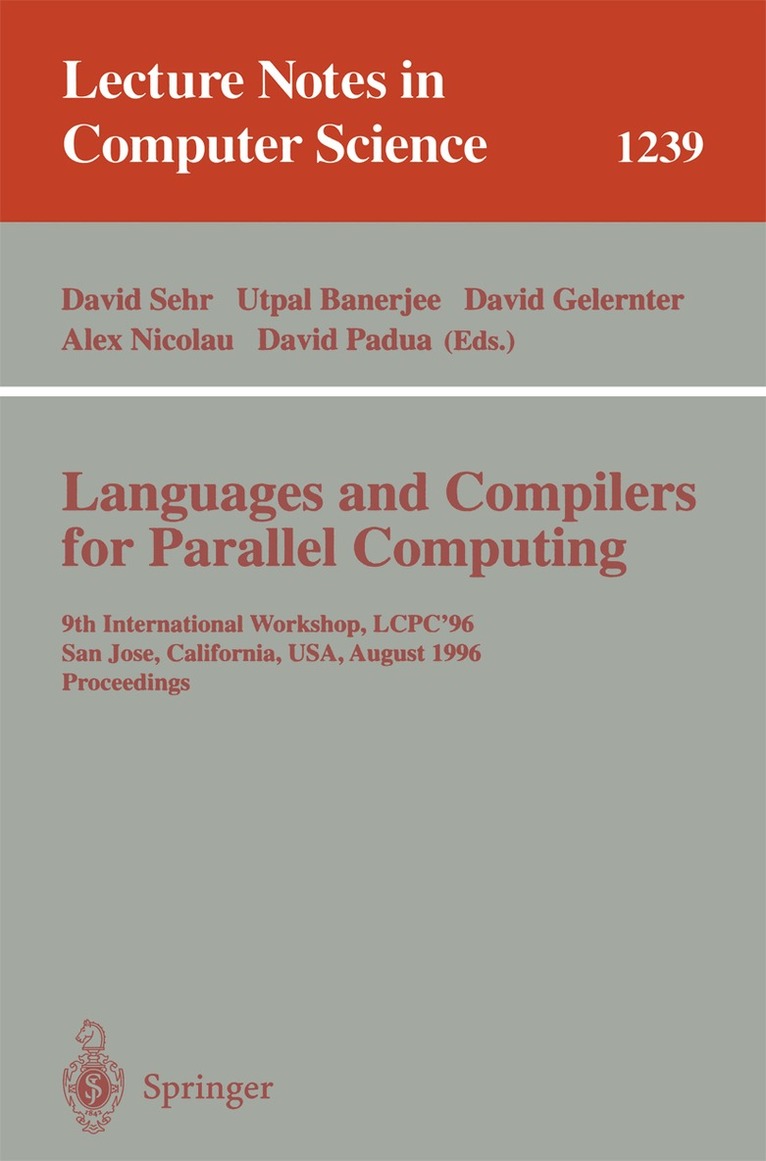
This book presents the thoroughly refereed post-workshop proceedings of the 9th International Workshop on Languages and Compilers for Parallel Computing, LCPC'96, held in San Jose, California, in August 1996.The book contains 35 carefully revised full papers together with nine poster presentations. The papers are organized in topical sections on automatic data distribution and locality enhancement, program analysis, compiler algorithms for fine-grain parallelism, instruction scheduling and register allocation, parallelizing compilers, communication optimization, compiling HPF, and run-time control of parallelism.
Häftad, Engelska, 2022
198 kr
Tillfälligt slut
Inbunden, Engelska, 2022
368 kr
Tillfälligt slut
Inbunden, Engelska, 2012
217 kr
Tillfälligt slut
America-Lite (where we all live) is just like America, only turned into an amusement park or a video game or a supersized Pinkberry, where the past and future are blank and there is only a big NOW. How did we come to expect no virtue and so much cynicism from our culture, our leaders--and each other? In this refreshingly judgmental book, David Gelernter connects the historical dots to reveal a stealth revolution carried out by post-religious globalist intellectuals who, by and large, "can't run their own universities or scholarly fields, but are very sure they can run you." These imperial academics have deployed their students into the top echelon of professions once monopolized by staid and steady WASPs. In this simple way, they have installed themselves as the new designated drivers of American culture. Imperial academics live in a world of theory; they preach disdain for mere facts and for old-fashioned fact-based judgments like true or false. Schoolchildren are routinely taught theories about history instead of actual history--they learn, for example, that all nations are equally nice except for America, which is nearly always nasty.With academic experts to do our thinking for us, we've politely shut up and let second-raters take the wheel. In fact, we have handed the keys to the star pupil and teacher's pet of the post-religious globalist intellectuals, whose election to the presidency of the United States constituted the ultimate global group hug. How do we finally face the truth and get back into the driver's seat? America-Lite ends with a one-point plan.
Häftad, Engelska, 2013
150 kr
Tillfälligt slut
America-Lite (where we all live) is just like America, only turned into an amusement park or a video game or a supersized Pinkberry, where the past and future are blank and there is only a big NOW. How did we come to expect no virtue and so much cynicism from our culture, our leaders-and each other? In this refreshingly judgmental book, David Gelernter connects the historical dots to reveal a stealth revolution carried out by post-religious globalist intellectuals who, by and large, "can't run their own universities or scholarly fields, but are very sure they can run you." These imperial academics have deployed their students into the top echelon of professions once monopolized by staid and steady WASPs. In this simple way, they have installed themselves as the new designated drivers of American culture. Imperial academics live in a world of theory; they preach disdain for mere facts and for old-fashioned fact-based judgments like true or false. Schoolchildren are routinely taught theories about history instead of actual history-they learn, for example, that all nations are equally nice except for America, which is nearly always nasty.With academic experts to do our thinking for us, we've politely shut up and let second-raters take the wheel. In fact, we have handed the keys to the star pupil and teacher's pet of the post-religious globalist intellectuals, whose election to the presidency of the United States constituted the ultimate global group hug. How do we finally face the truth and get back into the driver's seat? America-Lite ends with a one-point plan.
Häftad, Engelska, 2017
159 kr
Tillfälligt slut
The holy grail of scientists and psychologists since the beginning of artificial intelligence has been to replicate thought patterns of the human mind. Challenging the notion that this can ever be achieved through state-of-the-art research, legendary AI authority David Gelernter—a "rock star" (New York Times) of the computing world—surprisingly turns to literature, hoping that the works of introspective geniuses like Shakespeare, J. M. Coetzee, and Karen Blixen can help answer the same fundamental questions that neuroscientists have been struggling with for generations. Indeed, Gelernter’s landmark "spectrum of consciousness" decodes some of the deepest, most mysterious aspects of the human mind, such as the numinous light of early childhood, why sadism and masochism underpin some of our greatest artistic achievements, and why dreams often do predict the future. With "penetrating insight and a graceful, inviting presentation" (National Review), The Tides of Mind revolutionizes our very understanding of what it means to be a human being.