David Grinspoon – författare
Visar alla böcker från författaren . Handla med fri frakt och snabb leverans.
5 produkter
5 produkter
E-bok
Engelska, 2009114 kr
Läs direkt efter köp
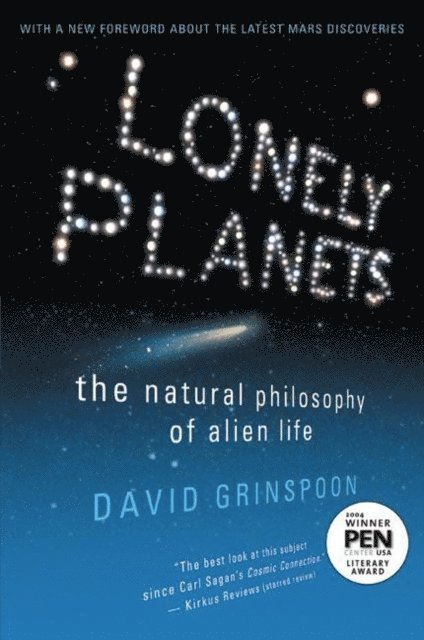
PEN Literary Award Winner: "The best, most entertaining examination of the possibility of other life in the universe since [Carl] Sagan''s best work." —Boulder Daily Camera It''s been decades since Carl Sagan first addressed the general public about the possibility of extraterrestrial life from a scientist''s perspective. We''ve learned a lot in those years, and now planetary scientist David Grinspoon investigates the big questions: How widespread are life and intelligence in the cosmos? Is life on Earth an accident, or in some sense the "purpose" of this universe? And how can we, working from the Earth-centric definition of "life," even begin to think about the varieties of life-forms on other planets?In accessible, lively prose, and using the topic of extraterrestrial life as a mirror with which to view human beliefs, evolution, history, and aspirations, Grinspoon takes us on a three-part journey—the history of our expanding awareness of other planets and our ideas on alien life dating back to the earliest days of astronomy; the science of cosmic evolution and the evolution of life on Earth, including a critique of the "Rare Earth hypothesis"; and the beliefs that humans hold, addressing the limits of our ability to conceptualize or communicate with intelligent aliens and the scientific and philosophical implications of far-future evolutionary possibilities.Rich in personal and often amusing anecdotes, Lonely Planets explores the shifting boundary between planetary science and natural philosophy, and reveals how the search for extraterrestrial life unites our spiritual and scientific quests for connection with the cosmos. Includes a new foreword about recent Mars discoveries "An outstanding introduction to cosmic evolution." —San Jose Mercury News "[A] terrific book." —San Diego Union-Tribune "A personable chat on life, the universe and everything." —Publishers Weekly
Häftad, Engelska, 1998
229 kr
Skickas inom 5-8 vardagar
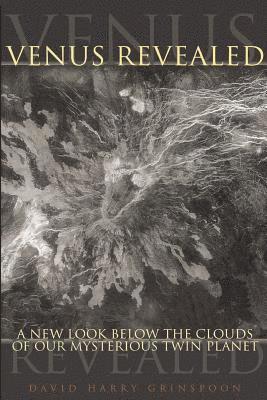
Until very recently, all we really knew about Venus, our nearest planetary neighbour, was that it was roughly the same size and mass as the earth and was surrounded by a thick atmosphere. Then, in 1989, American scientists launched Magellan,the spacecraft that would revolutionize our vision of this mysterious planet. Venus Revealed is the first book to explain the breathtaking results of this mission, which unveiled a Venusian world of active volcanoes, shining mountains, and river valleys carved by torrents of flowing lava. At one time, Venus may have even had a wet, temperate climate, much like Earth's. What happened to turn it into a hostile, burning acid world? The answer could very well help us solve some of our most pressing environmental problems,from global warming to acid rain. In Venus Revealed, David Grinspoon eloquently argues that studying our exotic twin will inevitable teach us more about ourselves.
Del 11 - ISSI Scientific Report Series
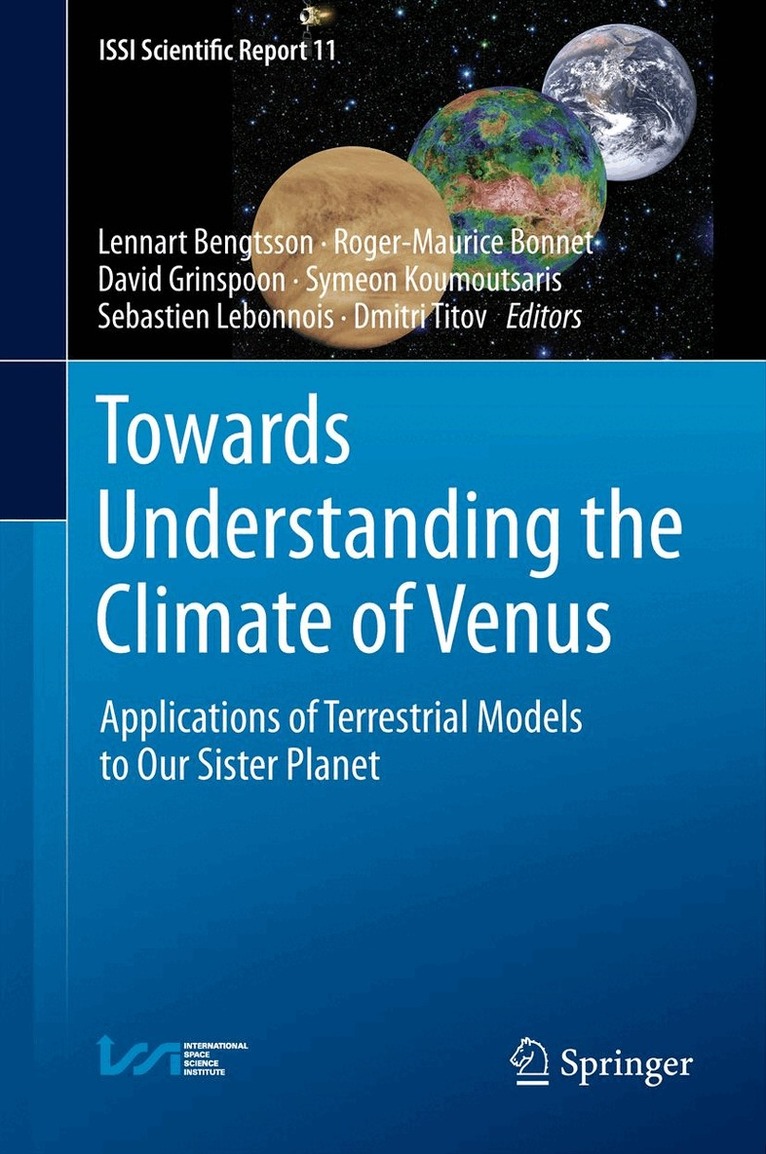
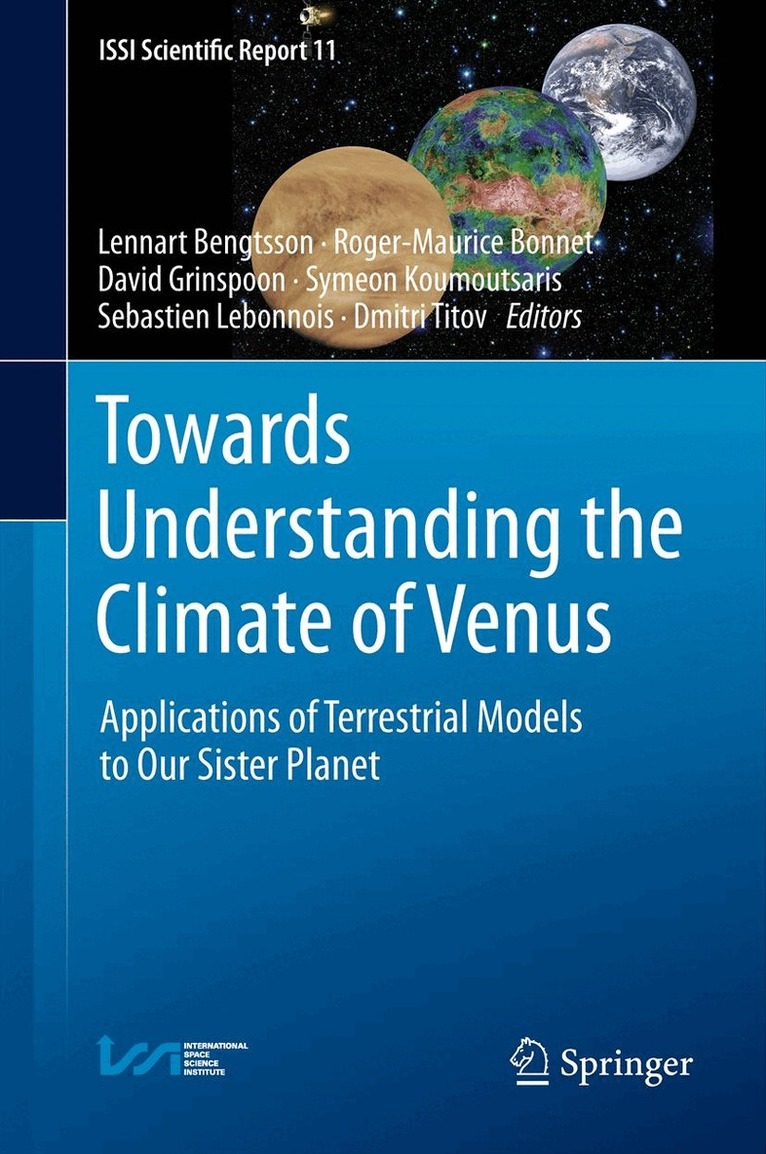
Towards Understanding the Climate of Venus
Applications of Terrestrial Models to Our Sister Planet
Inbunden, Engelska, 2012
1 077 kr
Skickas inom 10-15 vardagar
ESA’s Venus Express Mission has monitored Venus since April 2006, and scientists worldwide have used mathematical models to investigate its atmosphere and model its circulation. This book summarizes recent work to explore and understand the climate of the planet through a research program under the auspices of the International Space Science Institute (ISSI) in Bern, Switzerland. Some of the unique elements that are discussed are the anomalies with Venus’ surface temperature (the huge greenhouse effect causes the surface to rise to 460°C, without which would plummet as low as -40°C), its unusual lack of solar radiation (despite being closer to the Sun, Venus receives less solar radiation than Earth due to its dense cloud cover reflecting 76% back) and the juxtaposition of its atmosphere and planetary rotation (wind speeds can climb up to 200 m/s, much faster than Venus’ sidereal day of 243 Earth-days).
E-bok
PDF, Engelska, 20121 416 kr
Läs direkt efter köp
ESA’s Venus Express Mission has monitored Venus since April 2006, and scientists worldwide have used mathematical models to investigate its atmosphere and model its circulation. This book summarizes recent work to explore and understand the climate of the planet through a research program under the auspices of the International Space Science Institute (ISSI) in Bern, Switzerland. Some of the unique elements that are discussed are the anomalies with Venus’ surface temperature (the huge greenhouse effect causes the surface to rise to 460°C, without which would plummet as low as -40°C), its unusual lack of solar radiation (despite being closer to the Sun, Venus receives less solar radiation than Earth due to its dense cloud cover reflecting 76% back) and the juxtaposition of its atmosphere and planetary rotation (wind speeds can climb up to 200 m/s, much faster than Venus’ sidereal day of 243 Earth-days).
Del 11 - ISSI Scientific Report Series
Towards Understanding the Climate of Venus
Applications of Terrestrial Models to Our Sister Planet
Häftad, Engelska, 2015
1 077 kr
Skickas inom 10-15 vardagar
ESA’s Venus Express Mission has monitored Venus since April 2006, and scientists worldwide have used mathematical models to investigate its atmosphere and model its circulation. This book summarizes recent work to explore and understand the climate of the planet through a research program under the auspices of the International Space Science Institute (ISSI) in Bern, Switzerland. Some of the unique elements that are discussed are the anomalies with Venus’ surface temperature (the huge greenhouse effect causes the surface to rise to 460°C, without which would plummet as low as -40°C), its unusual lack of solar radiation (despite being closer to the Sun, Venus receives less solar radiation than Earth due to its dense cloud cover reflecting 76% back) and the juxtaposition of its atmosphere and planetary rotation (wind speeds can climb up to 200 m/s, much faster than Venus’ sidereal day of 243 Earth-days).