David H. Sanders – författare
Visar alla böcker från författaren David H. Sanders. Handla med fri frakt och snabb leverans.
5 produkter
5 produkter
Häftad, Engelska, 2008
791 kr
Skickas inom 10-15 vardagar
"Community Life for the Mentally Ill" presents a social innovative experiment aimed at providing new and more participating social positions in American society for mental patients. It presents the events that occurred when a courageous group of former chronic mental patients abruptly left a hospital and established their own autonomous sub-society in a large, metropolitan area.In order to complete this experiment, the patients created a small society in the community where discharged patients could live and work. Others evaluated the effects of the newly created society upon the behavior and perceptions of its members, which is also presented here. Both the descriptive and comparative aspects of this study are presented as they occurred in real life. The book is concerned with the medical, economic, sociological, and psychological facets of these former patients' daily lives. The effects of this small society upon the neighborhood and city in which it was located, as well as its effects upon professional persons, are richly explored.Clearly defining a radical departure from standard methods for treating the mentally ill, the authors conclude that such an autonomous society can thrive in the appropriate setting; the ex-patient's chances of employment are increased and the chance of recidivism are reduced; the member's self-esteem is enhanced; treatment costs are greatly reduced; the community adjustment of all members is increased, especially among those who have been hospitalized for a long period. With new guidelines for identifying danger zones in urban settings, this becomes a critical work.
Inbunden, Engelska, 2017
2 639 kr
Skickas inom 3-6 vardagar
"Community Life for the Mentally Ill" presents a social innovative experiment aimed at providing new and more participating social positions in American society for mental patients. It presents the events that occurred when a courageous group of former chronic mental patients abruptly left a hospital and established their own autonomous sub-society in a large, metropolitan area.In order to complete this experiment, the patients created a small society in the community where discharged patients could live and work. Others evaluated the effects of the newly created society upon the behavior and perceptions of its members, which is also presented here. Both the descriptive and comparative aspects of this study are presented as they occurred in real life. The book is concerned with the medical, economic, sociological, and psychological facets of these former patients' daily lives. The effects of this small society upon the neighborhood and city in which it was located, as well as its effects upon professional persons, are richly explored.Clearly defining a radical departure from standard methods for treating the mentally ill, the authors conclude that such an autonomous society can thrive in the appropriate setting; the ex-patient's chances of employment are increased and the chance of recidivism are reduced; the member's self-esteem is enhanced; treatment costs are greatly reduced; the community adjustment of all members is increased, especially among those who have been hospitalized for a long period. With new guidelines for identifying danger zones in urban settings, this becomes a critical work.
E-bok
Engelska, 2017892 kr
Läs direkt efter köp
"Community Life for the Mentally Ill" presents a social innovative experiment aimed at providing new and more participating social positions in American society for mental patients. It presents the events that occurred when a courageous group of former chronic mental patients abruptly left a hospital and established their own autonomous sub-society in a large, metropolitan area.In order to complete this experiment, the patients created a small society in the community where discharged patients could live and work. Others evaluated the effects of the newly created society upon the behavior and perceptions of its members, which is also presented here. Both the descriptive and comparative aspects of this study are presented as they occurred in real life. The book is concerned with the medical, economic, sociological, and psychological facets of these former patients'' daily lives. The effects of this small society upon the neighborhood and city in which it was located, as well as its effects upon professional persons, are richly explored.Clearly defining a radical departure from standard methods for treating the mentally ill, the authors conclude that such an autonomous society can thrive in the appropriate setting; the ex-patient''s chances of employment are increased and the chance of recidivism are reduced; the member''s self-esteem is enhanced; treatment costs are greatly reduced; the community adjustment of all members is increased, especially among those who have been hospitalized for a long period. With new guidelines for identifying danger zones in urban settings, this becomes a critical work.
E-bok
PDF, Engelska, 2017892 kr
Läs direkt efter köp
"Community Life for the Mentally Ill" presents a social innovative experiment aimed at providing new and more participating social positions in American society for mental patients. It presents the events that occurred when a courageous group of former chronic mental patients abruptly left a hospital and established their own autonomous sub-society in a large, metropolitan area.In order to complete this experiment, the patients created a small society in the community where discharged patients could live and work. Others evaluated the effects of the newly created society upon the behavior and perceptions of its members, which is also presented here. Both the descriptive and comparative aspects of this study are presented as they occurred in real life. The book is concerned with the medical, economic, sociological, and psychological facets of these former patients'' daily lives. The effects of this small society upon the neighborhood and city in which it was located, as well as its effects upon professional persons, are richly explored.Clearly defining a radical departure from standard methods for treating the mentally ill, the authors conclude that such an autonomous society can thrive in the appropriate setting; the ex-patient''s chances of employment are increased and the chance of recidivism are reduced; the member''s self-esteem is enhanced; treatment costs are greatly reduced; the community adjustment of all members is increased, especially among those who have been hospitalized for a long period. With new guidelines for identifying danger zones in urban settings, this becomes a critical work.
E-bok
PDF, Engelska, 2013756 kr
Läs direkt efter köp
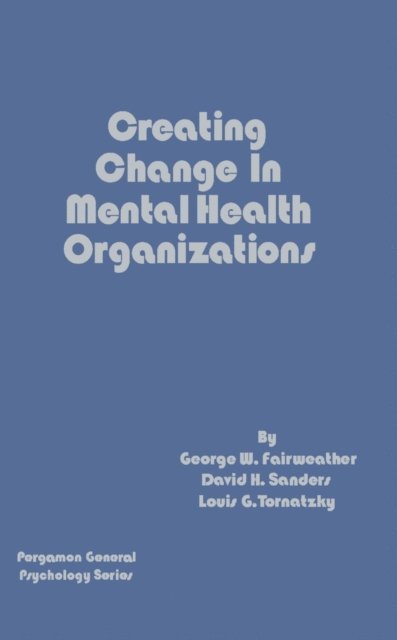
Creating Change in Mental Health Organizations discusses the findings of the experiment designed to identify the parameters of social change in mental health organizations. The title details the results from a variety of perspectives, such as experimental and hospital employees. The text first covers the need for social change in treating mental illness, and then proceeds to tackling organizational change background and research plan of the experiment. Next, the selection talks about the process of approach and persuasion. The next chapters cover the concerns in activating adoption, such as the factors, process, and conditions. Chapter 7 deals with the follow-up diffusion for the community lodge, while Chapter 8 talks about the principles for creating change in metal health organizations. The text also discusses the social policy decision aimed at solving human problems. The book will be of great use to professionals in the mental health care industry.