David J. Pym – författare
Visar alla böcker från författaren David J. Pym. Handla med fri frakt och snabb leverans.
4 produkter
4 produkter
Del 45 - Oxford Logic Guides
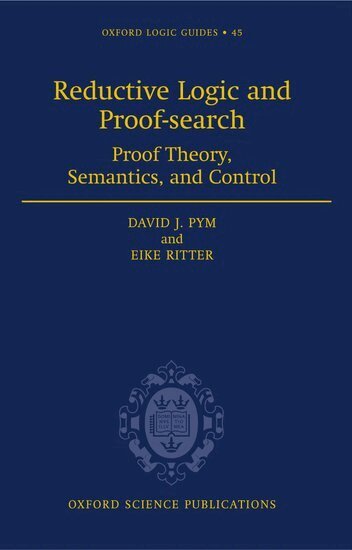
Reductive Logic and Proof-search
Proof Theory, Semantics, and Control
Inbunden, Engelska, 2004
2 329 kr
Skickas inom 5-8 vardagar
This book is a specialized monograph on the development of the mathematical and computational metatheory of reductive logic and proof-search, areas of logic that are becoming important in computer science. A systematic foundational text on these emerging topics, it includes proof-theoretic, semantic/model-theoretic and algorithmic aspects. The scope ranges from the conceptual background to reductive logic, through its mathematical metatheory, to its modern applications in the computational sciences.Suitable for researchers and graduate students in mathematical, computational and philosophical logic, and in theoretical computer science and artificial intelligence, this is the latest in the prestigous world-renowned Oxford Logic Guides, which contains Michael Dummet's Elements of intuitionism (2nd Edition), Dov M. Gabbay, Mark A. Reynolds, and Marcelo Finger's Temporal Logic Mathematical Foundations and Computational Aspects , J. M. Dunn and G. Hardegree's Algebraic Methods in Philosophical Logic, H. Rott's Change, Choice and Inference: A Study of Belief Revision and Nonmonotonic Reasoning , and P. T. Johnstone's Sketches of an Elephant: A Topos Theory Compendium: Volumes 1 and 2 .
Del 26 - Applied Logic Series
Semantics and Proof Theory of the Logic of Bunched Implications
Inbunden, Engelska, 2002
1 626 kr
Skickas inom 10-15 vardagar
This is a monograph about logic. Specifically, it presents the mathe matical theory of the logic of bunched implications, BI: I consider Bl's proof theory, model theory and computation theory. However, the mono graph is also about informatics in a sense which I explain. Specifically, it is about mathematical models of resources and logics for reasoning about resources. I begin with an introduction which presents my (background) view of logic from the point of view of informatics, paying particular attention to three logical topics which have arisen from the development of logic within informatics: • Resources as a basis for semantics; • Proof-search as a basis for reasoning; and • The theory of representation of object-logics in a meta-logic. The ensuing development represents a logical theory which draws upon the mathematical, philosophical and computational aspects of logic. Part I presents the logical theory of propositional BI, together with a computational interpretation. Part II presents a corresponding devel opment for predicate BI. In both parts, I develop proof-, model- and type-theoretic analyses. I also provide semantically-motivated compu tational perspectives, so beginning a mathematical theory of resources. I have not included any analysis, beyond conjecture, of properties such as decidability, finite models, games or complexity. I prefer to leave these matters to other occasions, perhaps in broader contexts.
Del 26 - Applied Logic Series
Semantics and Proof Theory of the Logic of Bunched Implications
Häftad, Engelska, 2010
1 633 kr
Skickas inom 10-15 vardagar
This is a monograph about logic. Specifically, it presents the mathe matical theory of the logic of bunched implications, BI: I consider Bl's proof theory, model theory and computation theory. However, the mono graph is also about informatics in a sense which I explain. Specifically, it is about mathematical models of resources and logics for reasoning about resources. I begin with an introduction which presents my (background) view of logic from the point of view of informatics, paying particular attention to three logical topics which have arisen from the development of logic within informatics: • Resources as a basis for semantics; • Proof-search as a basis for reasoning; and • The theory of representation of object-logics in a meta-logic. The ensuing development represents a logical theory which draws upon the mathematical, philosophical and computational aspects of logic. Part I presents the logical theory of propositional BI, together with a computational interpretation. Part II presents a corresponding devel opment for predicate BI. In both parts, I develop proof-, model- and type-theoretic analyses. I also provide semantically-motivated compu tational perspectives, so beginning a mathematical theory of resources. I have not included any analysis, beyond conjecture, of properties such as decidability, finite models, games or complexity. I prefer to leave these matters to other occasions, perhaps in broader contexts.
E-bok
PDF, Engelska, 20131 977 kr
Läs direkt efter köp
This is a monograph about logic. Specifically, it presents the mathe matical theory of the logic of bunched implications, BI: I consider Bl''s proof theory, model theory and computation theory. However, the mono graph is also about informatics in a sense which I explain. Specifically, it is about mathematical models of resources and logics for reasoning about resources. I begin with an introduction which presents my (background) view of logic from the point of view of informatics, paying particular attention to three logical topics which have arisen from the development of logic within informatics: • Resources as a basis for semantics; • Proof-search as a basis for reasoning; and • The theory of representation of object-logics in a meta-logic. The ensuing development represents a logical theory which draws upon the mathematical, philosophical and computational aspects of logic. Part I presents the logical theory of propositional BI, together with a computational interpretation. Part II presents a corresponding devel opment for predicate BI. In both parts, I develop proof-, model- and type-theoretic analyses. I also provide semantically-motivated compu tational perspectives, so beginning a mathematical theory of resources. I have not included any analysis, beyond conjecture, of properties such as decidability, finite models, games or complexity. I prefer to leave these matters to other occasions, perhaps in broader contexts.