David Lhuillier – författare
Visar alla böcker från författaren David Lhuillier. Handla med fri frakt och snabb leverans.
6 produkter
6 produkter
Inbunden, Engelska, 2005
1 834 kr
Skickas inom 10-15 vardagar
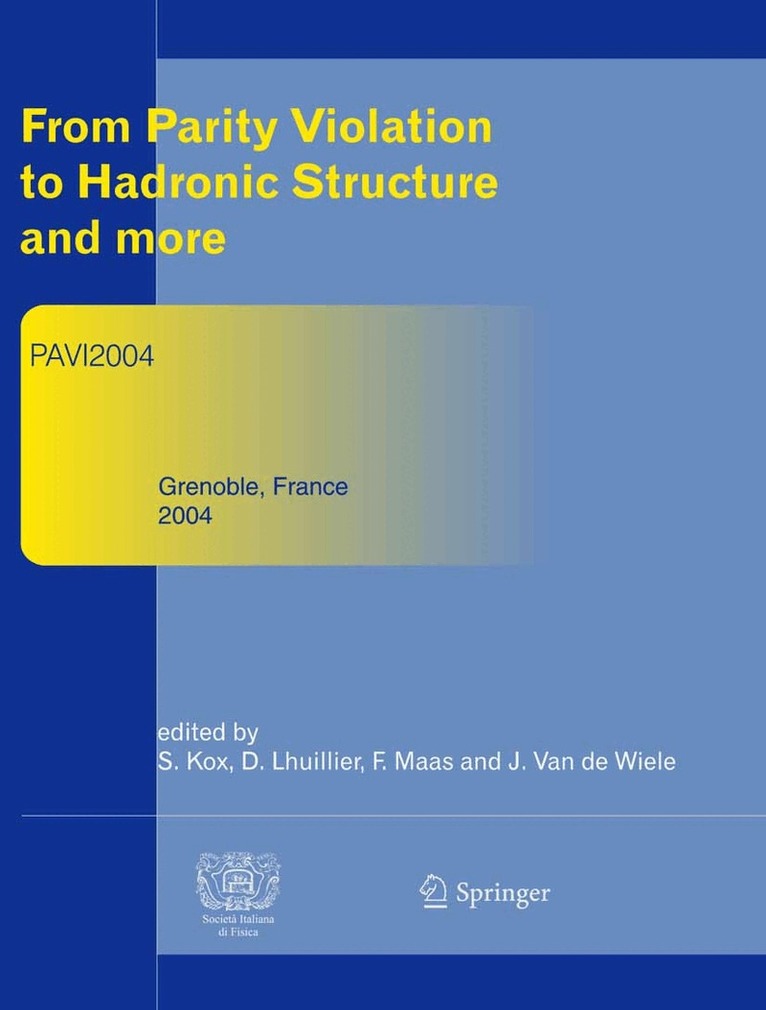
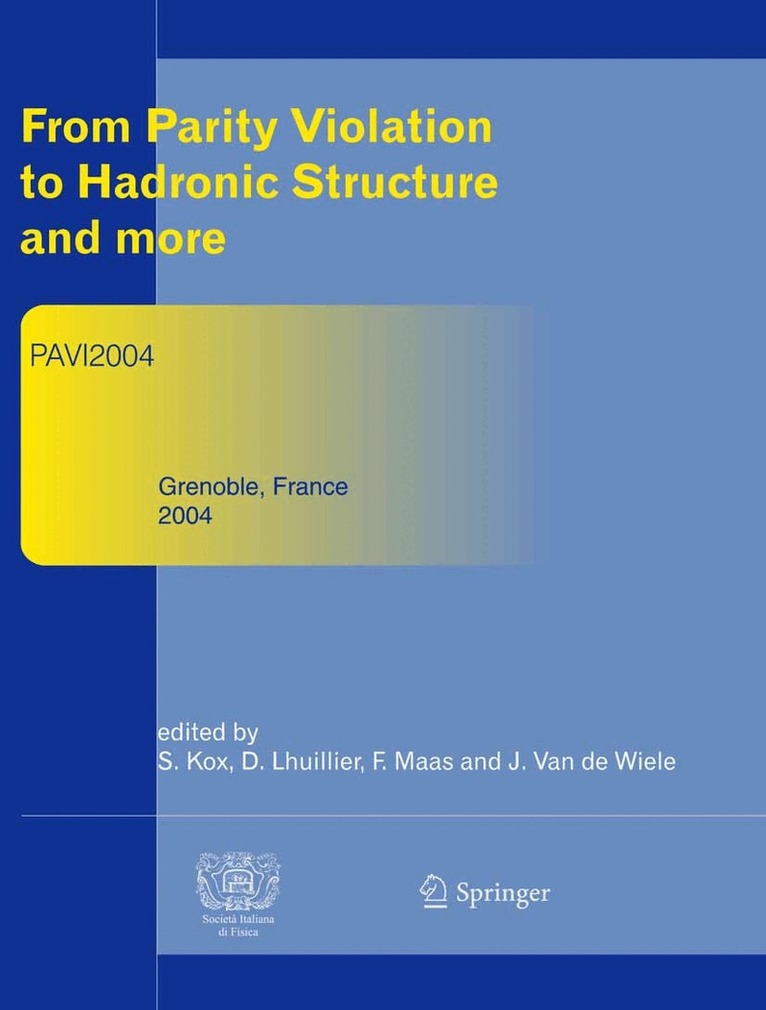
This volume contains the selected and refereed papers from a new series of regularly held meetings on the fundamental issues and applications of parity violation in nuclear and particle physics.
E-bok
PDF, Engelska, 20072 283 kr
Läs direkt efter köp
Almost 50 years after the proposal of Lee and Young in 1956 to test the hypothesis of parity violation in weak interactions and the subsequent experimental verification of parity violation by C. S. Wu, parity violation has today become a useful property of weak interactions. This is due to the fact that the focus nowadays has changed: parity violation in weak interactions is no more a topic of investigation but is used as a tool in many different fields ranging from nuclear physics to the search for the hidden extra dimensions requested by string theory. For our first workshop which took place June 5-8, 2002, at the Institut fiir Ke- physik of the Johannes Gutenberg-Universitat Mainz, we concentrated on the in vestigation of the strangeness contribution in the nucleon. This book contains the refereed and selected papers of the second workshop "From Parity Violation to Hadron Structure and more (Part II)", which took place June 8-11, in the Labo- toire de Physique Subatomique et de Cosmologie, in Grenoble. These papers appear in EPJAdirect, the electronic-only part of EPJA, and they are accessible without restrictions. They will also appear in printed form and can be ordered through Springer. The excellent presentations show the dramatic and steady progress in the accuracy of measured parity violating asymmetries over the last few years.
Inbunden, Engelska, 2007
1 082 kr
Skickas inom 10-15 vardagar
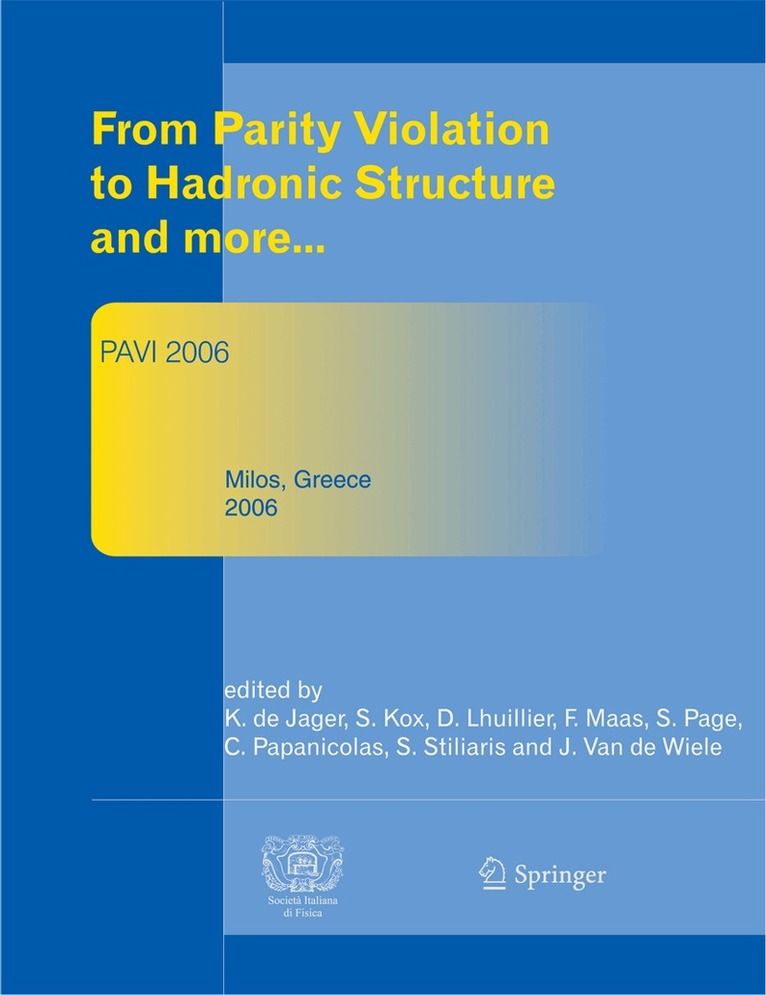
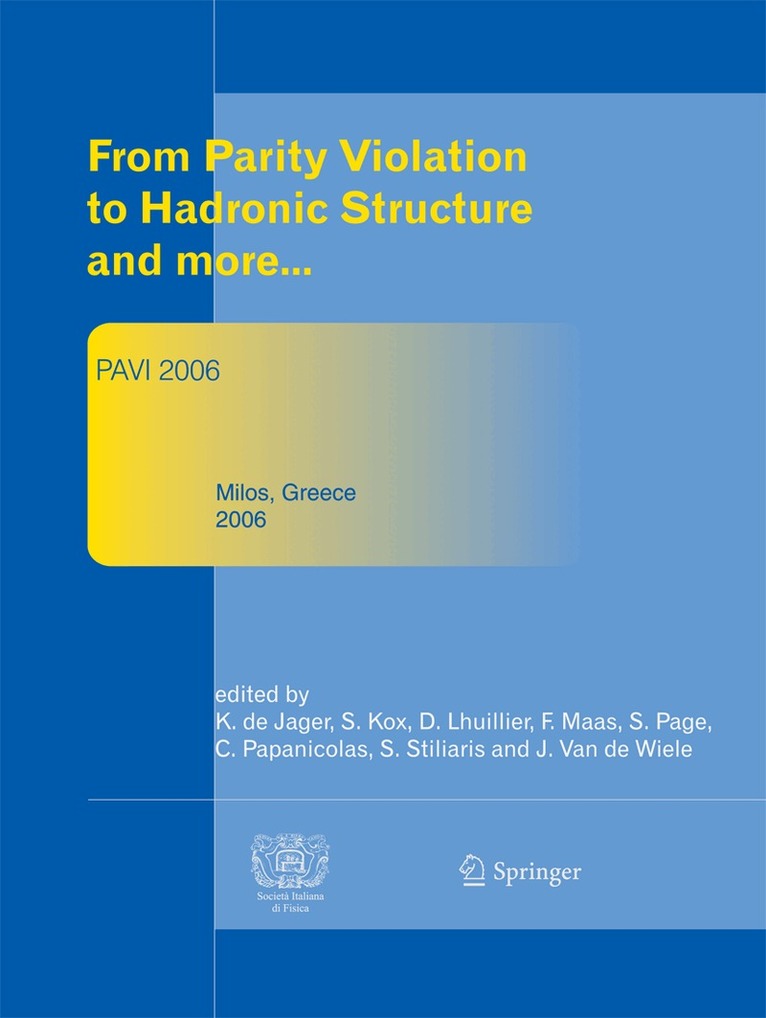
c Societ` a Italiana di Fisica / Springer-Verlag 2007 The third workshopFrom Parity Violation to Hadronic Structure and more ... was held from May 16 to May 20, 2006, at the George Eliopoulos conference center on the Greek island of Milos. It is part of a series that started in Mainz in 2002 and was followed by a second workshop in Grenoble in 2004. While originally initiated by the extraction of the strangeness contribution to the electromagnetic form factors of the nucleon, we have continuously broadened the focus of this workshop series to the application of parity violation usinghadronicprobesandtoparityviolation experimentsinatomicphysics.Meanwhiletherehavebeenmanyexciting new proposals for using parity violation in other areas like in the search for new physics beyond the standard model or in exploring hadron structure. There are also close connections to the open question on the size of the two-photon exchange amplitude. Fifty years after the 1956 proposal of Lee and Yang to test the hypothesis of violation of parity symmetry in the weak interaction, the many applications of parity violation in very di?erent experiments are way beyond the scope of what Lee and Yang could have imagined. For the physics topics discussed during this workshop, the application of parity violation has become a standard workhorse that allows to extract many physics topics in di?erent experiments.
E-bok
PDF, Engelska, 20081 367 kr
Läs direkt efter köp
c Societ` a Italiana di Fisica / Springer-Verlag 2007 The third workshopFrom Parity Violation to Hadronic Structure and more ... was held from May 16 to May 20, 2006, at the George Eliopoulos conference center on the Greek island of Milos. It is part of a series that started in Mainz in 2002 and was followed by a second workshop in Grenoble in 2004. While originally initiated by the extraction of the strangeness contribution to the electromagnetic form factors of the nucleon, we have continuously broadened the focus of this workshop series to the application of parity violation usinghadronicprobesandtoparityviolation experimentsinatomicphysics.Meanwhiletherehavebeenmanyexciting new proposals for using parity violation in other areas like in the search for new physics beyond the standard model or in exploring hadron structure. There are also close connections to the open question on the size of the two-photon exchange amplitude. Fifty years after the 1956 proposal of Lee and Yang to test the hypothesis of violation of parity symmetry in the weak interaction, the many applications of parity violation in very di?erent experiments are way beyond the scope of what Lee and Yang could have imagined. For the physics topics discussed during this workshop, the application of parity violation has become a standard workhorse that allows to extract many physics topics in di?erent experiments.
Häftad, Engelska, 2010
1 834 kr
Skickas inom 10-15 vardagar
This volume contains the selected and refereed papers from a new series of regularly held meetings on the fundamental issues and applications of parity violation in nuclear and particle physics.
Häftad, Engelska, 2014
1 082 kr
Skickas inom 10-15 vardagar
c Societ` a Italiana di Fisica / Springer-Verlag 2007 The third workshopFrom Parity Violation to Hadronic Structure and more ... was held from May 16 to May 20, 2006, at the George Eliopoulos conference center on the Greek island of Milos. It is part of a series that started in Mainz in 2002 and was followed by a second workshop in Grenoble in 2004. While originally initiated by the extraction of the strangeness contribution to the electromagnetic form factors of the nucleon, we have continuously broadened the focus of this workshop series to the application of parity violation usinghadronicprobesandtoparityviolation experimentsinatomicphysics.Meanwhiletherehavebeenmanyexciting new proposals for using parity violation in other areas like in the search for new physics beyond the standard model or in exploring hadron structure. There are also close connections to the open question on the size of the two-photon exchange amplitude. Fifty years after the 1956 proposal of Lee and Yang to test the hypothesis of violation of parity symmetry in the weak interaction, the many applications of parity violation in very di?erent experiments are way beyond the scope of what Lee and Yang could have imagined. For the physics topics discussed during this workshop, the application of parity violation has become a standard workhorse that allows to extract many physics topics in di?erent experiments.