David M. Glover - Böcker
Visar alla böcker från författaren David M. Glover. Handla med fri frakt och snabb leverans.
3 produkter
3 produkter
535 kr
Skickas inom 10-15 vardagar
1 064 kr
Skickas inom 10-15 vardagar
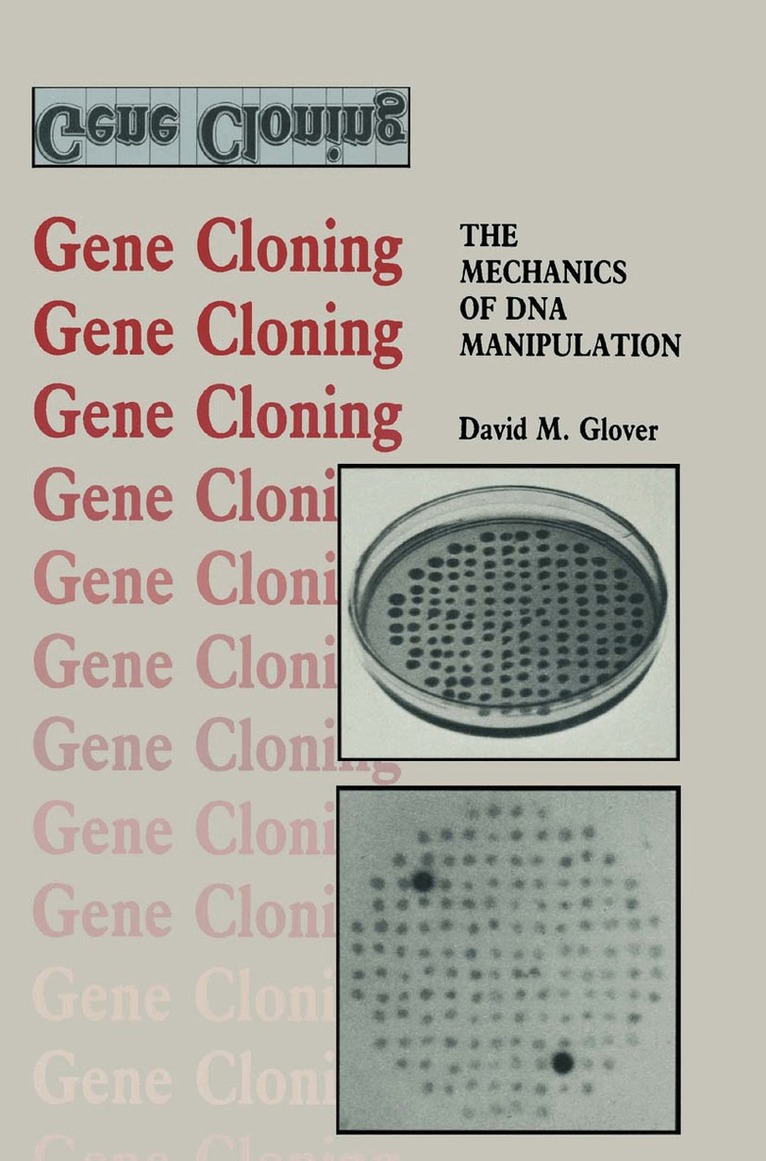
This book was originallyconceived in the form ofa second edition ofa volume published in 1980 in Chapman and Hall's 'OutllneStudies in Biology' series and entitled Genetic Engineering - Cloning DNA.It very rapidly became apparent that with the impact ofrecombinant DNA techniques being feIt in so many areas ofblology, it was going to be difficultifnotimpossible to keepthe bookwithin the space confines of these little monographs. The stays were therefore loosened and the book expanded comfortably to its present size.I hope that this extra space has allowed me to clarify sections ofthe text that were 'heavy going' in the earlierversion.Theextraspace has certainlyallowed me to cover topics that were not mentioned at all in the earlier book. These are primarily to be found in Chapters 7 and 8, which cover the rapid advances that have been recently made in the use ofplantand animal cells as hosts for recombinant DNAmolecules. The develop- ment ofother vectors has certainly not stood still over the past four years.This has necessitated a thorough revision ofChapters 3 and 4, which deal with bacteriophage and bacterial plasmid vectors.Numerous techniques for in vitromutagenesis have now been tried and tested allowing me to givecomprehensive coverage ofthisarea in Chapter 2 along with the biochemical techniques used to construct recombinant DNA molecules. Readers with some background knowledge of the approaches to gene cloning will be able to go straight toapart ofthe book in whichthey are specificallyinterested.
1 021 kr
Skickas inom 7-10 vardagar
This advanced textbook on modeling, data analysis and numerical techniques for marine science has been developed from a course taught by the authors for many years at the Woods Hole Oceanographic Institute. The first part covers statistics: singular value decomposition, error propagation, least squares regression, principal component analysis, time series analysis and objective interpolation. The second part deals with modeling techniques: finite differences, stability analysis and optimization. The third part describes case studies of actual ocean models of ever increasing dimensionality and complexity, starting with zero-dimensional models and finishing with three-dimensional general circulation models. Throughout the book hands-on computational examples are introduced using the MATLAB programming language and the principles of scientific visualization are emphasised. Ideal as a textbook for advanced students of oceanography on courses in data analysis and numerical modeling, the book is also an invaluable resource for a broad range of scientists undertaking modeling in chemical, biological, geological and physical oceanography.