David M. Levy – författare
Visar alla böcker från författaren David M. Levy. Handla med fri frakt och snabb leverans.
14 produkter
14 produkter
E-bok
Engelska, 2016150 kr
Läs direkt efter köp
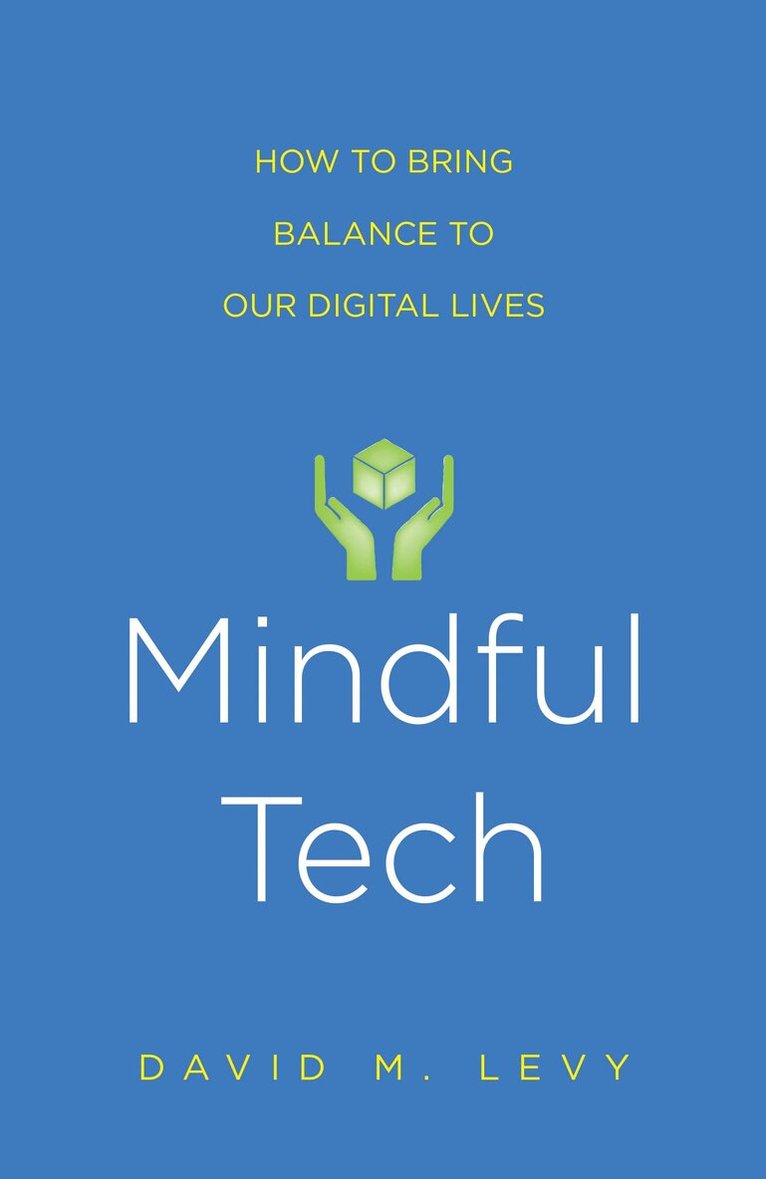
From email to smart phones, and from social media to Google searches, digital technologies have transformed the way we learn, entertain ourselves, socialize, and work. Despite their usefulness, these technologies have often led to information overload, stress, and distraction. In recent years many of us have begun to look at the pluses and minuses of our online lives and to ask how we might more skillfully use the tools we’ve developed.  David M. Levy, who has lived his life between the “fast world” of high tech and the “slow world” of contemplation, offers a welcome guide to being more relaxed, attentive, and emotionally balanced, and more effective, while online. In a series of exercises carefully designed to help readers observe and reflect on their own use, Levy has readers watch themselves closely while emailing and while multitasking, and also to experiment with unplugging for a specified period. Never prescriptive, the book opens up new avenues for self-inquiry and will allow readers—in the workplace, in the classroom, and in the privacy of their homes—to make meaningful and powerful changes.
Häftad, Engelska, 2017
262 kr
Skickas inom 3-6 vardagar
Through a series of lucid and engaging exercises, readers are invited to discover healthier and more effective digital practicesFrom email to smart phones, and from social media to Google searches, digital technologies have transformed the way we learn, entertain ourselves, socialize, and work. Despite their usefulness, these technologies have often led to information overload, stress, and distraction. In recent years many of us have begun to look at the pluses and minuses of our online lives and to ask how we might more skillfully use the tools we’ve developed. David M. Levy, who has lived his life between the “fast world” of high tech and the “slow world” of contemplation, offers a welcome guide to being more relaxed, attentive, and emotionally balanced, and more effective, while online. In a series of exercises carefully designed to help readers observe and reflect on their own use, Levy has readers watch themselves closely while emailing and while multitasking, and also to experiment with unplugging for a specified period. Never prescriptive, the book opens up new avenues for self-inquiry and will allow readers—in the workplace, in the classroom, and in the privacy of their homes—to make meaningful and powerful changes.
Inbunden, Engelska, 2008
1 195 kr
Skickas inom 5-8 vardagar
Adam Smith, asserting the common humanity of the street porter and the philosopher, articulated the classical economists' model of social interactions as exchanges among equals. This model had largely fallen out of favor until, recently, a number of scholars in the avant-garde of economic thought rediscovered it and rechristened it "analytical egalitarianism." In this volume, Sandra J. Peart and David M. Levy bring together an impressive array of authors to explore the ramifications of this analytical ideal and to discuss the ways in which an egalitarian theory of individuality can enable economists to reconcile ideas from opposite ends of the political spectrum."The analytical egalitarianism project that Peart and Levy have advanced has come to occupy a prominent place in the current agenda of historians of economic thought."---Ross Emmett, Associate Professor of Economics and Co-Director of the Michigan Center for Innovation and Economic Prosperity, Michigan State University"These essays and dialogs from the Summer Institute would make Adam Smith, economist and moral philosopher, proud."---J. Daniel Hammond, Hultquist Family Professor of Economics, Wake Forest UniversityWith essays by:James M. Buchanan, Alfred Nobel Memorial Prize in Economic Sciences recipient (1985) and Professor Emeritus, George Mason University and Virginia Polytechnic and State University Juan Pablo Couyoumdijian, Universidad del Desearrollo, Chile Tyler Cowen, George Mason University Eric Crampton, University of Canterbury, New Zealand Andrew Farrant, Dickinson College Samuel Hollander, Professor Emeritus, University of Toronto M. Ali Khan, Johns Hopkins University Thomas Leonard, Princeton University Deirdre McCloskey, University of Illinois, Chicago Leonidas Montes, Dean of School of Government, Universidad Adolfo Ibañez, Chile Maria Pia Paganelli, Yeshiva University and New York University Warren J. Samuels, Professor Emeritus, Michigan State University Eric Schliesser, VENI post-doctoral research fellow, Leiden University, and University of Amsterdam Gordon Tullock, George Mason UniversitySandra J. Peart is Dean of the Jepson School of Leadership Studies, University of Richmond, Virginia.David M. Levy is Professor of Economics at George Mason University (GMU) and Research Associate at the Center for Study of Public Choice at GMU.They are Co-Directors of George Mason University's Summer Institute for the Preservation of the History of Economics.
Inbunden, Engelska, 2016
1 397 kr
Skickas inom 7-10 vardagar
The orthodox view of economic policy holds that public deliberation sets the goals or ends, and then experts select the means to implement these goals. This assumes that experts are no more than trustworthy servants of the public interest. David M. Levy and Sandra J. Peart examine the historical record to consider cases in which experts were trusted with disastrous results, such as eugenics, the regulatory use of security ratings, and central economic planning. This history suggests that experts have not only the public interest but also their own interests to consider. The authors then recover and extend an alternative view of economic policy that subjects experts' proposals to further discussion, resulting in transparency and ensuring that the public obtains the best insights of experts in economics while avoiding pitfalls such as expert bias.
Inbunden, Engelska, 2020
1 464 kr
Skickas inom 7-10 vardagar
The Virginia School's economics of natural equals makes consent critical for policy. Democracy is understood as government by discussion, not majority rule. The claim of efficiency unsupported by consent, as common in orthodox economics, appeals to social hierarchy. Politics becomes an act of exchange among equals where the economist is only entitled to offer advice to citizens, not to dictators. The foundation of natural equality and consent explains the common themes of James Buchanan and John Rawls as well as Ronald Coase and the Fabian socialists. What orthodox economics treats as efficient racial discrimination violates the fair chance entitlement to which people consent in a market economy. The importance of replication stressed by Gordon Tullock, developing themes from Karl Popper, is another expression of natural equality since the foresight of replication induces care into research. The publication of previously unpublished correspondence and documentation allows the reader to judge recent controversy.
Häftad, Engelska, 2016
352 kr
Skickas inom 7-10 vardagar
The orthodox view of economic policy holds that public deliberation sets the goals or ends, and then experts select the means to implement these goals. This assumes that experts are no more than trustworthy servants of the public interest. David M. Levy and Sandra J. Peart examine the historical record to consider cases in which experts were trusted with disastrous results, such as eugenics, the regulatory use of security ratings, and central economic planning. This history suggests that experts have not only the public interest but also their own interests to consider. The authors then recover and extend an alternative view of economic policy that subjects experts' proposals to further discussion, resulting in transparency and ensuring that the public obtains the best insights of experts in economics while avoiding pitfalls such as expert bias.
E-bok
Engelska, 2016429 kr
Läs direkt efter köp
The orthodox view of economic policy holds that public deliberation sets the goals or ends, and then experts select the means to implement these goals. This assumes that experts are no more than trustworthy servants of the public interest. David M. Levy and Sandra J. Peart examine the historical record to consider cases in which experts were trusted with disastrous results, such as eugenics, the regulatory use of security ratings, and central economic planning. This history suggests that experts have not only the public interest but also their own interests to consider. The authors then recover and extend an alternative view of economic policy that subjects experts'' proposals to further discussion, resulting in transparency and ensuring that the public obtains the best insights of experts in economics while avoiding pitfalls such as expert bias.
E-bok
PDF, Engelska, 2016425 kr
Läs direkt efter köp
The orthodox view of economic policy holds that public deliberation sets the goals or ends, and then experts select the means to implement these goals. This assumes that experts are no more than trustworthy servants of the public interest. David M. Levy and Sandra J. Peart examine the historical record to consider cases in which experts were trusted with disastrous results, such as eugenics, the regulatory use of security ratings, and central economic planning. This history suggests that experts have not only the public interest but also their own interests to consider. The authors then recover and extend an alternative view of economic policy that subjects experts'' proposals to further discussion, resulting in transparency and ensuring that the public obtains the best insights of experts in economics while avoiding pitfalls such as expert bias.
Häftad, Engelska, 2008
161 kr
Skickas inom 5-8 vardagar
Inbunden, Engelska, 2008
315 kr
Skickas inom 5-8 vardagar
Häftad, Engelska
406 kr
Skickas inom 3-6 vardagar
E-bok
Engelska, 201279 kr
Läs direkt efter köp
We are surrounded by documents of all kinds, from receipts to letters, business memos to books, yet we rarely stop to reflect on their significance. Now, in this period of digital transition, our written forms as well as out reading and writing habits are being questioned and transformed by new technologies ad practices. What is the future of the book? Is paper about to disappear? With the Internet and World Wide Web, what will happen to libraries, copyright and education? Starting with a simple deli lunch receipt, SCROLLING FORWARD examines documents of all kinds from the perspectives of culture, history, and technology in order to show how they can work and what they say about us and the values we carry into the new age.
164 kr
Läs direkt efter köp
A fascinating, insightful, and wonderfully written exploration of the document.Like Henry Petroski’s The Pencil, David Levy’s Scrolling Forward takes a common, everyday object, the document, and illuminates what it reveals about us, both in the past and in the digital age.We are surrounded daily by documents of all kinds—letters and credit card receipts, business memos and books, television images and web pages—yet we rarely stop to reflect on their significance. Now, in this period of digital transition, our written forms as well as our reading and writing habits are being disturbed and transformed by new technologies and practices.An expert on information and written forms, and a former researcher for the document pioneer Xerox, Levy masterfully navigates these concerns, offering reassurance while sharing his own excitement about many of the new kinds of emerging documents. He demonstrates how today’s technologies, particularly the personal computer and the World Wide Web, are having analogous effects to past inventions—such as paper, the printing press, writing implements, and typewriters—in shaping how we use documents and the forms those documents take. Scrolling Forward lets us see the continuity between the written forms of today and those of the past.Skyhorse Publishing, as well as our Arcade imprint, are proud to publish a broad range of books for readers interested in history--books about World War II, the Third Reich, Hitler and his henchmen, the JFK assassination, conspiracies, the American Civil War, the American Revolution, gladiators, Vikings, ancient Rome, medieval times, the old West, and much more. While not every title we publish becomes a New York Times bestseller or a national bestseller, we are committed to books on subjects that are sometimes overlooked and to authors whose work might not otherwise find a home.
E-bok
Spanska, 201679 kr
Läs direkt efter köp
Desde el correo electrónico hasta los smartphones, y desde los medios sociales hasta las búsquedas en Google, las tecnologías digitales han transformado nuestra forma de aprender, entretenernos, socializar y trabajar. A pesar de su utilidad, estas tecnologías han conducido a menudo al exceso de información, al estrés y a la distracción. En los últimos años, muchos de nosotros hemos comenzado a sopesar los pros y los contras de nuestras vidas en línea, y a preguntarnos cómo podríamos utilizar con más destreza las herramientas que hemos desarrollado. David M. Levy, que ha vivido siempre a caballo entre el "mundo rápido" de la alta tecnología y el "mundo lento" de la contemplación, ofrece una oportuna guía para estar más relajados, atentos y emocionalmente equilibrados mientras estemos conectados. En una serie de ejercicios cuidadosamente diseñados para ayudar a los lectores a observar y reflexionar sobre su propio uso, Levy nos invita a observarnos mientras utilizamos el correo electrónico o ejercitamos la multitarea, así como a experimentar con la desconexión durante un período determinado. Nunca prescriptivo, el libro abre nuevas sendas para investigarnos a nosotros mismos, y permitirá a los lectores realizar cambios significativos y poderosos en su lugar de trabajo, en el aula y en la intimidad de su hogar.