David M. Rasmussen - Böcker
Visar alla böcker från författaren David M. Rasmussen. Handla med fri frakt och snabb leverans.
7 produkter
7 produkter
493 kr
Skickas inom 7-10 vardagar
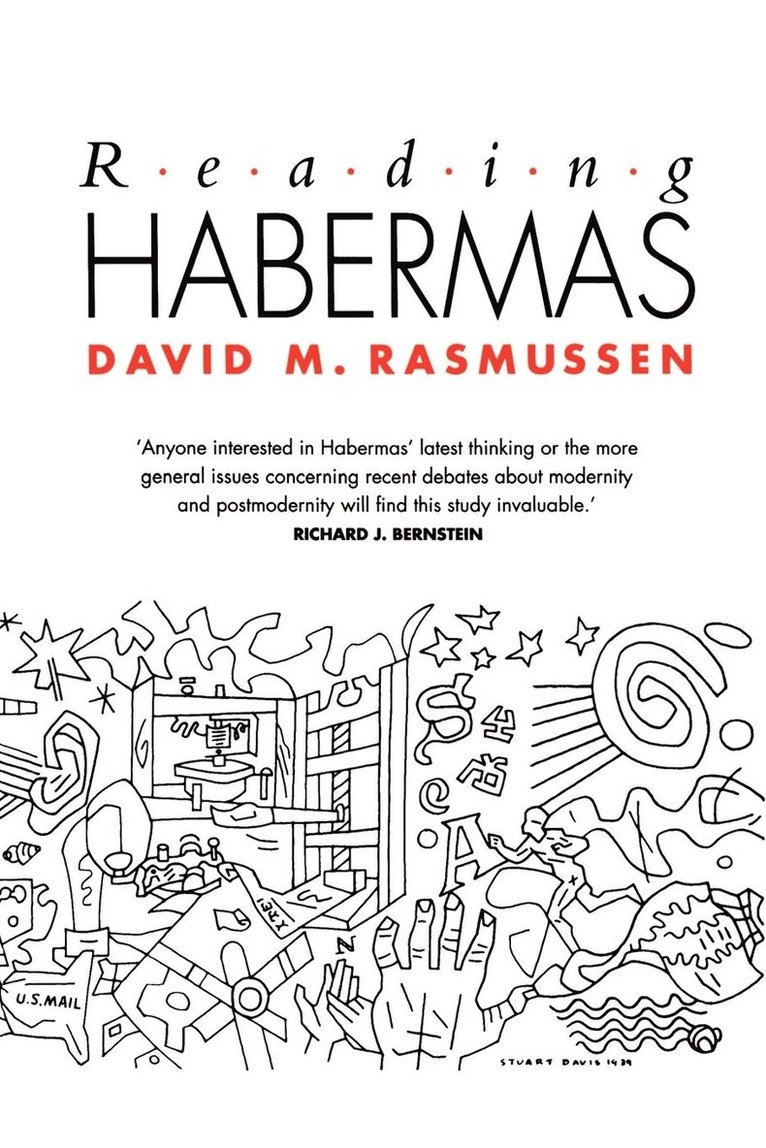
In the past decade the work of Jurgen Habermas has sparked off a series of lively debates over modernity and post-modernity, the nature of language, the interplay of law and politics and the dilemmas of morality. Significantly, these debates unfold in the context of his particular reading of the modern philosophical tradition from the German enlightment to the present period.In this original interpretation, David Rasmussen provides both guide and critique to the later Habermas encountered in the context of the best of the critical literature that has emerged in recent years. Reading Habermas argues that Habermas' concept of modernity provides the context for the theory of language as well as his approaches to law and ethics.This book, as its title implies, offers a reading. It explores philosophical options chosen in the light of other, rejected readings. It is a distinctive, readable contribution to the current controversy surrounding the most recent developments in critical theory.
1 714 kr
Skickas inom 7-10 vardagar
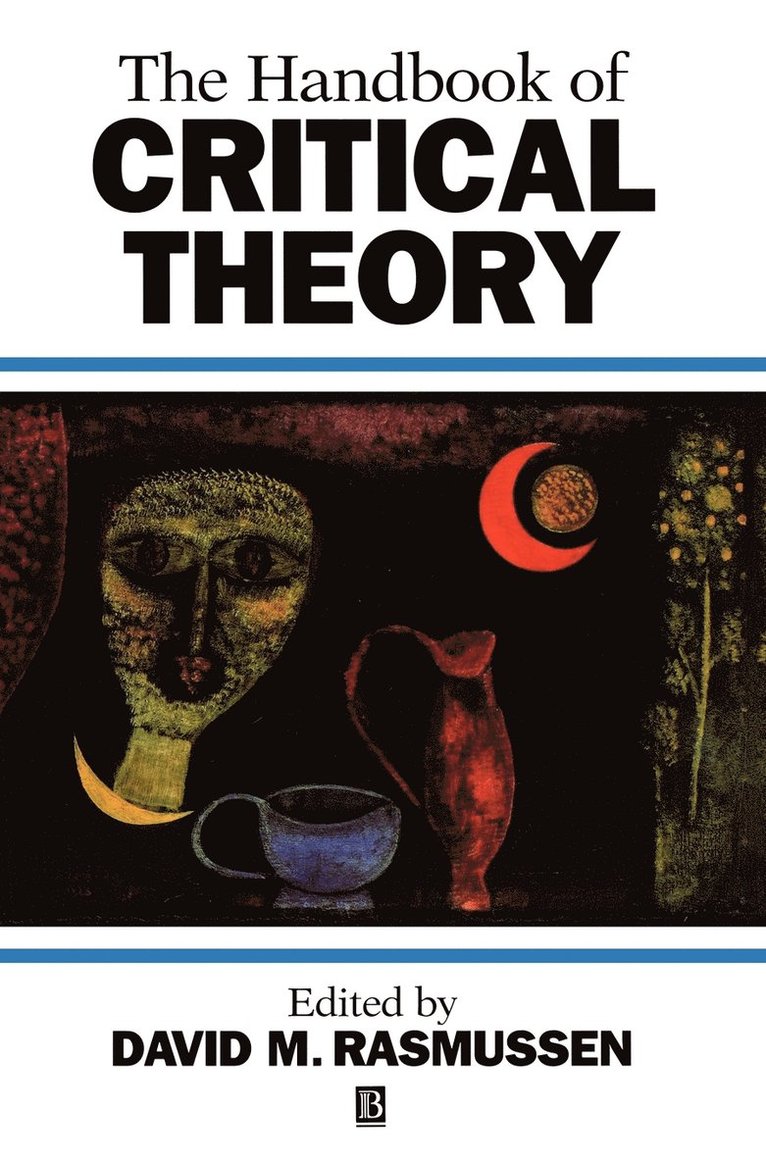
The Handbook of Critical Theory brings together for the first time a detailed examination of the state of critical theory today. The fifteen essays provide analyses of the various orientations which critical theory has taken both historically and systematically in recent years, expositions of the new perspectives which have begun to shape the field, and reflections upon the direction of critical theory.
620 kr
Skickas inom 7-10 vardagar
The Handbook of Critical Theory brings together for the first time a detailed examination of the state of critical theory today. The fifteen essays provide analyses of the various orientations which critical theory has taken both historically and systematically in recent years, expositions of the new perspectives which have begun to shape the field, and reflections upon the direction of critical theory.
519 kr
Skickas inom 7-10 vardagar
This comprehensive anthology provides a collection of classic and contemporary readings in continental aesthetics. Spanning Romanticism through Modernism to Postmodernism, the volume includes landmark texts that have sparked renewed interest in aesthetics, including works by Schiller, Kant, Nietzsche, Hegel, Heidegger, Sartre, Luk?cs, Habermas, Foucault, Kristeva, and Derrida.
Mythic-Symbolic Language and Philosophical Anthropology
A Constructive Interpretation of the Thought of Paul Ricœur
Häftad, Engelska, 1971
1 096 kr
Skickas inom 10-15 vardagar
This book will attempt to achieve a constructive and positive correla tion between mythic-symbolic language and philosophical anthropolo gy. It is intended as a reflection on the philosophical accomplishment of Paul Ricoeur. The term mythic-symbolic language in this context means the language of the multivalent symbol given in the myth with its psychological and poetic counterparts. The term symbol is not con ceived as an abstract sign as it is used in symbolic logic, but rather as a concrete phenomenon - religious, psychological, and poetic. The task inherent in this correlation is monumental when one considers the dual dilemma of problematic and possibility which is at its heart. The prob lematic arises out of the apparent difficulty presented by the so-called challenge of modernity which seems to require the elimination of my thic-symbolic language as an intelligible mode of communication. Mythic-symbolic language is sometimes eliminated because in a world molded by abstract conceptualizations conceptUalizations of science, such a language is thought to be unintelligible. The claim is that its "primitive" explana tions have been transcended by our modernity. Others believe that the problem of mythic-symbolic language is the problem of the myth. If the mythic forms of language could be eliminated, the truth of such language could be preserved through its translation into an intelligible mode of discourse. The problematic is heightened further by the relation of consider ations of language to philosophical anthropology.
Mythic-Symbolic Language and Philosophical Anthropology
A Constructive Interpretation of the Thought of Paul Ricœur
Häftad, Engelska, 1971
552 kr
Skickas inom 10-15 vardagar
This book will attempt to achieve a constructive and positive correla tion between mythic-symbolic language and philosophical anthropolo gy. It is intended as a reflection on the philosophical accomplishment of Paul Ricoeur. The term mythic-symbolic language in this context means the language of the multivalent symbol given in the myth with its psychological and poetic counterparts. The term symbol is not con ceived as an abstract sign as it is used in symbolic logic, but rather as a concrete phenomenon - religious, psychological, and poetic. The task inherent in this correlation is monumental when one considers the dual dilemma of problematic and possibility which is at its heart. The prob lematic arises out of the apparent difficulty presented by the so-called challenge of modernity which seems to require the elimination of my thic-symbolic language as an intelligible mode of communication. Mythic-symbolic language is sometimes eliminated because in a world molded by abstract conceptualizations of science, such a language is thought to be unintelligible. The claim is that its "primitive" explana tions have been transcended by our modernity. Others believe that the problem of mythic-symbolic language is the problem of the myth. If the mythic forms of language could be eliminated, the truth of such language could be preserved through its translation into an intelligible mode of discourse. The problematic is heightened further by the relation of consider ations of language to philosophical anthropology. Any consideration of language involves a related view of the nature of man.
552 kr
Skickas inom 10-15 vardagar
For the past four or five years much of my thinking has centered up on the relationship of symbolic forms to philosophic imagination ,and interpretation. As one whose own philosophic speculations began at. the end of a cultural epoch under methodologies dominated either by neo-Kantianism or schools of logical empiricism the symbol as a prod uct of a cultural imagination has been diminished; it has been neces sary for those who wanted to preserve the symbol to find appropriate philosophical methodologies to do so. In the following chapters we shall attempt to show, through a consideration of a series of recent interpretations of the symbol, as well as through constructive argu ment, that the symbol ought to be considered as a linguistic form in the sense that it constitutes a special language with its own rubrics and properties. There are two special considerations to be taken ac count of in this argument; first, the definition of the symbol, and sec ond, the interpretation of the symbol. Although we shall refrain from defining the symbol explicitly at this point let it suffice to state that our definition of the symbol is more aesthetic than logical (in the technical sense of formal logic), more cultural than individual, more imaginative than scientific. The symbol in our view is somewhere at the center of culture, the well-spring which testifies to the human imagination in its poetic, . psychic, religious, social and political forms.