David Macarthur - Böcker
Visar alla böcker från författaren David Macarthur. Handla med fri frakt och snabb leverans.
8 produkter
8 produkter
1 192 kr
Skickas inom 7-10 vardagar
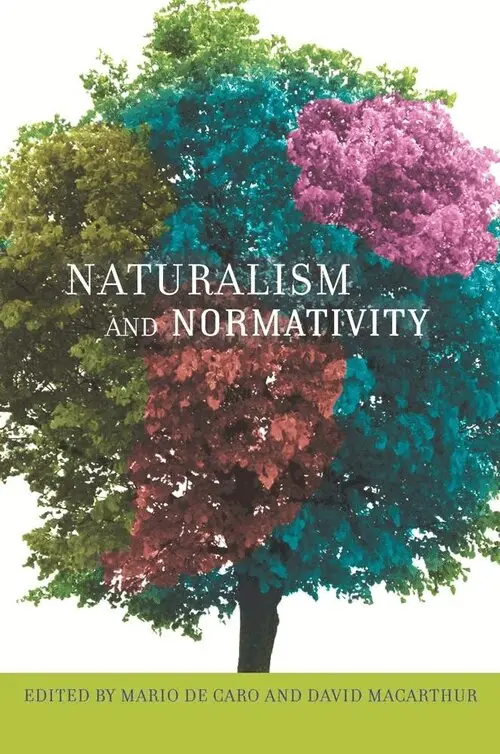
Normativity concerns what we ought to think or do and the evaluations we make. For example, we say that we ought to think consistently, we ought to keep our promises, or that Mozart is a better composer than Salieri. Yet what philosophical moral can we draw from the apparent absence of normativity in the scientific image of the world? For scientific naturalists, the moral is that the normative must be reduced to the nonnormative, while for nonnaturalists, the moral is that there must be a transcendent realm of norms. Naturalism and Normativity engages with both sides of this debate. Essays explore philosophical options for understanding normativity in the space between scientific naturalism and Platonic supernaturalism. They articulate a liberal conception of philosophy that is neither reducible to the sciences nor completely independent of them--yet one that maintains the right to call itself naturalism. Contributors think in new ways about the relations among the scientific worldview, our experience of norms and values, and our movements in the space of reason.Detailed discussions include the relationship between philosophy and science, physicalism and ontological pluralism, the realm of the ordinary, objectivity and subjectivity, truth and justification, and the liberal naturalisms of Donald Davidson, John Dewey, John McDowell, and Ludwig Wittgenstein.
636 kr
Skickas inom 3-6 vardagar
Normativity concerns what we ought to think or do and the evaluations we make. For example, we say that we ought to think consistently, we ought to keep our promises, or that Mozart is a better composer than Salieri. Yet what philosophical moral can we draw from the apparent absence of normativity in the scientific image of the world? For scientific naturalists, the moral is that the normative must be reduced to the nonnormative, while for nonnaturalists, the moral is that there must be a transcendent realm of norms. Naturalism and Normativity engages with both sides of this debate. Essays explore philosophical options for understanding normativity in the space between scientific naturalism and Platonic supernaturalism. They articulate a liberal conception of philosophy that is neither reducible to the sciences nor completely independent of them--yet one that maintains the right to call itself naturalism. Contributors think in new ways about the relations among the scientific worldview, our experience of norms and values, and our movements in the space of reason.Detailed discussions include the relationship between philosophy and science, physicalism and ontological pluralism, the realm of the ordinary, objectivity and subjectivity, truth and justification, and the liberal naturalisms of Donald Davidson, John Dewey, John McDowell, and Ludwig Wittgenstein.
526 kr
Skickas inom 10-15 vardagar
Today the majority of philosophers in the English-speaking world adhere to the "naturalist" credos that philosophy is continuous with science, and that the natural sciences provide a complete account of all that exists--whether human or nonhuman. The new faith says science, not man, is the measure of all things. However, there is a growing skepticism about the adequacy of this complacent orthodoxy. This volume presents a group of leading thinkers who criticize scientific naturalism not in the name of some form of supernaturalism, but in order to defend a more inclusive or liberal naturalism.The many prominent Anglo-American philosophers appearing in this book--Akeel Bilgrami, Stanley Cavell, Donald Davidson, John Dupré, Jennifer Hornsby, Erin Kelly, John McDowell, Huw Price, Hilary Putnam, Carol Rovane, Barry Stroud, and Stephen White--do not march in lockstep, yet their contributions demonstrate mutual affinities and various unifying themes. Instead of attempting to force human nature into a restricted scientific image of the world, these papers represent an attempt to place human nature at the center of renewed--but still scientifically respectful--conceptions of philosophy and nature.
707 kr
Skickas inom 10-15 vardagar
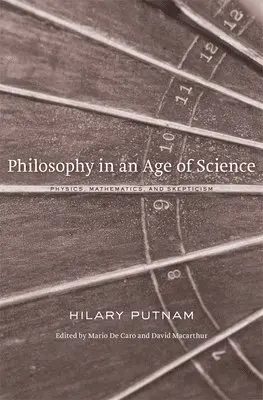
Hilary Putnam’s unceasing self-criticism has led to the frequent changes of mind he is famous for, but his thinking is also marked by considerable continuity. A simultaneous interest in science and ethics—unusual in the current climate of contention—has long characterized his thought. In Philosophy in an Age of Science, Putnam collects his papers for publication—his first volume in almost two decades.Mario De Caro and David Macarthur’s introduction identifies central themes to help the reader negotiate between Putnam past and Putnam present: his critique of logical positivism; his enduring aspiration to be realist about rational normativity; his anti-essentialism about a range of central philosophical notions; his reconciliation of the scientific worldview and the humanistic tradition; and his movement from reductive scientific naturalism to liberal naturalism. Putnam returns here to some of his first enthusiasms in philosophy, such as logic, mathematics, and quantum mechanics. The reader is given a glimpse, too, of ideas currently in development on the subject of perception.Putnam’s work, contributing to a broad range of philosophical inquiry, has been said to represent a “history of recent philosophy in outline.” Here it also delineates a possible future.
363 kr
Skickas inom 7-10 vardagar
A collection of Hilary Putnam’s stimulating, incisive responses to such varied and eminent thinkers as Richard Rorty, Jürgen Habermas, Noam Chomsky, Martha Nussbaum, W. V. Quine, Wilfrid Sellars, John McDowell, and Cornel West.Hilary Putnam (1926–2016) was renowned—some would say infamous—for changing his philosophical positions over the course of his long and much-admired career. This collection of essays, the first of its kind, showcases how his ideas evolved as he wrestled with the work of his contemporaries.Divided into five thematic sections, Philosophy as Dialogue begins with questions of language and formal logic, tracing Putnam’s reactions to the arguments of Wilfrid Sellars, Noam Chomsky, Charles Travis, and Tyler Burge. Next, it brings together Putnam’s responses to realists and antirealists, philosophers of science and of perception, followed by forays into pragmatism and skepticism. While Putnam devoted most of his efforts to logic, mathematics, and the philosophy of mind, he also took up issues in moral philosophy, politics, and religion. Here we read him in conversation with giants of these fields, including Martha Nussbaum, Jürgen Habermas, Elizabeth Anscombe, Cora Diamond, Richard Rorty, and Franz Rosenzweig. Finally, Philosophy as Dialogue presents Putnam’s deeply personal and largely unknown writing on philosophical method that reveals the influence of W. V. Quine, Michael Dummett, and Stanley Cavell on his work.Once more, Mario De Caro and David Macarthur have presented and introduced a choice selection of Hilary Putnam’s writings that will change the way he is understood. Most of all, these thirty-six replies and responses to his contemporaries showcase the extraordinary—perhaps even unparalleled—breadth of his work, and his capacity to engage deeply with seemingly every mode of philosophy.
Pragmatism as a Way of Life
The Lasting Legacy of William James and John Dewey
Inbunden, Engelska, 2021
537 kr
Skickas inom 10-15 vardagar
Throughout his diverse and highly influential career, Hilary Putnam was famous for changing his mind. As a pragmatist he treated philosophical “positions” as experiments in deliberate living. His aim was not to fix on one position but to attempt to do justice to the depth and complexity of reality. In this new collection, he and Ruth Anna Putnam argue that key elements of the classical pragmatism of William James and John Dewey provide a framework for the most progressive and forward-looking forms of philosophy in contemporary thought. The Putnams present a compelling defense of the radical originality of the philosophical ideas of James and Dewey and their usefulness in confronting the urgent social, political, and moral problems of the twenty-first century.Pragmatism as a Way of Life brings together almost all of the Putnams’ pragmatist writings—essays they wrote as individuals and as coauthors. The pragmatism they endorse, though respectful of the sciences, is an open experience-based philosophy of our everyday lives that trenchantly criticizes the fact/value dualism running through contemporary culture. Hilary Putnam argues that all facts are dependent on cognitive values, while Ruth Anna Putnam turns the problem around, illuminating the factual basis of moral principles. Together, they offer a shared vision which, in Hilary’s words, “could serve as a manifesto for what the two of us would like philosophy to look like in the twenty-first century and beyond.”
3 265 kr
Skickas inom 10-15 vardagar
The central question of naturalism - the relation of philosophy to science - was one of the defining strands of twentieth-century thought and remains a major source of debate and controversy. Today many argue that philosophy should fold itself into the sciences, especially the natural sciences. Liberal naturalists argue that such scientific naturalism demands reductive and Procrustean conceptions of knowledge and reality. Moreover, many philosophical problems are beyond the scope of the sciences, such as the nature of persons, the normativity of the space of reasons, and how best to understand the peculiar mix of objectivity and subjectivity of ethics and art.The Routledge Handbook of Liberal Naturalism is the first collection to present a comprehensive overview of liberal naturalism, a philosophical outlook that lies between scientific naturalism and supernaturalism. Comprising 37 chapters by an international team of contributors, it examines important cutting-edge topics including: what is liberal naturalism?is metaphysics a viable project?naturalism in the history of philosophy, including Hume, Dewey, and Quinecontemporary liberal naturalists such as P.F. Strawson, John McDowell, Hilary Putnam, and John Rawlsrelated kinds of naturalism, including subject naturalism, common-sense naturalism and biological naturalismthe bearing of liberal naturalism on contemporary debates in epistemology, philosophy of mind, ethics and aesthetics.Essential reading for students and researchers in all areas of philosophy, this volume will be of particular interest for those studying philosophical naturalism, philosophy of science, metaphysics, epistemology, philosophy of mind, ethics and aesthetics.
674 kr
Skickas inom 10-15 vardagar
The central question of naturalism - the relation of philosophy to science - was one of the defining strands of twentieth-century thought and remains a major source of debate and controversy. Today many argue that philosophy should fold itself into the sciences, especially the natural sciences. Liberal naturalists argue that such scientific naturalism demands reductive and Procrustean conceptions of knowledge and reality. Moreover, many philosophical problems are beyond the scope of the sciences, such as the nature of persons, the normativity of the space of reasons, and how best to understand the peculiar mix of objectivity and subjectivity of ethics and art.The Routledge Handbook of Liberal Naturalism is the first collection to present a comprehensive overview of liberal naturalism, a philosophical outlook that lies between scientific naturalism and supernaturalism. Comprising 37 chapters by an international team of contributors, it examines important cutting-edge topics including: what is liberal naturalism?is metaphysics a viable project?naturalism in the history of philosophy, including Hume, Dewey, and Quinecontemporary liberal naturalists such as P.F. Strawson, John McDowell, Hilary Putnam, and John Rawlsrelated kinds of naturalism, including subject naturalism, common-sense naturalism and biological naturalismthe bearing of liberal naturalism on contemporary debates in epistemology, philosophy of mind, ethics and aesthetics.Essential reading for students and researchers in all areas of philosophy, this volume will be of particular interest for those studying philosophical naturalism, philosophy of science, metaphysics, epistemology, philosophy of mind, ethics and aesthetics.