David S. Luft - Böcker
Visar alla böcker från författaren David S. Luft. Handla med fri frakt och snabb leverans.
4 produkter
4 produkter
448 kr
Skickas inom 7-10 vardagar
Although we usually think of the intellectual legacy of 20th-century Vienna as synonymous with Sigmund Freud and his psychoanalytic theories, other prominent writers from Vienna were also radically reconceiving sexuality and gender. In this new study, David S. Luft recovers the work of three such writers: Otto Weininger, Robert Musil and Heimito von Doderer. Weininger viewed human beings as bisexual and applied this theme to issues of creativity and morality. Robert Musil developed creative ethics that were closely related to his open, flexible view of sexuality and gender. And Heimito von Doderer portrayed his own sexual obsessions as a way of understanding the power of total ideologies, including his own attraction to National Socialism. For Luft, the significance of these three writers lies in their understandings of eros and inwardness and in the roles that both play in ethical experience and the formation of meaningful relations to the world - a process that continues to engage artists, writers and thinkers today. "Eros and Inwardness in Vienna" should change our understanding of Vienna's intellectual history. it should be important for anyone interested in Austrian or German history, literature or philosophy.
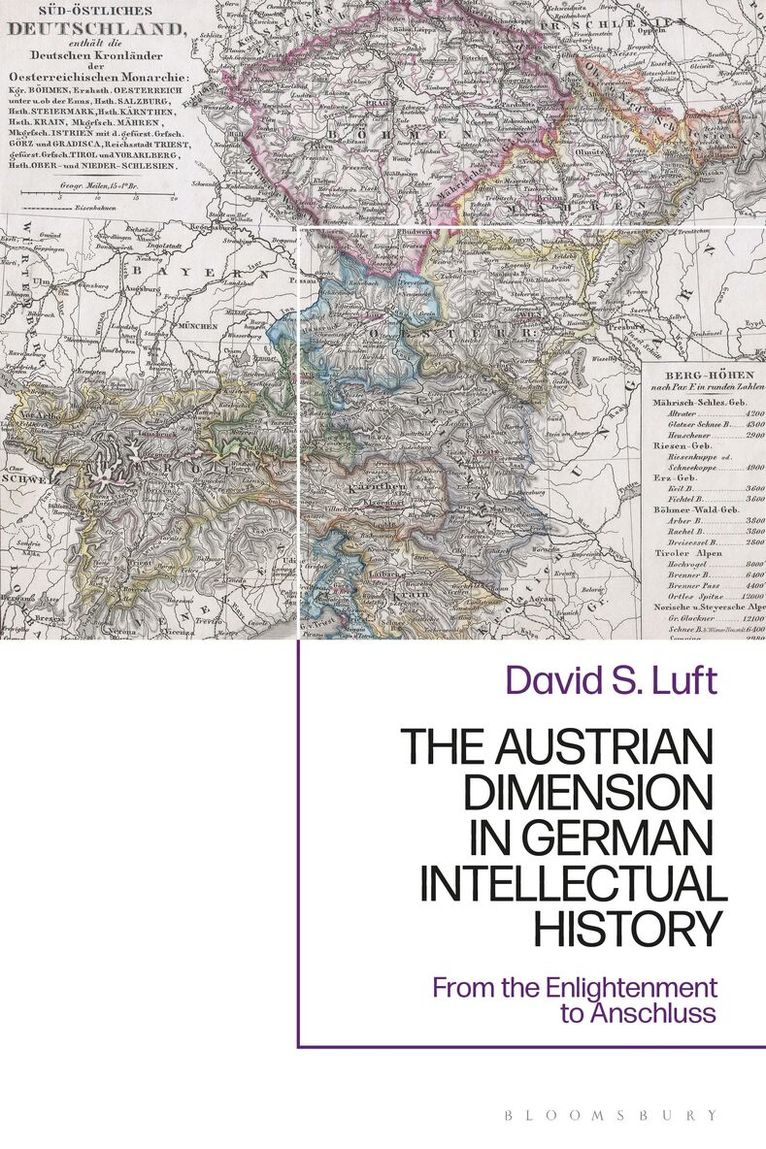
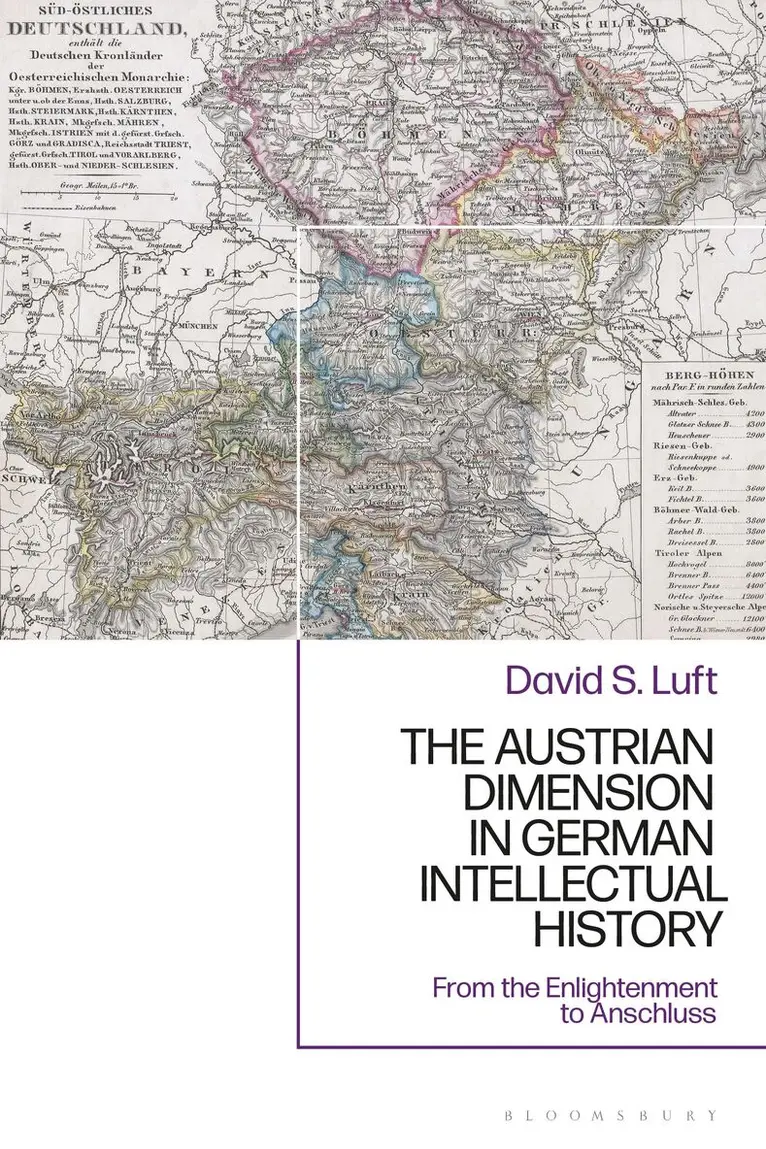
Austrian Dimension in German Intellectual History
From the Enlightenment to Anschluss
Inbunden, Engelska, 2021
1 383 kr
Skickas inom 10-15 vardagar
Tracing Austrian intellectual life from Maria Theresa to Hitler’s annexation of Austria and Czechoslovakia, this innovative book offers a precise and engaging account of Austrian intellectual history since the Enlightenment.Here, David S. Luft begins by locating his narrative in the region known as Cisleithanian Austria, the area to the west of the Leitha River that was the basis for the modern Austrian state after 1740. Chapter 2 provides a history of the German-speaking intellectual life of these central lands of the Habsburg Monarchy (Austria and Bohemia) from the Enlightenment to annexation by Nazi Germany. Chapters 3 to 5 identify the most important philosophers, writers, and social thinkers who contributed to Austrian intellectual life in the period between 1740 and 1938/1939 and address the intellectual significance of their work.Elegantly written and meticulously researched, Luft’s book brings out the contributions of major figures such as Wittgenstein, Hofmannsthal, Musil, Kafka, Rilke, and Freud, but also draws attention to less well-known figures such as Bolzano, Brentano, Grillparzer, Stifter, Broch, and Hayek.
Austrian Dimension in German Intellectual History
From the Enlightenment to Anschluss
Häftad, Engelska, 2022
420 kr
Skickas inom 10-15 vardagar
Tracing Austrian intellectual life from Maria Theresa to Hitler’s annexation of Austria and Czechoslovakia, this innovative book offers a precise and engaging account of Austrian intellectual history since the Enlightenment.Here, David S. Luft begins by locating his narrative in the region known as Cisleithanian Austria, the area to the west of the Leitha River that was the basis for the modern Austrian state after 1740. Chapter 2 provides a history of the German-speaking intellectual life of these central lands of the Habsburg Monarchy (Austria and Bohemia) from the Enlightenment to annexation by Nazi Germany. Chapters 3 to 5 identify the most important philosophers, writers, and social thinkers who contributed to Austrian intellectual life in the period between 1740 and 1938/1939 and address the intellectual significance of their work.Elegantly written and meticulously researched, Luft’s book brings out the contributions of major figures such as Wittgenstein, Hofmannsthal, Musil, Kafka, Rilke, and Freud, but also draws attention to less well-known figures such as Bolzano, Brentano, Grillparzer, Stifter, Broch, and Hayek.
Hugo Von Hofmannsthal and the Austrian Ideal
Selected Essays and Addresses, 1906-1027
Häftad, Engelska, 2011
299 kr
Skickas inom 10-15 vardagar
The Austrian writer Hugo von Hofmannsthal (1874-1929) was one of the great modernists in the German language, but his importance as a major intellectual of the early twentieth century has not received adequate attention in the English-speaking world. One distinguished literary scholar of his generation called Hofmannsthal a spiritual-moral authority of a kind German culture had only rarely produced. This volume provides translations of essays that deal with the Austrian idea and with the distinctive position of German-speaking Austrians between German nationalism and peoples to the East, whether in the Habsburg Monarchy or beyond it, as well as essays that locate Hofmannsthal's thinking about Austria in relation to the broader situation of German and European culture. It is the true accomplishment of this translation that Hofmannsthal's language, recreated in a clear and elegant English, regains its melody of an earlier time. If there ever was a captivating documentation of the European potential of Austria beyond the stereotypes of Vienna at 1900, it has been brought together in this volume of essays that responded to the tragic challenges of World War I in a constructive way. Frank Trommler, University of Pennsylvania