David Throsby – författare
Visar alla böcker från författaren David Throsby. Handla med fri frakt och snabb leverans.
10 produkter
Economics and Culture
E-bok, 2000
672 kr
Lägg i varukorg
In an increasingly globalised world, economic and cultural imperatives can be seen as two of the most powerful forces shaping human behaviour. This book considers the relationship between economics and culture both as areas of intellectual discourse, and as systems of societal organisation. …
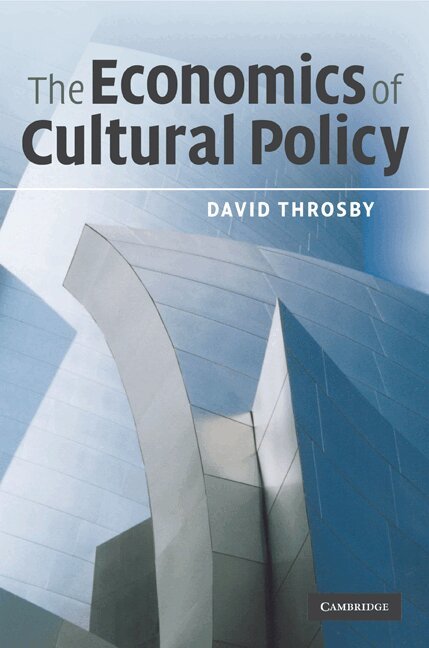
Economics of Cultural Policy
E-bok, 2010
657 kr
Lägg i varukorg
Cultural policy is changing. Traditionally, cultural policies have been concerned with providing financial support for the arts, for cultural heritage and for institutions such as museums and galleries. In recent years, around the world, interest has grown in the creative industries as a source of …
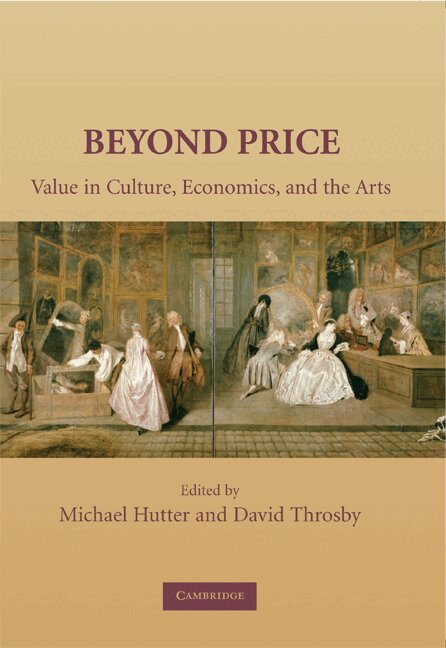
Beyond Price
Value in Culture, Economics, and the Arts
Av Michael Hutter, David Throsby
Häftad, 2011
731 kr
Lägg i varukorg
Much recent discussion surrounding valuation of the arts and culture, particularly in the policy arena, has been dominated by a concern to identify an economic and financial basis for valuation of art works, arts, activities and more general ways in which we express our culture. Whereas a great …
Economics and Culture
Inbunden, 2000
1844 kr
Lägg i varukorg
In an increasingly globalised world, economic and cultural imperatives can be seen as two of the most powerful forces shaping human behaviour. This book considers the relationship between economics and culture both as areas of intellectual discourse, and as systems of societal organisation. …
Economics and Culture
Häftad, 2000
637 kr
Lägg i varukorg
In an increasingly globalised world, economic and cultural imperatives can be seen as two of the most powerful forces shaping human behaviour. This book considers the relationship between economics and culture both as areas of intellectual discourse, and as systems of societal organisation. …
The Economics of Cultural Policy
Häftad, 2010
687 kr
Lägg i varukorg
Cultural policy is changing. Traditionally, cultural policies have been concerned with providing financial support for the arts, for cultural heritage and for institutions such as museums and galleries. In recent years, around the world, interest has grown in the creative industries as a source of …
Beyond Price
Value in Culture, Economics, and the Arts
Av Michael Hutter, David Throsby
Inbunden, 2007
892 kr
Lägg i varukorg
Much recent discussion surrounding valuation of the arts and culture, particularly in the policy arena, has been dominated by a concern to identify an economic and financial basis for valuation of art works, arts, activities and more general ways in which we express our culture. Whereas a great …
The Economics of Cultural Policy
Inbunden, 2010
1761 kr
Lägg i varukorg
Cultural policy is changing. Traditionally, cultural policies have been concerned with providing financial support for the arts, for cultural heritage and for institutions such as museums and galleries. In recent years, around the world, interest has grown in the creative industries as a source of …
Economics of Cultural Policy
E-bok, 2010
672 kr
Lägg i varukorg
Cultural policy is changing. Traditionally, cultural policies have been concerned with providing financial support for the arts, for cultural heritage and for institutions such as museums and galleries. In recent years, around the world, interest has grown in the creative industries as a source of …
Economics and Culture
E-bok, 2000
672 kr
Lägg i varukorg
In an increasingly globalised world, economic and cultural imperatives can be seen as two of the most powerful forces shaping human behaviour. This book considers the relationship between economics and culture both as areas of intellectual discourse, and as systems of societal organisation. …