David Weisberg – författare
Visar alla böcker från författaren David Weisberg. Handla med fri frakt och snabb leverans.
5 produkter
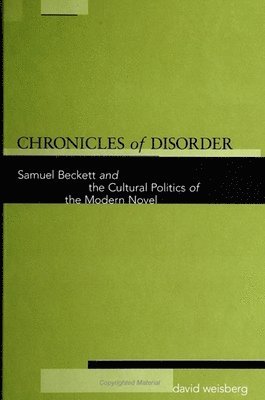
Chronicles of Disorder
Samuel Beckett and the Cultural Politics of the Modern Novel
Häftad, 2000
427 kr
Lägg i varukorg
Offers a striking new interpretation of Beckett's major fiction, demonstrating how his development as a writer was shaped by shifting twentieth-century ideas about the social function of literature.Offering a striking new interpretation of Beckett's major fiction, Chronicles of Disorder …
Late Babylonian Texts of the Oriental Institute Collection
Häftad, 1991
361 kr
Lägg i varukorg
In this volume D.B. Weisberg publishes the 54 cuneiform texts, almost all legal texts, from Uruk dated to the Seleucid and Arsacid periods which are preserved in the Tablet Collection of the Oriental Institute of the University of Chicago.
Late Babylonian Texts of the Oriental Institute Collection
Inbunden, 1991
519 kr
Tillfälligt slut
In this volume D.B. Weisberg publishes the 54 cuneiform texts, almost all legal texts, from Uruk dated to the Seleucid and Arsacid periods which are preserved in the Tablet Collection of the Oriental Institute of the University of Chicago.