David Woodhouse – författare
Visar alla böcker från författaren . Handla med fri frakt och snabb leverans.
4 produkter
4 produkter
Inbunden, Engelska, 2021
323 kr
Skickas
When Len Hutton led the MCC to the Caribbean in 1953/54, the series was billed as the 'world championship of cricket' and described later as the most controversial since Bodyline. Who Only Cricket Know provides the first full-length account of this extraordinary tour, where a rollercoaster of a Test series was only half the story.

Häftad, Engelska, 2023
196 kr
Skickas
Who Only Cricket Know tells the story of the second most controversial tour in English cricket history after Bodyline and has not been revisited since two tour books came out in the immediate aftermath. The cricket is dramatic, the key characters fascinating, and it is awash with incidents on and off the field, many of them involving race and social class. This was the first tour in which MCC travelled by plane (although they returned home on the boat) and the first in they were captained by a professional player – Len Hutton. It was also Hutton’s Yorkshire teammate Fred Trueman’s debut tour and for the opposition, the Three Ws were in their pomp and a young man called Garfield Sobers made his international bow.David Woodhouse has meticulously researched every aspect of the tour as well as carrying out a number of interviews, retaining the nuances and subtleties of the different levels of the story. He takes us through the lead-up to the tour, the warm-up games and the five Test matches, as well as the recriminations that took place both at Lord’s and in the West Indies in the tour’s aftermath.
Häftad, Engelska, 2018
514 kr
Skickas inom 3-6 vardagar
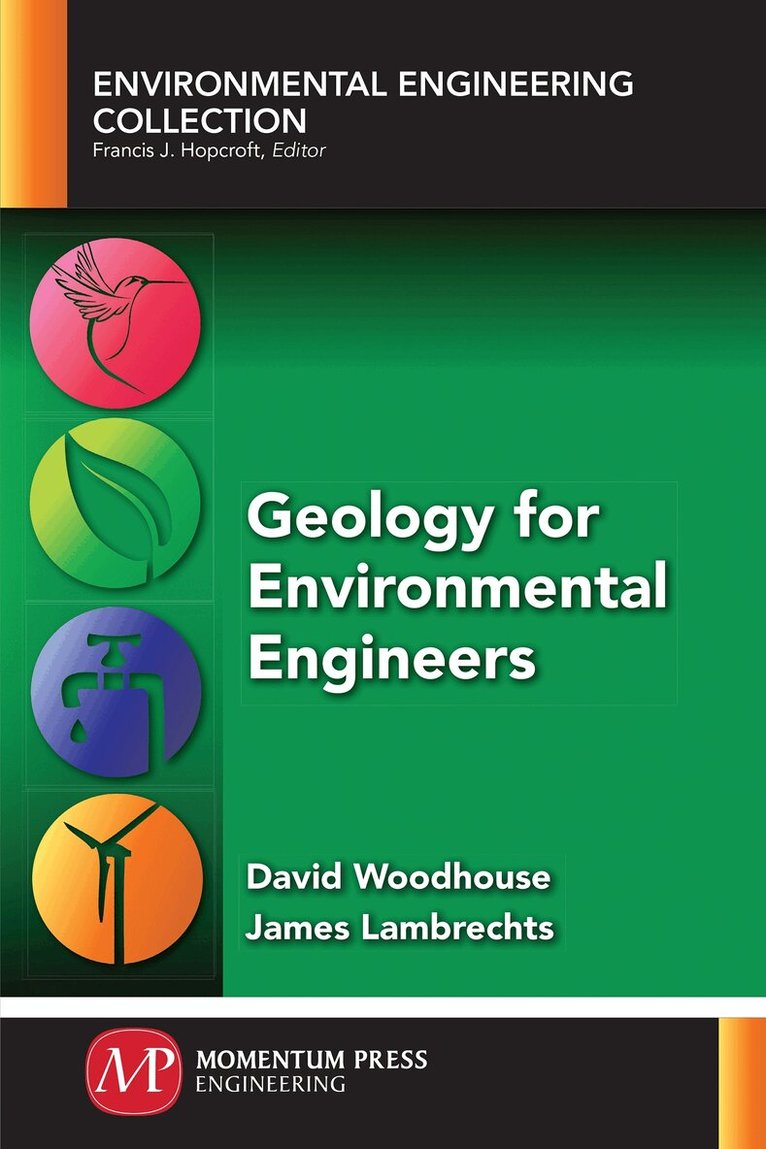
The environmental field has evolved since its beginnings in 1970 with the creation of the US Environmental Protection Agency (EPA), and further with the 1980 passage of CERCLA legislation (Comprehensive Environmental Response, Compensation, and Liability Act), commonly known as Superfund. Many site characterization studies and remediation designs have also evolved since that time. In order for the Environmental Engineer to understand the behavior and design remediation of the chemicals and pollutants in the environment, knowledge of the principles and tenets of geology is critical. Geology means the study of the Earth and is the science that seeks to collect, correlate, and interpret facts concerning the Earth. Its scope is almost boundless. The cycle that gives origin to the different types of rock and the geologic processes that produce the soils is discussed. On a macro scale, it seeks to discover the origin of the Earth, of mountains, valleys, glaciers, rocks, volcanoes, and a myriad number of other phenomena. Plate tectonics, continental drift, and subduction zones all played a role in the formation of our planet. On the micro scale, geology seeks to understand fluid flow through small pores and fractures. The fate and transport of chemicals through soils and especially through bedrock is a function of the geology. The rock structure and its understanding of the geologic processes which produce fractures and allows fluid flow is a major factor in remediation design.
E-bok
Engelska, 2018315 kr
Läs direkt efter köp
The environmental field has evolved since its beginnings in 1970 with the creation of the US Environmental Protection Agency (EPA), and further with the 1980 passage of CERCLA legislation (Comprehensive Environmental Response, Compensation, and Liability Act), commonly known as Superfund. Many site characterization studies and remediation designs have also evolved since that time. In order for the Environmental Engineer to understand the behavior and design remediation of the chemicals and pollutants in the environment, knowledge of the principles and tenets of geology is critical. Geology means the study of the Earth and is the science that seeks to collect, correlate, and interpret facts concerning the Earth. Its scope is almost boundless. The cycle that gives origin to the different types of rock and the geologic processes that produce the soils is discussed. On a macro scale, it seeks to discover the origin of the Earth, of mountains, valleys, glaciers, rocks, volcanoes, and a myriad number of other phenomena. Plate tectonics, continental drift, and subduction zones all played a role in the formation of our planet. On the micro scale, geology seeks to understand fluid flow through small pores and fractures. The fate and transport of chemicals through soils and especially through bedrock is a function of the geology. The rock structure and its understanding of the geologic processes which produce fractures and allows fluid flow is a major factor in remediation design.