Davidse Kristin Davidse – författare
Visar alla böcker från författaren Davidse Kristin Davidse. Handla med fri frakt och snabb leverans.
5 produkter
5 produkter
E-bok
PDF, Engelska, 20141 317 kr
Läs direkt efter köp
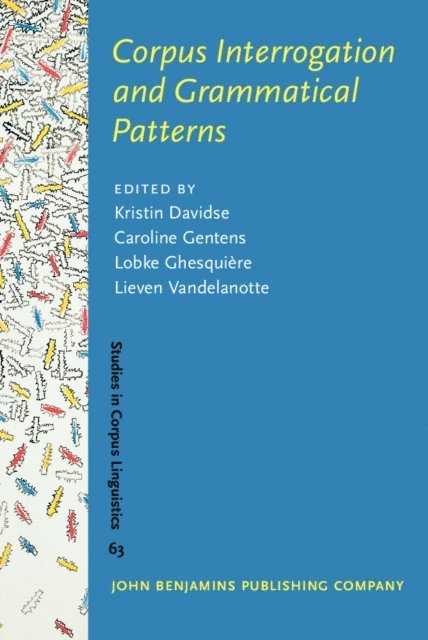
The studies in this volume approach English grammatical patterns in novel ways by interrogating corpora, focusing on patterns in the verb phrase (tense, aspect and modality), the noun phrase (intensification and focus marking), complementation structures and clause combining. Some studies interrogate historical corpora to reconstruct the diachronic development of patterns such as light verb constructions, verb-particle combinations, the be a-verbing progressive and absolute constructions. Other studies analyse synchronic datasets to typify the functions in discourse of, amongst others, tag questions and it-clefts, or to elucidate some long-standing problems in the syntactic analysis of verbal or adjectival complementation patterns, thanks to the empirical detail only corpora can provide. The volume documents the practices that have been developed to guarantee optimal representativeness of corpus data, to formulate definitions of patterns that can be operationalized in extractions, and to build dimensions of variation such as text type and register into rich grammatical descriptions.
E-bok
PDF, Engelska, 20121 305 kr
Läs direkt efter köp
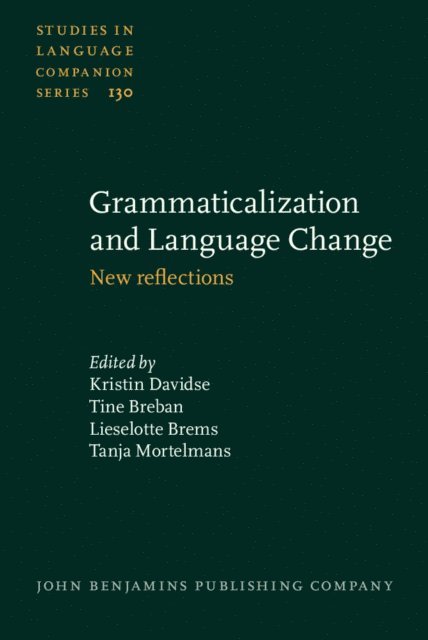
This collective volume focuses on the latest developments in the study of grammaticalization and related processes of change such as degrammaticalization, constructionalization, lexicalization, and petrification. It addresses topical issues relating to the motivations, sources, defining features, and outcomes of these changes. New theoretical reflections are offered on the pragmatic motivation of grammaticalization paths, process-oriented differences between grammaticalization, lexicalization and degrammaticalization, the question of gradualness and pace of grammaticalization, and deictics as a distinct source of grammaticalization. The articles describe various constructional and distributional changes affecting deictics, determiners, reflexives, clitics, nouns, affixes, adverbs and (auxiliary) verbs, mainly in the Germanic and Romance languages. The volume will be of great interest to historical linguists working on grammaticalization and related changes, and to all linguists working on the interface between morphosyntax, semantics, pragmatics and discourse.
E-bok
PDF, Engelska, 19971 651 kr
Läs direkt efter köp
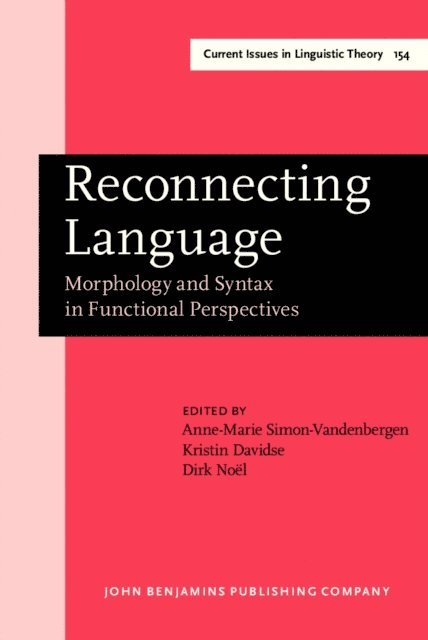
Although the contributors to this book do not belong to one particular ‘school’ of linguistic theory, they all share an interest in the external functions of language in society and in the relationship between these functions and internal linguistic phenomena. In this sense they all take a functional approach to grammatical issues. Apart from this common starting-point, the contributions share the aim of demonstrating the non-autonomous nature of morphology and syntax, and the inadequacy of linguistic models which deal with syntax, morphology and lexicon in separate, independent components. The recurrent theme throughout the book is the inseparability of lexis and morphosyntax, of structure and function, of grammar and society. The third and more specific common thread is case, which in some contributions is adduced to illustrate the more general point of the link between word form on the one hand and clausal and textual relations on the other hand, while in other papers it is at the centre of the discussion.The interest of the proposed volume consists in the fact that it brings together the views of leading scholars in functional linguistics of various ‘denominations’ on the place of morphosyntax in linguistic theory. The book provides convincing argumentation against a modular theory with autonomous levels (the dominant framework in mainstream 20th century linguistics) and is a plea for further research into the connections between the lexicogrammar and the linguistic and extralinguistic context.
E-bok
PDF, Engelska, 20101 305 kr
Läs direkt efter köp
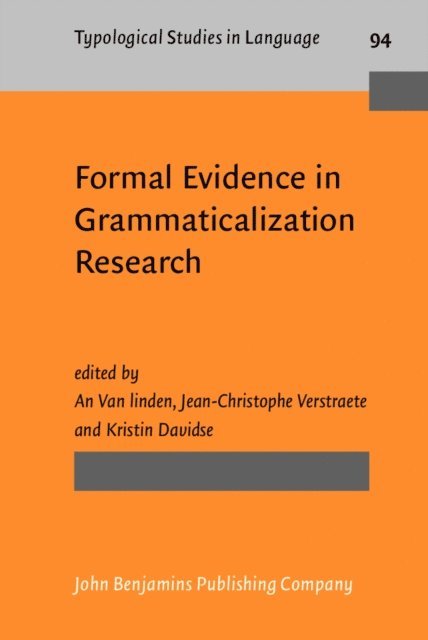
This collective volume focuses on the crucial role of formal evidence in recognizing and explaining instances of grammaticalization. It addresses the hitherto neglected issue of system-internal factors steering grammaticalization and also revisits formal recognition criteria such as Lehmann and Hopper’s parameters of grammaticalization. The articles investigate developments of such phenomena as modal auxiliaries, attitudinal markers, V1-conditionals, nominalizers, and pronouns, using data from a wide range of languages and (in some cases) from diachronic corpora. In the process, they explore finer mechanisms of grammaticalization such as modification of coding means, structural and semantic analogy, changes in frequency and prosody, and shifts in collocational and grammatical distribution. The volume is of particular interest to historical linguists working on grammaticalization, and general linguists working on the interface between syntax, semantics and pragmatics, as well as that between synchrony and diachrony.
E-bok
PDF, Engelska, 20021 651 kr
Läs direkt efter köp
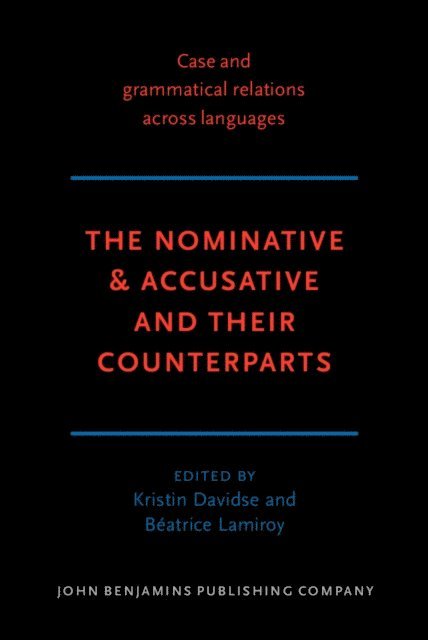
This volume is devoted to the central cases relating to the basic oppositions between subject-object and agent-patient, viz. nominative and accusative, as well as their counterparts such as ergative and absolutive. It aims at contributing to the typological investigation of these cases by providing descriptive studies of ten different languages, not only Romance and Germanic languages, but also Polish and Basque, as well as Cora, Warrwa and Ewe. These studies show that the formal devices used to mark the two nuclear cases may be quite diverse (including non-overt and ‘configurational’ coding), but that all the languages studied crucially display a subject-object asymmetry, even languages such as Basque and Ewe for which this had been questioned. One of the most striking subthemes to emerge from this collection is the complexity of the object-zone, both with regard to formal and functional diversity. Various studies in the volume also contribute reflections, couched mainly in broadly cognitive-functional terms, about the semantic function of the subject-object contrast and why it is so central across languages.