Daya Thussu – författare
3 863 kr
Skickas inom 3-6 vardagar
`A most timely book, with many valuable insights' - Martin Bell O.B.E
`It has long been known that the outcome of war is deeply influenced by the battle to win 'hearts and minds'. This book provides a stimulating set of perspectives which combine the analyses of prominent academics with the experiences of leading journalists' -
Professor Tom Woodhouse, University of Bradford
`This volume represents an all-star cast of authors who have a tremendous amount of knowledge about media and world conflict. One of its strengths is that it doesn't focus entirely narrowly on media, but puts the discussion of media issues in the context of changes in the world order in military doctrine' -
Professor Daniel C. Hallin, University of California
`This book comes just in time. A coherent and wide-ranging collection of data, analyses and insights that help our understanding of the complex interaction between communication and conflict. A major intellectual contribution to critical thinking about the early 21st century' - Cees J Hamelink, Professor International Communication, University of Amsterdam
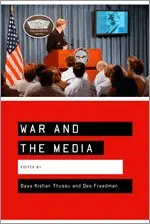
With what new tools do governments manage the news in order to prepare us for conflict?
Are the media responsible for turning conflict into infotainment?
Is reporting gender specific?
How do journalists view their role in covering distant wars?
This book critically examines the changing contours of media coverage of war and considers the complexity of the relationship between mass media and governments in wartime.
Assessing how far the political, cultural and professional contexts of media coverage have been affected by 9/11 and its aftermath, the volume also explores media representations of the `War on Terrorism' from regional and international perspectives, including new actors such as the Qatar-based Al-Jazeera - the pan-Arabic television network.
One key theme of the book is how new information and communication technologies are influencing the production, distribution and reception of media messages. In an age of instant global communication and round-the-clock news, powerful governments have refined their public relations machinery, particularly in the way warfare is covered on television, to market their version of events effectively to their domestic as well as international viewing public.
Transnational in its intellectual scope and in perspectives, War and the Media includes essays from internationally known academics along with contributions from media professionals working for leading broadcasters such as BBC World and CNN.
1 346 kr
Skickas inom 3-6 vardagar
`A most timely book, with many valuable insights' - Martin Bell O.B.E
`It has long been known that the outcome of war is deeply influenced by the battle to win 'hearts and minds'. This book provides a stimulating set of perspectives which combine the analyses of prominent academics with the experiences of leading journalists' -
Professor Tom Woodhouse, University of Bradford
`This volume represents an all-star cast of authors who have a tremendous amount of knowledge about media and world conflict. One of its strengths is that it doesn't focus entirely narrowly on media, but puts the discussion of media issues in the context of changes in the world order in military doctrine' -
Professor Daniel C. Hallin, University of California
`This book comes just in time. A coherent and wide-ranging collection of data, analyses and insights that help our understanding of the complex interaction between communication and conflict. A major intellectual contribution to critical thinking about the early 21st century' - Cees J Hamelink, Professor International Communication, University of Amsterdam
With what new tools do governments manage the news in order to prepare us for conflict?
Are the media responsible for turning conflict into infotainment?
Is reporting gender specific?
How do journalists view their role in covering distant wars?
This book critically examines the changing contours of media coverage of war and considers the complexity of the relationship between mass media and governments in wartime.
Assessing how far the political, cultural and professional contexts of media coverage have been affected by 9/11 and its aftermath, the volume also explores media representations of the `War on Terrorism' from regional and international perspectives, including new actors such as the Qatar-based Al-Jazeera - the pan-Arabic television network.
One key theme of the book is how new information and communication technologies are influencing the production, distribution and reception of media messages. In an age of instant global communication and round-the-clock news, powerful governments have refined their public relations machinery, particularly in the way warfare is covered on television, to market their version of events effectively to their domestic as well as international viewing public.
Transnational in its intellectual scope and in perspectives, War and the Media includes essays from internationally known academics along with contributions from media professionals working for leading broadcasters such as BBC World and CNN.
3 012 kr
Skickas inom 3-6 vardagar
"Thussu's account of war as infotainment, the Bollywoodization of news and the emergence of a global infotainment sphere is as compelling as it is alarming. This is a significant and essential book for anyone interested in exploring the connections between news journalism, informed citizenship and democracy." - Bob Franklin, The Cardiff School of Journalism, Media and Cultural Studies
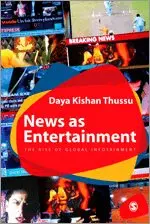
Richly detailed and empirically grounded, this first book-length study of infotainment and its globalization by a leading scholar of global communication, offers a comprehensive and critical analysis of this emerging phenomenon. Going beyond - both geographically and theoretically - the 'dumbing down' discourse, largely confined to the Anglo-American media, the book argues that infotainment may have an important ideological role, a diversion in which 'soft news' masks the hard realities of neo-liberal imperialism.
Chapters include a historical appraisal of infotainment; the infrastructure for its globalization as well as coverage of recent wars on television news as high-tech infotainment and the growing synergies between Hollywood and Bollywood-originated infotainment. A 'global infotainment sphere' is emerging, the book argues, within which competing versions of news - from 24/7 news networks to bloggers - coexist. Accessible, engagingly written and robustly argued, the book combines analyses of theoretical debates on infotainment with extensive and up-to-date comparative data.
567 kr
Skickas
"Thussu's account of war as infotainment, the Bollywoodization of news and the emergence of a global infotainment sphere is as compelling as it is alarming. This is a significant and essential book for anyone interested in exploring the connections between news journalism, informed citizenship and democracy." - Bob Franklin, The Cardiff School of Journalism, Media and Cultural Studies
Richly detailed and empirically grounded, this first book-length study of infotainment and its globalization by a leading scholar of global communication, offers a comprehensive and critical analysis of this emerging phenomenon. Going beyond - both geographically and theoretically - the 'dumbing down' discourse, largely confined to the Anglo-American media, the book argues that infotainment may have an important ideological role, a diversion in which 'soft news' masks the hard realities of neo-liberal imperialism.
Chapters include a historical appraisal of infotainment; the infrastructure for its globalization as well as coverage of recent wars on television news as high-tech infotainment and the growing synergies between Hollywood and Bollywood-originated infotainment. A 'global infotainment sphere' is emerging, the book argues, within which competing versions of news - from 24/7 news networks to bloggers - coexist. Accessible, engagingly written and robustly argued, the book combines analyses of theoretical debates on infotainment with extensive and up-to-date comparative data.
1 772 kr
Skickas inom 10-15 vardagar
459 kr
Skickas inom 10-15 vardagar
538 kr
Läs direkt efter köp
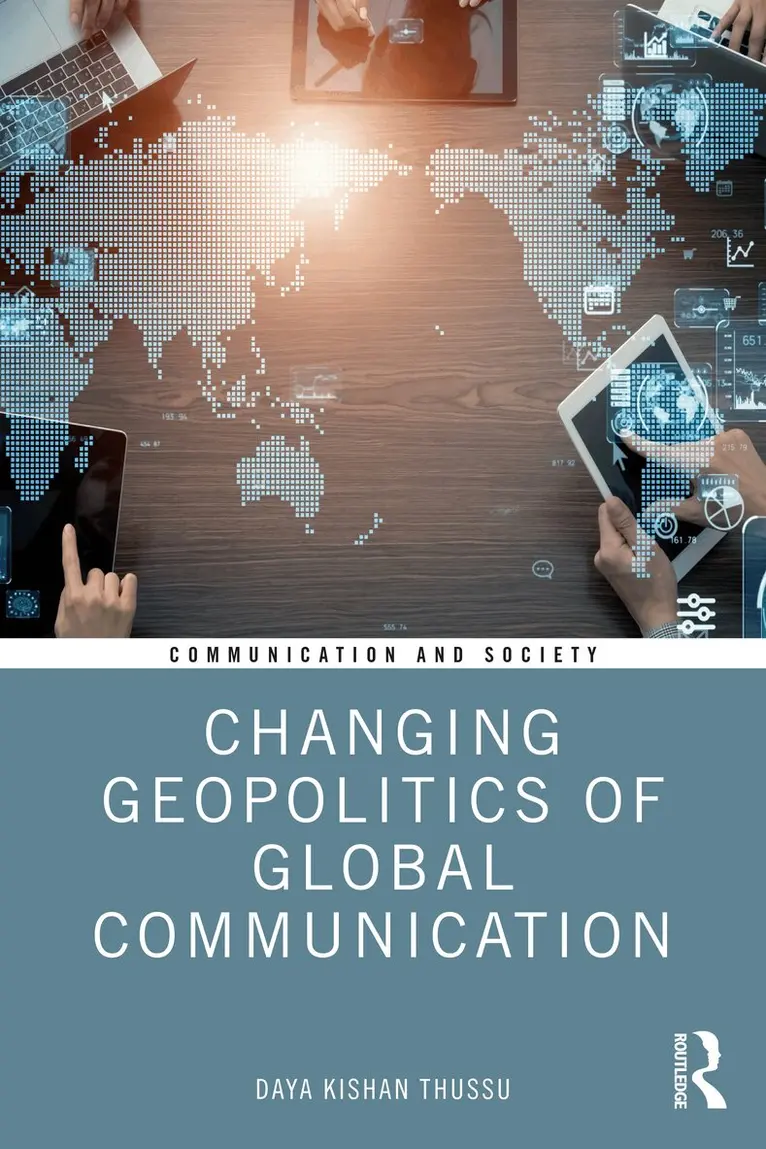
Changing Geopolitics of Global Communication examines the rapidly evolving dynamics between global communication and geopolitics. As an intersection between communication and international relations, it bridges the existing gap in scholarship and highlights the growing importance of digital communication in legitimizing and promoting the geopolitical and economic goals of leading powers. One central theme that emerges in the book is the continuity of asymmetries in power relations that can be traced back to 19th-century European imperialism, manifested in its various incarnations from ‘liberal’ to ‘neo-liberal’, to ‘digital’ imperialism. The book includes a discussion of the post–Cold War US-led transformation of the hardware and software of global communication and how it has been challenged by the ‘rise of the rest’, especially China. Other key issues covered include the geopolitics of image wars, weaponization of information and the visibility of discourses emanating from outside the Euro-Atlantic zone. The ideas and arguments advanced here privilege a reading of geopolitical processes and examples from the perspective of the global South. Written by a leading scholar of global communication, this comprehensive and transdisciplinary study adopts a holistic approach and will be of interest to the global community of scholars, researchers and commentators in communication and international relations, among other fields.
538 kr
Läs direkt efter köp
Changing Geopolitics of Global Communication examines the rapidly evolving dynamics between global communication and geopolitics. As an intersection between communication and international relations, it bridges the existing gap in scholarship and highlights the growing importance of digital communication in legitimizing and promoting the geopolitical and economic goals of leading powers. One central theme that emerges in the book is the continuity of asymmetries in power relations that can be traced back to 19th-century European imperialism, manifested in its various incarnations from ‘liberal’ to ‘neo-liberal’, to ‘digital’ imperialism. The book includes a discussion of the post–Cold War US-led transformation of the hardware and software of global communication and how it has been challenged by the ‘rise of the rest’, especially China. Other key issues covered include the geopolitics of image wars, weaponization of information and the visibility of discourses emanating from outside the Euro-Atlantic zone. The ideas and arguments advanced here privilege a reading of geopolitical processes and examples from the perspective of the global South. Written by a leading scholar of global communication, this comprehensive and transdisciplinary study adopts a holistic approach and will be of interest to the global community of scholars, researchers and commentators in communication and international relations, among other fields.
1 615 kr
Skickas inom 3-6 vardagar
10 346 kr
Tillfälligt slut
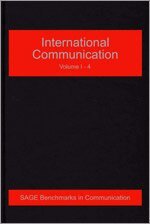
Volume One: International Communication in Context
Volume Two: Theoretical Pluralism and International Communication
Volume Three: The Political Economy of International Communication
Volume Four: Cultures of International Communication