Deborah Esch - Böcker
Visar alla böcker från författaren Deborah Esch. Handla med fri frakt och snabb leverans.
4 produkter
4 produkter
1 144 kr
Skickas inom 7-10 vardagar
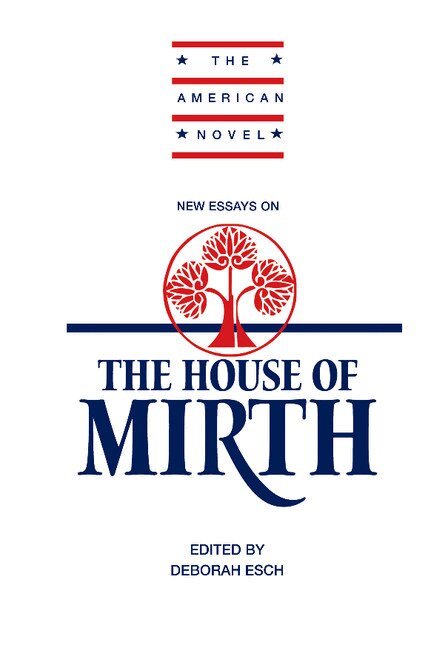
Edith Wharton's The House of Mirth captured the attention of a large portion of the reading public when it was published in a serial version in Scribner's for most of 1905 and then as a hardback in October of that year. Wharton's story of Lily Bart, a 'social parasite', according to reviewer Edmund Wilson, 'on the fringes of the very rich', topped the American bestseller list for four months. Furthermore, the novel sealed the author's reputation as one of the major English-language fiction writers of her generation. Each of the four articles collected in this New Essays volume, first published in 2001, makes distinctive claims for the historical, critical, and theoretical significance of Wharton's seminal work.
399 kr
Skickas inom 7-10 vardagar
Edith Wharton's The House of Mirth captured the attention of a large portion of the reading public when it was published in a serial version in Scribner's for most of 1905 and then as a hardback in October of that year. Wharton's story of Lily Bart, a 'social parasite', according to reviewer Edmund Wilson, 'on the fringes of the very rich', topped the American bestseller list for four months. Furthermore, the novel sealed the author's reputation as one of the major English-language fiction writers of her generation. Each of the four articles collected in this New Essays volume, first published in 2001, makes distinctive claims for the historical, critical, and theoretical significance of Wharton's seminal work.
1 350 kr
Skickas inom 10-15 vardagar
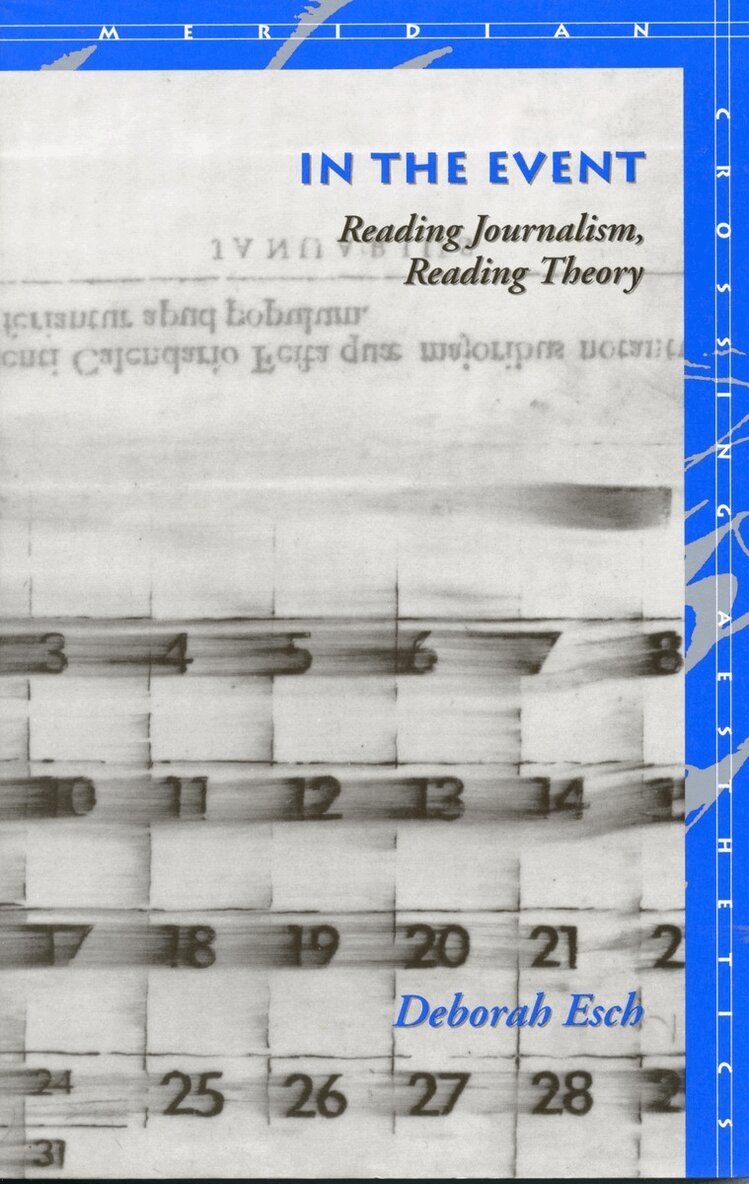
Assuming the burden of reading imposed by the correlation of the order of language and the order of events, this book argues that the possibility of reading and writing history is tied to the endurance of traces of the past and their coming to legibility, allegorically, at a given time. Through attentive readings of a range of texts—including theoretical writings, diaries, newspaper reports, and "live" television broadcasts—In the Event elaborates the ways in which allegory disrupts our presumptions of continuity and simultaneity between the image (whatever its medium) and what we take it to represent.The author demonstrates that a theoretical corpus must be understood not merely as a discrete set of arguments, but as work that takes place in time and on which time itself is at work. Against the temptation to regard a text (including a text of philosophical aesthetics or critical linguistics) as explained or defined by a fixed temporal context, this book emphasizes the textual operation of time. This attention to temporality opens the possibility of reading the notoriously difficult and resistant text of television.The book's central chapters analyze the seductions of "live" broadcasting: an incisive account of news coverage of the Gulf War, for example, reveals how the unproblematic articulation of "live" television with the real has its impulse in a broader realist ideology that finds its opportunity in the failure to reflect on the distances of space and time that characterize the medium. The author also explores the very different punctuality of the journal in evocative readings of the diaries of Alice James and Derek Jarman, both "journals of survival" written at the uncertain boundary of life and death. Here, and throughout the book, the readings argue that what we take to be historical events are actually produced, even constituted, by an array of discursive technologies, including language itself.
324 kr
Skickas inom 7-10 vardagar
Assuming the burden of reading imposed by the correlation of the order of language and the order of events, this book argues that the possibility of reading and writing history is tied to the endurance of traces of the past and their coming to legibility, allegorically, at a given time. Through attentive readings of a range of texts—including theoretical writings, diaries, newspaper reports, and "live" television broadcasts—In the Event elaborates the ways in which allegory disrupts our presumptions of continuity and simultaneity between the image (whatever its medium) and what we take it to represent.The author demonstrates that a theoretical corpus must be understood not merely as a discrete set of arguments, but as work that takes place in time and on which time itself is at work. Against the temptation to regard a text (including a text of philosophical aesthetics or critical linguistics) as explained or defined by a fixed temporal context, this book emphasizes the textual operation of time. This attention to temporality opens the possibility of reading the notoriously difficult and resistant text of television.The book's central chapters analyze the seductions of "live" broadcasting: an incisive account of news coverage of the Gulf War, for example, reveals how the unproblematic articulation of "live" television with the real has its impulse in a broader realist ideology that finds its opportunity in the failure to reflect on the distances of space and time that characterize the medium. The author also explores the very different punctuality of the journal in evocative readings of the diaries of Alice James and Derek Jarman, both "journals of survival" written at the uncertain boundary of life and death. Here, and throughout the book, the readings argue that what we take to be historical events are actually produced, even constituted, by an array of discursive technologies, including language itself.