Denis Maillet - Böcker
Visar alla böcker från författaren Denis Maillet. Handla med fri frakt och snabb leverans.
3 produkter
3 produkter
2 559 kr
Skickas inom 7-10 vardagar
Thermal Quadrupoles: Solving the Heat Equation through Integral TransformsThis superb text describes a novel and powerful method for allowing design engineers to firstly model a linear problem in heat conduction, then build a solution in an explicit form and finally obtain a numerical solution. It constitutes a modelling and calculation tool based on a very efficient and systemic methodological approach.Solving the heat equations through integral transforms does not constitute a new subject. However, finding a solution generally constitutes only one part of the problem. In design problems, an initial thermal design has to be tested through the calculation of the temperature or flux field, followed by an analysis of this field in terms of constraints. A modified design is then proposed, followed by a new thermal field calculation, and so on until the right design is found. The thermal quadrupole method allows this often painful iterative procedure to be removed by allowing only one calculation.The chapters in this book increase in complexity from a rapid presentation of the method for one dimensional transient problems in chapter one, to non uniform boundary conditions or inhomogeneous media in chapter six. In addition, a wide range of corrected problems of contemporary interest are presented mainly in chapters three and six with their numerical implementation in MATLAB(r) language. This book covers the whole scope of linear problems and presents a wide range of concrete issues of contemporary interest such as harmonic excitations of buildings, transfer in composite media, thermal contact resistance and moving material heat transfer. Extensions of this method to coupled transfers in a semi-transparent medium and to mass transfer in porous media are considered respectively in chapters seven and eight. Chapter nine is devoted to practical numerical methods that can be used to inverse the Laplace transform.Written from an engineering perspective, with applications to real engineering problems, this book will be of significant interest not only to researchers, lecturers and graduate students in mechanical engineering (thermodynamics) and process engineers needing to model a heat transfer problem to obtain optimized operating conditions, but also to researchers interested in the simulation or design of experiments where heat transfer play a significant role.
1 105 kr
Skickas inom 10-15 vardagar
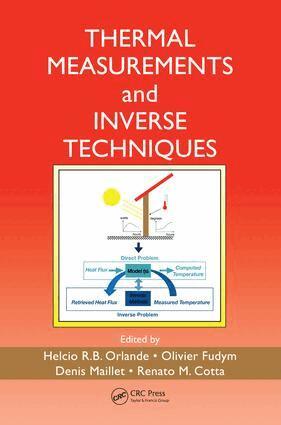
With its uncommon presentation of instructional material regarding mathematical modeling, measurements, and solution of inverse problems, Thermal Measurements and Inverse Techniques is a one-stop reference for those dealing with various aspects of heat transfer. Progress in mathematical modeling of complex industrial and environmental systems has enabled numerical simulations of most physical phenomena. In addition, recent advances in thermal instrumentation and heat transfer modeling have improved experimental procedures and indirect measurements for heat transfer research of both natural phenomena and manmade applications. These new resources and methods help theoretical, computational, and experimental researchers synergistically interact to better understand the physical phenomena being studied. This book explores how inverse analysis can be used to increase understanding of interactions between technological systems and nature, by bridging the gap between data derived from measurements and information from theoretical predictions. Assembled in three parts—Modeling and Measurements in Heat Transfer, Inverse Heat Transfer Problems, and Applications—this self-contained resource: Explores theoretical background and examples Outlines practical applications, including sample test cases Presents inverse techniques to estimate spatially and time-varying functions (such as heat sources, fluxes, and thermophysical properties), as well as constant parameters in heat transfer problemsWritten by international experts, this book assumes basic heat transfer knowledge, presenting a balanced approach suitable for advanced undergraduates and graduate students, as well as practicing engineers and academic and industrial researchers. With coverage of modeling at the micro- and nanoscales, this book covers classic and novel approaches to help readers understand and solve heat transfer problems of all kinds.
3 163 kr
Skickas inom 10-15 vardagar
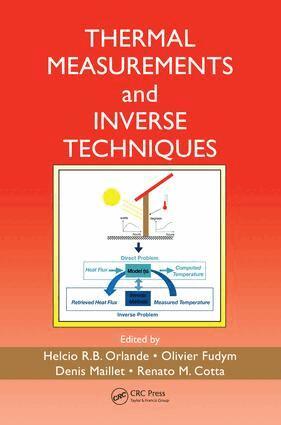
With its uncommon presentation of instructional material regarding mathematical modeling, measurements, and solution of inverse problems, Thermal Measurements and Inverse Techniques is a one-stop reference for those dealing with various aspects of heat transfer. Progress in mathematical modeling of complex industrial and environmental systems has enabled numerical simulations of most physical phenomena. In addition, recent advances in thermal instrumentation and heat transfer modeling have improved experimental procedures and indirect measurements for heat transfer research of both natural phenomena and manmade applications. These new resources and methods help theoretical, computational, and experimental researchers synergistically interact to better understand the physical phenomena being studied. This book explores how inverse analysis can be used to increase understanding of interactions between technological systems and nature, by bridging the gap between data derived from measurements and information from theoretical predictions. Assembled in three parts—Modeling and Measurements in Heat Transfer, Inverse Heat Transfer Problems, and Applications—this self-contained resource: Explores theoretical background and examples Outlines practical applications, including sample test cases Presents inverse techniques to estimate spatially and time-varying functions (such as heat sources, fluxes, and thermophysical properties), as well as constant parameters in heat transfer problemsWritten by international experts, this book assumes basic heat transfer knowledge, presenting a balanced approach suitable for advanced undergraduates and graduate students, as well as practicing engineers and academic and industrial researchers. With coverage of modeling at the micro- and nanoscales, this book covers classic and novel approaches to help readers understand and solve heat transfer problems of all kinds.