Denise Ferreira da Silva - Böcker
Visar alla böcker från författaren Denise Ferreira da Silva. Handla med fri frakt och snabb leverans.
5 produkter
5 produkter
20 255 kr
Skickas inom 10-15 vardagar
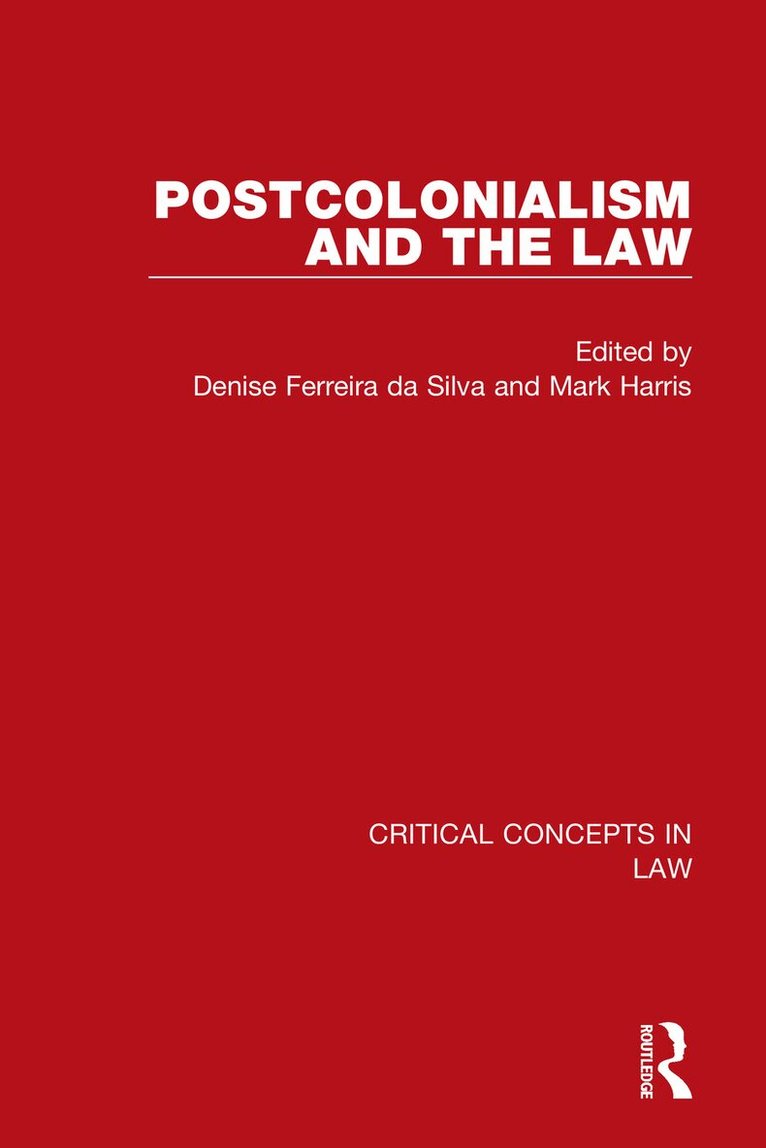
Postcolonialism and the Law provides a long overdue delineation of the field of enquiry that engages with the legal programmes, structures, and procedures which have sustained Euro-North American supremacy on the international political stage for the past fifty years or so. Focusing on the relationship between law and the racial and colonial mechanisms of subjugation at work in the global present, the contributions assembled in this new four-volume collection from Routledge’s Critical Concepts in Law series attend to juridical apparatuses as they operate in concert with economic and ethical frameworks, procedures, and architectures. Instead of approaching law as a self-sufficient instrument of power, the gathered major works expose the complex deployment and operation of legal instruments and how they—along with economic mechanisms and ethical programmes—participate in the constitution of the political space shared by both former colonial powers and colonies.With a full index, together with a comprehensive introduction, newly written by the editors, which places the collected material in its historical and intellectual context, Postcolonialism and the Law is an essential work of reference. The collection will be particularly useful as a database allowing scattered and often fugitive material to be easily located. It will also be welcomed as a crucial tool permitting rapid access to less familiar—and sometimes overlooked—texts. For postcolonial theorists and lawyers, as well as those working in cognate disciplines, such as Critical Legal Studies, Ethics, Cultural Studies, Race and Ethnicity Studies, and Human Rights, it is certain to be valued as a vital one-stop research and pedagogic resource.
16 147 kr
Skickas inom 10-15 vardagar
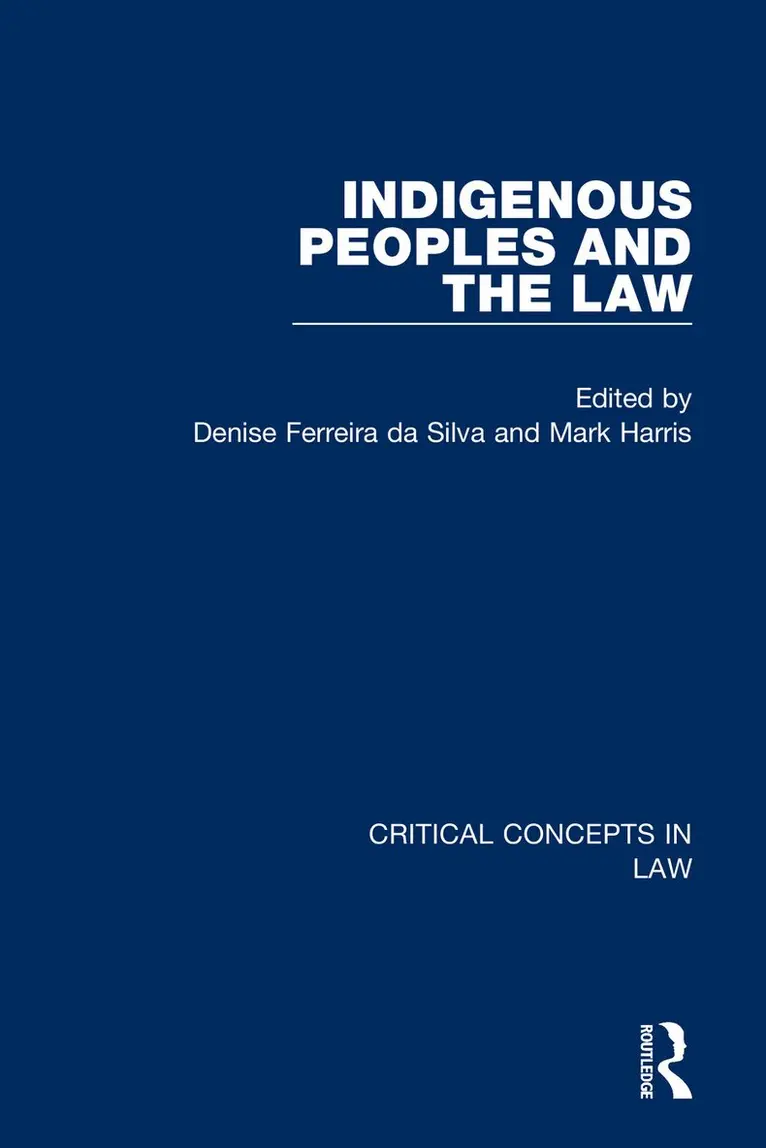
Despite the fact that the appropriation of land and resources of the so-called New World necessarily involved the dispossession and exploitation (and, sometimes, genocide) of the original inhabitants of colonized nations, it was not until the late twentieth century that Indigenous Peoples attained any meaningful degree of legal recognition in both national and international spheres. Until then Indigenous Peoples (also known as ‘First Nations’ and ‘First Peoples’) were routinely denied any form of juridical identity.Research in and around Indigenous Peoples and the Law is now very wide-ranging and flourishes as never before. But much of the relevant literature remains inaccessible or is highly specialized and compartmentalized, so that it is difficult for many of those who are interested in the subject to obtain an informed, balanced, and comprehensive overview. This new four-volume collection meets the need for an authoritative anthology to make sense of the subject’s vast and dispersed literature and the continuing explosion in research output. Drawing on a wide variety of materials from a broad range of disciplines and theoretical approaches, the collection gathers canonical and cutting-edge major works in a ‘one-stop’ resource to enable users to understand how the law Indigenous Peoples encounter has been transformed from an oppressive, rights-denying system to a site of contestation and for the articulation of claims.The collection includes a full index and is supplemented by introductions to each volume, newly written by the editors, which place the gathered materials in their historical and intellectual context. Indigenous Peoples and the Law is an essential reference work which will be valued as a vital resource by students, scholars, policy-makers, and practitioners.
299 kr
Skickas inom 10-15 vardagar
In this far-ranging and penetrating work, Denise Ferreira da Silva asks why, after more than five hundred years of violence perpetrated by Europeans against people of color, is there no ethical outrage? Rejecting the prevailing view that social categories of difference such as race and culture operate solely as principles of exclusion, Silva presents a critique of modern thought that shows how racial knowledge and power produce global space. Looking at the United States and Brazil, she argues that modern subjects are formed in philosophical accounts that presume two ontological moments-historicity and globality-which are refigured in the concepts of the nation and the racial, respectively. By displacing historicity’s ontological prerogative, Silva proposes that the notion of racial difference governs the present global power configuration because it institutes moral regions not covered by the leading post-Enlightenment ethical ideals-namely, universality and self-determination. By introducing a view of the racial as the signifier of globalit y,Toward a Global Idea of Race provides a new basis for the investigation of past and present modern social processes and contexts of subjection. Denise Ferreira da Silva is associate professor of ethnic studies at University of California, San Diego.
384 kr
Skickas inom 7-10 vardagar
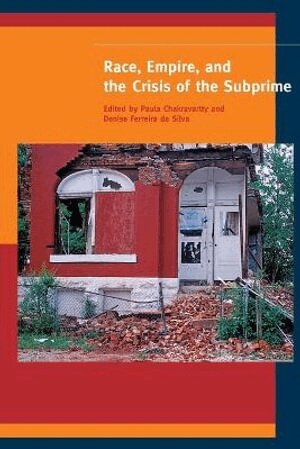
Predatory lending of subprime mortgages targeting the most economically vulnerable minority communities helped trigger the current global financial crisis. This special issue of the journal American Quarterly explores the ways in which "subprime" becomes a racial signifier in the current debate about the causes and fixes for a capitalism itself in crisis. It signifies both the accumulated dispossession of racial exclusion in the twenty-first century gilded age in the United States and Global North more broadly, as well as the imperial ambitions of three decades of U.S.-led neoliberal rule over the Global South. Essays are divided into sections: debt, discipline, and empire; the pathologies of debt; and security, space, and resistance in the post-racial urban setting. Focusing on race and empire, that is, on racial and global subjugation, the contributors expose the ethical-political underpinnings of the current global financial crisis. Contributors include: Radhika Balakrishnan Jordan T. Camp Paula Chakravartty Ofelia Ortiz Cuevas Sophie Ellen Fung Daniel J. Hammel James Heintz Bosco Ho Zachary Liebowitz Tayyab Mahmud John D. Marquez Pierson Nettling C. S.Ponder Sarita Echavez See Shawn Shimpach Denise Ferreira da Silva Catherine R. Squires Michael J. Watts Elvin Wyly
326 kr
Skickas