Devin M. Garofalo – författare
Visar alla böcker från författaren . Handla med fri frakt och snabb leverans.
3 produkter
3 produkter
Inbunden, Engelska, 2026
1 294 kr
Kommande
Nineteenth-Century Poetry and Cosmologies of the Human traces how lyric personification and anthropomorphic poetics--often regarded as benign or humanizing--have underwritten violent projects of planetary world-building whose consequences persist well into the present day. Through readings of poets and theorists of poetry such as William Wordsworth, John Stuart Mill, John Ruskin, Alfred Lord Tennyson, Elizabeth Barrett Browning, and Phillis Wheatley--and of writings on the intersections of race and environment by the Comte de Buffon, Charles Lyell, Robert Knox, and Immanuel Kant--Devin M. Garofalo excavates a Romantic and Victorian verse tradition that renders Earth in the likeness of a purportedly universal but fundamentally white colonial subject.This anthropomorphized Earth, Garofalo argues, finds its aesthetic foundation in nineteenth-century “lyric manscapes”: poetic worlds that fuse ecological feeling with racialized ideas of human difference. Far from opposing environmental harm, these forms often reproduce the very racial logics that animate ecocide itself, even when poets appear to lament environmental loss. Drawing on Sylvia Wynter's work on race, nature, and power, Garofalo complicates simplified narratives of the Anthropocene by demonstrating how human domination is sometimes asserted through, rather than against, the Earth.Nineteenth-Century Poetry and Cosmologies of the Human ultimately calls for direct confrontation with the racialized assumptions embedded in standard practices of reading Romantic and Victorian poetry. In alignment with Wheatley's densely allusive and heterocosmic lyrics, Garofalo advances an unsentimental mode of salvage criticism, testing ambivalence as a readerly disposition attuned to Earth's pluriversal scales and to an interhuman reimagining of nineteenth-century literary studies.
Häftad, Engelska, 2026
387 kr
Kommande
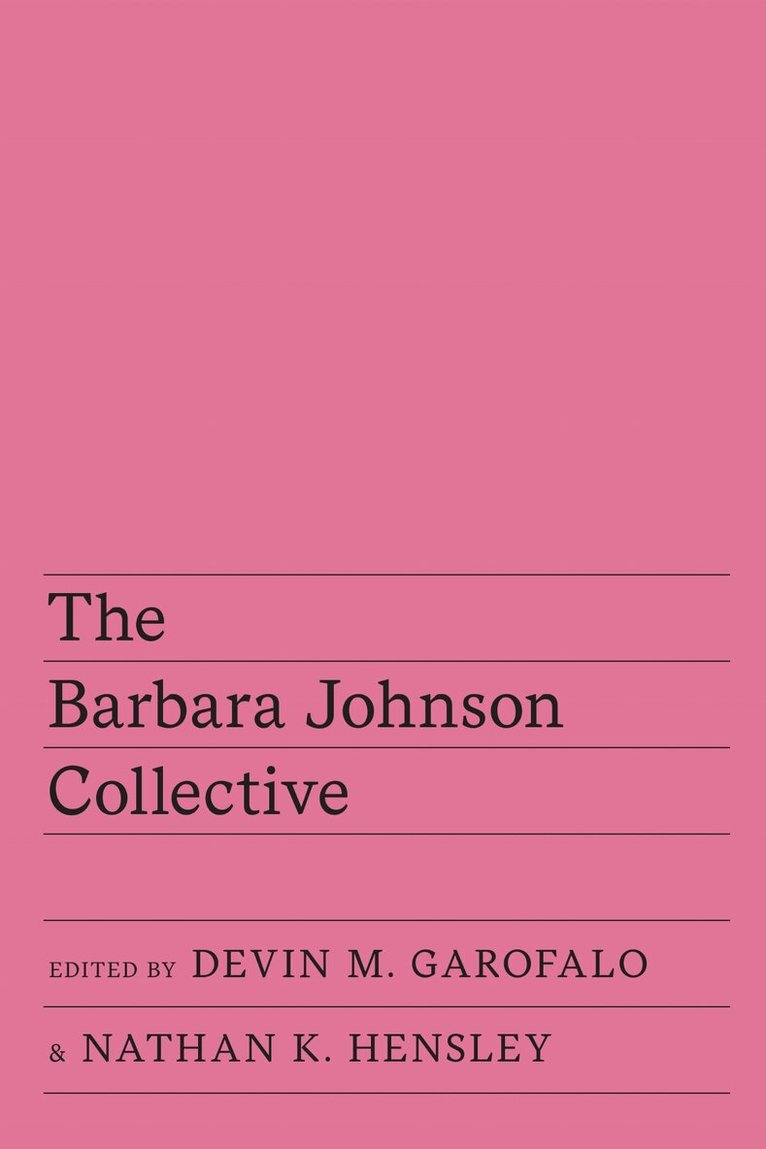
Collaboratively reassesses Barbara Johnson's legacy as a reader and thinker with an eye to contemporary conditionsAcross an archive of essays on abortion and race, Mallarmé and Melville, feminist philosophy, rhetorical device, and pedagogical method, Barbara Johnson built a legacy of thought whose energies reverberate into the present. This collected volume gathers writers and critics from a range of North American higher educational settings to engage with this essential but still often underappreciated critic in a time of renewed and deepening crisis.In Zoom meetings and shared essays, across a virtualized map of today's academic and para-academic worlds, the group assessed how the rolling catastrophes of late neoliberalism continue to stage the sort of analogy Johnson herself would highlight between patriarchy, capitalism, ecocide, and other forms of structural violence. Emerging from that assemblage, this experimental collection tracks Johnson's efforts to link literary reading with concrete matters of personhood and care at a moment when the very system of higher education that enabled Johnson's work in the 1980s and 1990s faces existential threat. The frozen record of a live experience, the book is an impure procedure, tangled in the idiom of its own unfolding: a temporary culmination of an ongoing collaborative undertaking that will always remain unfinished.
Inbunden, Engelska, 2026
1 459 kr
Kommande
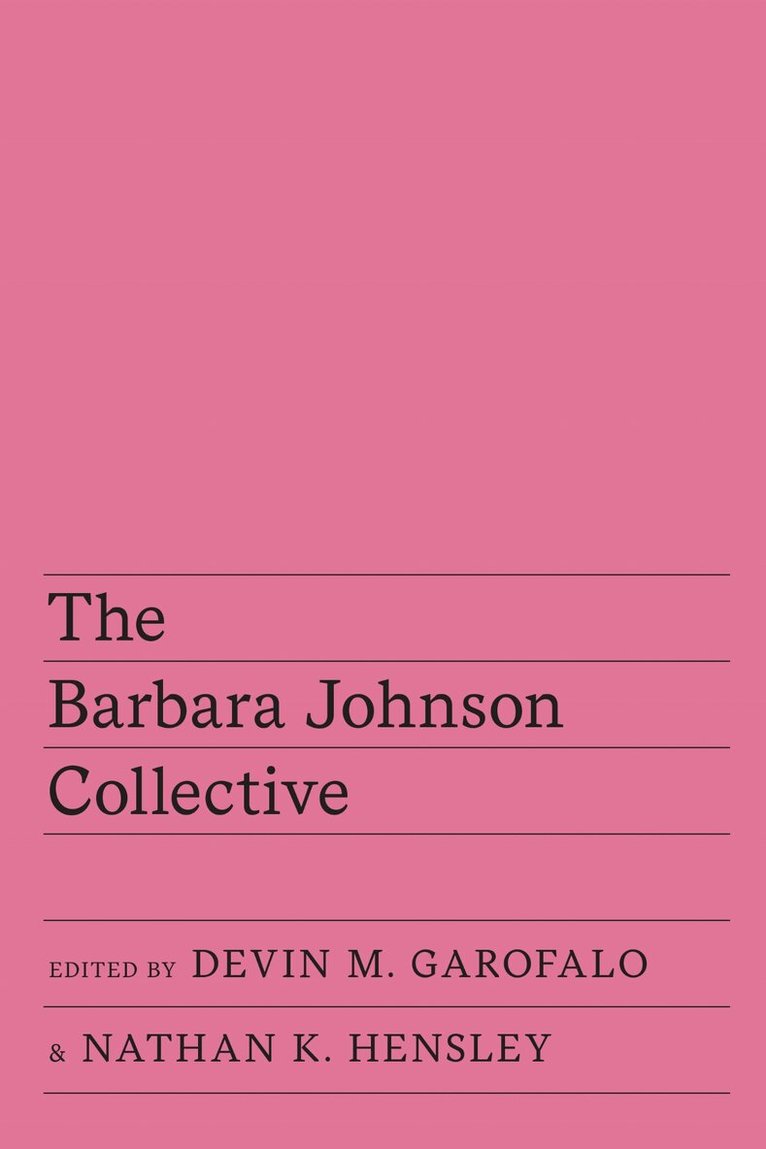
Collaboratively reassesses Barbara Johnson's legacy as a reader and thinker with an eye to contemporary conditionsAcross an archive of essays on abortion and race, Mallarmé and Melville, feminist philosophy, rhetorical device, and pedagogical method, Barbara Johnson built a legacy of thought whose energies reverberate into the present. This collected volume gathers writers and critics from a range of North American higher educational settings to engage with this essential but still often underappreciated critic in a time of renewed and deepening crisis.In Zoom meetings and shared essays, across a virtualized map of today's academic and para-academic worlds, the group assessed how the rolling catastrophes of late neoliberalism continue to stage the sort of analogy Johnson herself would highlight between patriarchy, capitalism, ecocide, and other forms of structural violence. Emerging from that assemblage, this experimental collection tracks Johnson's efforts to link literary reading with concrete matters of personhood and care at a moment when the very system of higher education that enabled Johnson's work in the 1980s and 1990s faces existential threat. The frozen record of a live experience, the book is an impure procedure, tangled in the idiom of its own unfolding: a temporary culmination of an ongoing collaborative undertaking that will always remain unfinished.