Dikken Marcel den Dikken – författare
Visar alla böcker från författaren Dikken Marcel den Dikken. Handla med fri frakt och snabb leverans.
4 produkter
4 produkter
E-bok
PDF, Engelska, 20161 447 kr
Läs direkt efter köp
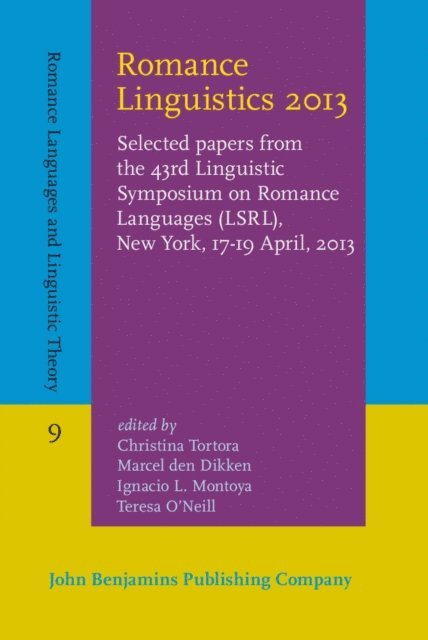
This volume contains a selection of peer-reviewed articles first presented at the 43rd Linguistic Symposium on Romance Languages (LSRL), held in New York in 2013. The articles deal with various synchronic and diachronic aspects of Romance languages and dialects world-wide. They will be of interest to scholars in Romance and in general linguistics.
E-bok
PDF, Engelska, 20091 384 kr
Läs direkt efter köp
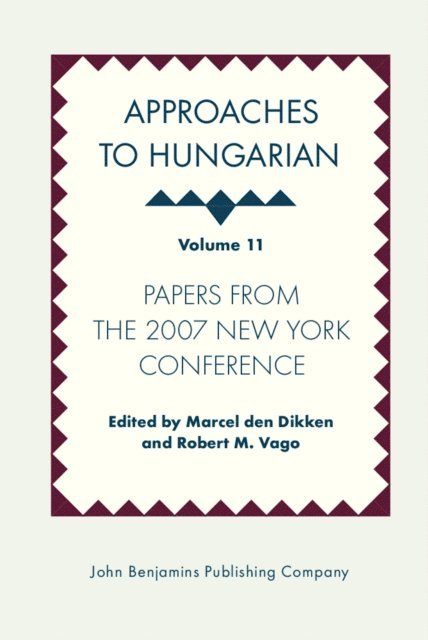
This volume brings together ten papers, all presented at the 8th International Conference on the Structure of Hungarian (New York City, 2007), addressing a wide range of topics in the morphology, phonetics, phonology, pragmatics, semantics, and syntax of Hungarian, with discussion of related facts in other languages as well. The volume includes an analysis of the morphophonology of the infinitival suffix in Optimality Theory, a plea for a phonetically-grounded theory of phonology based on partial neutralization of the v/f contrast, a Government Phonology account of vowel/zero alternations, a discussion of the recursive nature of speech prosody, a context-structure perspective on the pragmatics of polarity particles, a novel outlook on the prosody, semantics, and syntax of negative quantifiers, a structural approach to the difference between factive and non-factive complements and the distribution of the clausal expletive azt, a pioneering study of the licensing and position of overt nominative subjects of infinitival complement clauses, a lexicalist perspective on the distribution of ablative cause-PPs in anti-causative constructions, and an analysis of the complicated morphosyntax of adpositional preverbs and their doubling in terms of partial chain reduction in a phase-based cyclic mapping of syntax to phonology. The volume will be of interest not just to scholars working on Hungarian, but to a general audience of generative linguists.
E-bok
PDF, Engelska, 20051 588 kr
Läs direkt efter köp
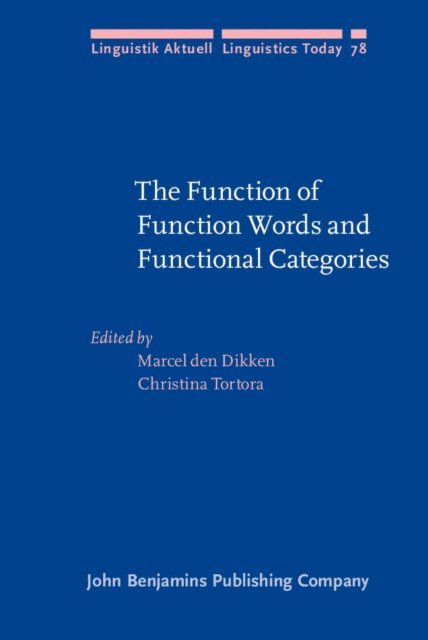
This volume brings together papers which address a range of issues regarding the syntax of function words and functional categories in the Germanic languages. The works offered in this volume derive specifically from comparative studies of Germanic; at the same time they all bear directly on long-standing problems in syntactic theory and universal grammar. The contributions include novel theoretical and empirical approaches to infinitives, the syntax and acquisition of Verb Second, the structure and interpretation of present tense, the syntax and semantics of reflexives, the relationship between expletive syntax and the EPP, the syntax of possession, and the DP-internal syntax of pronouns. Some contributions present the results of experimental research which provide an entirely fresh perspective on previously unchallenged claims.
E-bok
PDF, Engelska, 20001 588 kr
Läs direkt efter köp
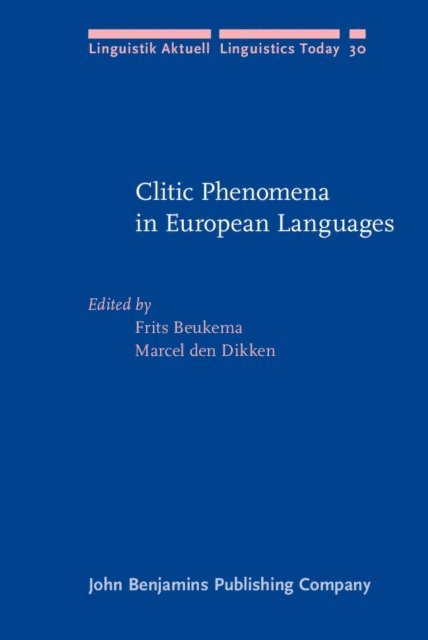
This book is concerned with a number of central issues in the theory of clitics, a topic that has become much debated in recent years. Mainly written within a recent generative framework, its contrastive approach discusses these issues against the background of a number of European languages, among which the Balkan Slavic languages figure prominently. The question as to whether clitics are to be located in the syntax or in the phonology or in both is addressed in articles by Boškovič, Progovac and Franks, who also provides a thorough introductory essay to the volume. There are detailed studies on clitic behavior in Greek relative clauses (Alexiadou and Anagnostopolou), Bulgarian and English DPs (Dimitrova-Vulchanova), the various Romance languages (Franco), Slovene (Golden and Milojevič Sheppard), Albanian and Greek (Kallulli) and Macedonian (Tomič). Finally, the book contains a discourse-related description of clitic doubling in Balkan Slavic languages (Schick). The book should be of interest to any scholar, theoretical or descriptive, whose research touches upon the central phenomenon of cliticisation.