Dirk Scheer – författare
941 kr
Läs direkt efter köp
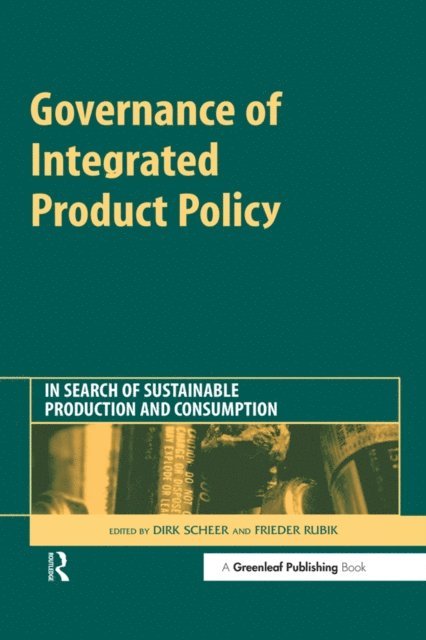
European policy patterns are in a state of transformation. New governance models are shifting power away from states and toward the involvement of all stakeholders and the idea of shared responsibility. It''s a move from command and control to push and pull.
What''s in this new approach for the environment? This book provides a detailed analysis of the example of integrated product policy (IPP) which aims to improve the environmental performance of products and services through their life-cycle. All products cause environmental degradation in some way, whether from their manufacturing, use or disposal. The life-cycle of a product is often long and complicated. It covers all the areas from the extraction of natural resources, through their design, manufacture, assembly, marketing, distribution, sale and use to their eventual disposal as waste. At the same time it also involves many different actors such as designers, manufacturers, marketers, retailers and consumers. IPP attempts to systematically stimulate each phase of this complicated chain to improve its environmental performance. With the involvement of so many different products and actors there cannot be one simple policy measure for everything. Instead, IPP employs a whole variety of tools – both voluntary and mandatory – which are used to achieve identified objectives. These include economic instruments, the phase-out of dangerous materials, voluntary agreements, eco-labelling and product design guidelines.
IPP is still in relative infancy and can be seen as an ongoing process hugely dependent on effective governance measures to ensure its continued success. This book presents a plethora of perspectives from policy-makers, researchers and consultancies, representatives from business, environmental and consumer associations on how to effectively conceptualise, institutionalise and implement IPP.
The book is divided into four parts. First, the approach to the governance of IPP is examined in relation to other approaches to sustainable production and consumption. Second, the widely differing approaches to environmental product policy in practice at national, supranational and global level are analysed. Third, the book explores the challenge of designing a coherent policy mix to support the integration of sustainable consumption and production patterns by sector and theme. Finally, the book concentrates on the key issue of how to involve stakeholders in IPP in order to encourage continuous innovations for sustainability throughout the value chain.
Governance of Integrated Product Policy aims to fill a clear gap in work to date on sustainable production and consumption by providing researchers and practitioners from politics, business and civil society new insights into modern environmental governance in practice.
941 kr
Läs direkt efter köp
European policy patterns are in a state of transformation. New governance models are shifting power away from states and toward the involvement of all stakeholders and the idea of shared responsibility. It''s a move from command and control to push and pull.
What''s in this new approach for the environment? This book provides a detailed analysis of the example of integrated product policy (IPP) which aims to improve the environmental performance of products and services through their life-cycle. All products cause environmental degradation in some way, whether from their manufacturing, use or disposal. The life-cycle of a product is often long and complicated. It covers all the areas from the extraction of natural resources, through their design, manufacture, assembly, marketing, distribution, sale and use to their eventual disposal as waste. At the same time it also involves many different actors such as designers, manufacturers, marketers, retailers and consumers. IPP attempts to systematically stimulate each phase of this complicated chain to improve its environmental performance. With the involvement of so many different products and actors there cannot be one simple policy measure for everything. Instead, IPP employs a whole variety of tools – both voluntary and mandatory – which are used to achieve identified objectives. These include economic instruments, the phase-out of dangerous materials, voluntary agreements, eco-labelling and product design guidelines.
IPP is still in relative infancy and can be seen as an ongoing process hugely dependent on effective governance measures to ensure its continued success. This book presents a plethora of perspectives from policy-makers, researchers and consultancies, representatives from business, environmental and consumer associations on how to effectively conceptualise, institutionalise and implement IPP.
The book is divided into four parts. First, the approach to the governance of IPP is examined in relation to other approaches to sustainable production and consumption. Second, the widely differing approaches to environmental product policy in practice at national, supranational and global level are analysed. Third, the book explores the challenge of designing a coherent policy mix to support the integration of sustainable consumption and production patterns by sector and theme. Finally, the book concentrates on the key issue of how to involve stakeholders in IPP in order to encourage continuous innovations for sustainability throughout the value chain.
Governance of Integrated Product Policy aims to fill a clear gap in work to date on sustainable production and consumption by providing researchers and practitioners from politics, business and civil society new insights into modern environmental governance in practice.
812 kr
Skickas inom 10-15 vardagar
1 083 kr
Skickas inom 10-15 vardagar
1 367 kr
Läs direkt efter köp
This book provides a broad overview of essential features of subsurface environmental modelling at the science-policy interface, offering insights into the potential challenges in the field of subsurface flow and transport, as well as the corresponding computational modelling and its impact on the area of policy- and decision-making. The book is divided into two parts: Part I presents models, methods and software at the science-policy interface. Building on this, Part II illustrates the specifications using detailed case studies of subsurface environmental modelling. It also includes a systematic research overview and discusses the anthropogenic use of the subsurface, with a particular focus on energy-related technologies, such as carbon sequestration, geothermal technologies, fluid and energy storage, nuclear waste disposal, and unconventional oil and gas recovery.
1 083 kr
Skickas inom 10-15 vardagar
409 kr
Skickas inom 10-15 vardagar
344 kr
Läs direkt efter köp
559 kr
Skickas inom 10-15 vardagar
550 kr
Läs direkt efter köp
435 kr
Skickas inom 5-8 vardagar
Back to the Roots
358 kr
Skickas inom 3-6 vardagar