Donald Grier Stephenson – författare
Visar alla böcker från författaren Donald Grier Stephenson. Handla med fri frakt och snabb leverans.
3 produkter
3 produkter
Inbunden, Engelska, 1991
957 kr
Skickas inom 10-15 vardagar
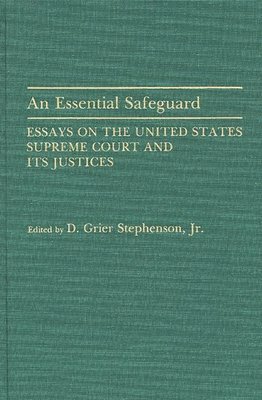
This timely collection examines the record of current and recent justices in fashioning the Constitution and looks at the larger political context in which their work has occurred. The eight essays, written by distinguished scholars of the Supreme Court, review the achievements of current Justices O'Connor and Rehnquist as well as recent justices Douglas, Black, and Harlan. The essay on Justice O'Connor is one of the first overall assessments of her record to appear in print. Editor D. Grier Stephenson, Jr.'s introductory chapter presents an insightful overview of the Supreme Court's role in American government today. Collectively these chapters make a rich contribution to an understanding of constitutional government and render a complex subject both accessible to general readers and interesting to experts.Following editor Stephenson's cogent introduction, Henry Abraham's Can Presidents Really Pack the Supreme Court? focuses on the political and intellectual environments within which the Supreme Court functions and on the candidates selected by presidents to sit on the High Bench. In Chapter Three, former solicitor general Rex E. Lee zeroes on a central aspect of, and a key player in, the judicial process. Leadership and the relationships among the justices are the subject of Chapter Four. Harold J. Spaeth's essay on Justice Sandra Day O'Connor emphasizes personality as an element contributing to the Court's decisions. The legacy of Justice William O. Douglas and the impact of the Court's past on its present decisions are both examined by Walter Murphy. Similarly, the next chapter's study of Justice John Marshall Harlan shows the importance of the Constitutional legacy in understanding the Supreme Court. Affirmative Action and the Supreme Court reviews the responses of current members of the Court to one of the most divisive and significant policy questions of our time. The concluding essay surveys Chief Justice Rehnquist and the Future of the Supreme Court. This volume is important reading for students of law, history, and political science.
E-bok
PDF, Engelska, 2003806 kr
Läs direkt efter köp
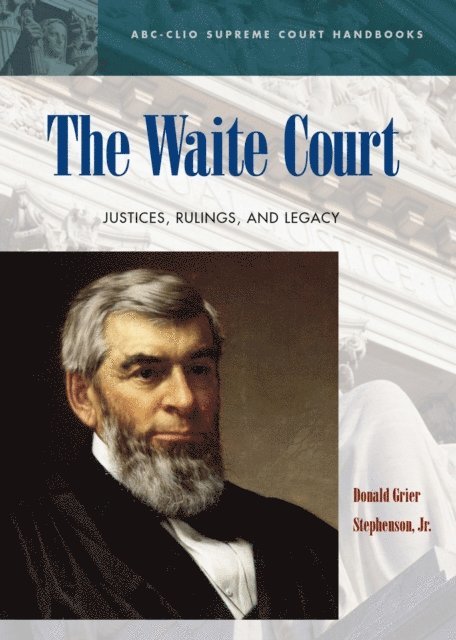
An extensive exploration of the major decisions and personalities of the Supreme Court during the 14-year tenure of Chief Justice Morrison Remick Waite.The Waite Court: Justices, Rulings, and Legacy presents a fresh interpretation of the Supreme Court under the tenure of Chief Justice Morrison Remick Waite (1874–1888). An in-depth analysis of key decisions demonstrates how the Waite Court confronted such profound issues as the post-Civil War rights of African Americans and state regulations intended to cope with rampant industrialization.Highlighting the Court's most famous decision, Munn v. Illinois, which upheld legislation regulating railroad and grain elevator rates, this careful analysis also reviews the Court's unique involvement in the 1876 presidential election electoral predicament. Profiles of the 15 justices who served on the Waite Court include extensive descriptions of the five that rank among the most outstanding justices ever to serve on the Supreme Court.
E-bok
PDF, Engelska, 2004827 kr
Läs direkt efter köp
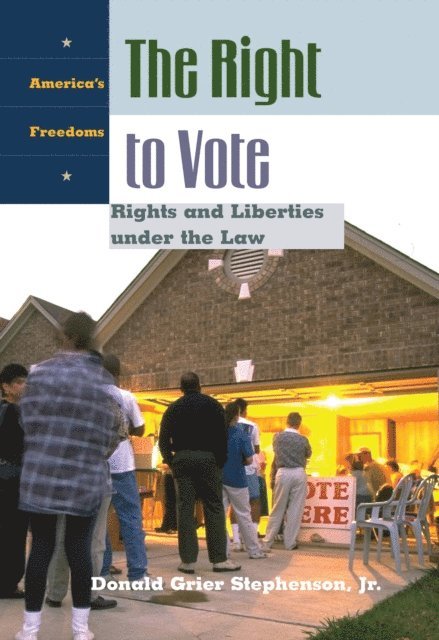
From its roots in early English rules to its practice today, this work covers the evolution, expansion, and ongoing debates regarding "the first liberty" in America.The Right to Vote: Rights and Liberties under the Law tracks the expansion of the franchise in America from colonial times to the present. Opening with a case study establishing the importance of access to the ballot, the main emphasis shifts to pivotal points in American history including the hard-fought struggles for women's suffrage and racial equality.A chapter on 21st-century voting rights addresses the most unsettled issue we face today—the use of majority-minority districts to enhance the political influence of African Americans and Latinos. A parting look at free and fair elections and the 2000 presidential election debacle shows how votes not counted or improperly credited can make a mockery of the democratic process.