Donald Lazere – författare
2 248 kr
Skickas inom 10-15 vardagar
793 kr
Skickas inom 10-15 vardagar
431 kr
Skickas
673 kr
Läs direkt efter köp
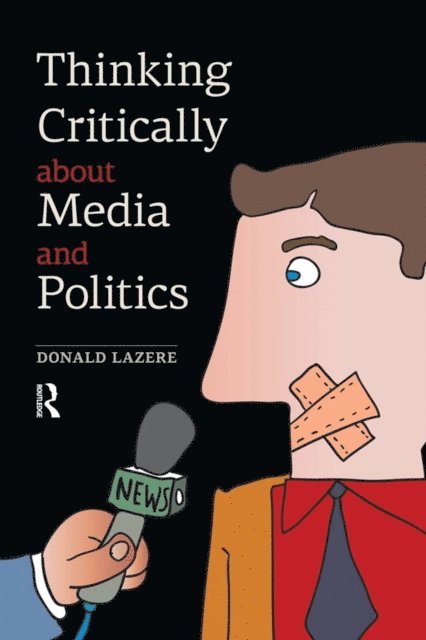
This book offers a critical introduction to the media as well as a “self defense” against the “spin” of politicians, advertising, and assorted propagandists. Its interdisciplinary application of principles of critical thinking and argumentative rhetoric can be incorporated into a diverse range of college courses, including communication, journalism, rhetoric, and media criticism.
Lazere offers a basic guide to and critique of the semantic complexities of terms such as liberal, conservative, left, and right as well as related words like democracy, freedom, capitalism, and socialism. He provides student guides for understanding opposing viewpoints between conservative and liberal polemicists on controversial issues in current politics and media, such as the nation’s wealth gap, including the rhetoric of economic arguments and the use and interpretation of statistics. His book offers insights into understanding the positions behind many other well-publicized debates in American society - from women’s rights to racial attitudes to the role of government. Lazere provides students with tools for understanding and argumentation, showing how to recognize logical fallacies, verbal slanting, and emotional appeal through connotative language - and how to discern intentions behind political and other advertisements.
In contrast to most textbooks’ approach to logical fallacies that assumes they result only from unintentional lapses in reasoning, this book confronts the hard truth that real-life arguments frequently are tainted by deliberate deception. Chapter 3 surveys various influences on political bias in the media, while Chapter 4 examines special pleading, conflicts of interest, invective, smearing, and hype—as propagated by sources like lobbies, public relations agencies, think tanks, advocacy, and political advertising.
673 kr
Läs direkt efter köp
This book offers a critical introduction to the media as well as a “self defense” against the “spin” of politicians, advertising, and assorted propagandists. Its interdisciplinary application of principles of critical thinking and argumentative rhetoric can be incorporated into a diverse range of college courses, including communication, journalism, rhetoric, and media criticism.
Lazere offers a basic guide to and critique of the semantic complexities of terms such as liberal, conservative, left, and right as well as related words like democracy, freedom, capitalism, and socialism. He provides student guides for understanding opposing viewpoints between conservative and liberal polemicists on controversial issues in current politics and media, such as the nation’s wealth gap, including the rhetoric of economic arguments and the use and interpretation of statistics. His book offers insights into understanding the positions behind many other well-publicized debates in American society - from women’s rights to racial attitudes to the role of government. Lazere provides students with tools for understanding and argumentation, showing how to recognize logical fallacies, verbal slanting, and emotional appeal through connotative language - and how to discern intentions behind political and other advertisements.
In contrast to most textbooks’ approach to logical fallacies that assumes they result only from unintentional lapses in reasoning, this book confronts the hard truth that real-life arguments frequently are tainted by deliberate deception. Chapter 3 surveys various influences on political bias in the media, while Chapter 4 examines special pleading, conflicts of interest, invective, smearing, and hype—as propagated by sources like lobbies, public relations agencies, think tanks, advocacy, and political advertising.
942 kr
Läs direkt efter köp
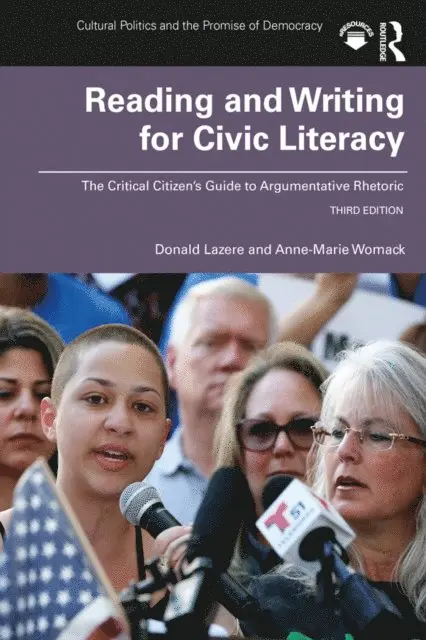
This rhetoric-and-reader textbook teaches college students to develop critical reading, writing, and thinking skills for self-defense in the contentious arena of American civic rhetoric. This edition is substantially updated for an era of renewed tensions over race, gender, and economic inequality—all compounded by the escalating decibel level and polarization of public rhetoric.
Readings include civil rights advocate Michelle Alexander on "the new Jim Crow," recent reconsiderations of socialism versus capitalism, Naomi Wolf’s and Christine Hoff Sommers’ opposing views on "the beauty myth," a section on the rhetoric of war, and debates on identity politics, abortion, and student debt.
Designed for first-year or more advanced composition and critical thinking courses, the book trains students in a wealth of techniques to locate fallacies and other weaknesses in argumentation in their prose and the writings of others. Exercises also help students understand the ideological positions and rhetorical patterns that underlie opposing views, from Ann Coulter to Bernie Sanders. Widely debated issues of whether objectivity is possible and whether there is a liberal or conservative bias in news and entertainment media, as well as in education itself, are foregrounded as topics for rhetorical analysis.
942 kr
Läs direkt efter köp
This rhetoric-and-reader textbook teaches college students to develop critical reading, writing, and thinking skills for self-defense in the contentious arena of American civic rhetoric. This edition is substantially updated for an era of renewed tensions over race, gender, and economic inequality—all compounded by the escalating decibel level and polarization of public rhetoric.
Readings include civil rights advocate Michelle Alexander on "the new Jim Crow," recent reconsiderations of socialism versus capitalism, Naomi Wolf’s and Christine Hoff Sommers’ opposing views on "the beauty myth," a section on the rhetoric of war, and debates on identity politics, abortion, and student debt.
Designed for first-year or more advanced composition and critical thinking courses, the book trains students in a wealth of techniques to locate fallacies and other weaknesses in argumentation in their prose and the writings of others. Exercises also help students understand the ideological positions and rhetorical patterns that underlie opposing views, from Ann Coulter to Bernie Sanders. Widely debated issues of whether objectivity is possible and whether there is a liberal or conservative bias in news and entertainment media, as well as in education itself, are foregrounded as topics for rhetorical analysis.
621 kr
Skickas inom 10-15 vardagar
2 394 kr
Skickas inom 10-15 vardagar
568 kr
Skickas inom 10-15 vardagar
1 259 kr
Tillfälligt slut