Donald P. Spence - Böcker
Visar alla böcker från författaren Donald P. Spence. Handla med fri frakt och snabb leverans.
3 produkter
3 produkter
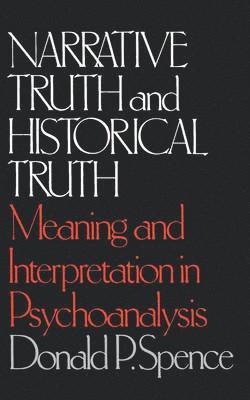
Narrative Truth and Historical Truth
Meaning and Interpretation in Psychoanalysis
Häftad, Engelska, 1984
278 kr
Skickas inom 5-8 vardagar
Donald Spence's book, Meaning and Interpretation in Psychoanalysis, is so disturbing and so revolutionary, in the sense of essaying so radical and fundamental a critique of our most central clinical and theoretical operating assumptions.

258 kr
Skickas inom 5-8 vardagar
Until recently, psychoanalysis has been a most reluctant recipient of the new inheritance. For most of its century-long life it has clung to the positivist epistemology of Freud, its founding genius, belying his hope that his followers would be as skeptical about received wisdom in their time as he was in his. Psychoanalysis has protected itself from change by preserving its store of founding metaphors in their original form.
466 kr
Skickas inom 10-15 vardagar
As psychoanalysis approaches its second century, it seems no closer to being a science than when Freud first invented the discipline. All the clinical experience of the past hundred years, Donald Spence tells us in this trenchant book, has not overcome a tendency to decouple theory from evidence. Deprived of its observational base, theory operates more like shared fantasy. In support of this provocative claim, Spence mounts a powerful critique of the way psychoanalysis functions—as a clinical method and as a scholarly discipline or “science.” In the process, he prescribes an antidote for the uncontrolled rhetoric that currently governs psychoanalytic practice.The reliance on rhetoric is the problem Spence identifies, and he attributes the troubling lack of progress in psychoanalysis to its outmoded method of data collection and its preference for fanciful argument over hard fact. Writing to Jung in 1911, Freud admitted that he “was not at all cut out to be an inductive researcher—I was entirely meant for intuition.” His intuitive approach led him to retreat form traditional Baconian principles of inductive investigation and to move toward a more Aristotelian approach that emphasized choice specimens and favorite examples, played down replication, and depended on arguments based on authority. Detailing this development, with particular attention to the role of self-analysis in the Freudian myth and the evidential drawbacks of the case study genre, Spence shows how psychoanalysis was set on its present course and how rhetorical maneuvers have taken the place of evidence.With this diagnosis, Spence offers a remedy—an example of the sort of empirical research that can transform clinical wisdom into useful knowledge. His book holds out the hope that, by challenging the traditions and diminishing the power rhetoric, psychoanalysis can remain a creative enterprise, but one based on a solid scientific foundation.