Donald Walsh - Böcker
Visar alla böcker från författaren Donald Walsh. Handla med fri frakt och snabb leverans.
3 produkter
3 produkter
2 062 kr
Skickas inom 5-8 vardagar
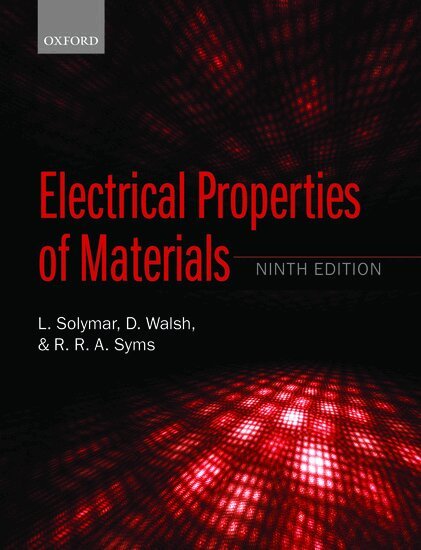
An informal and highly accessible writing style, a simple treatment of mathematics, and clear guide to applications have made this book a classic text in electrical and electronic engineering. Students will find it both readable and comprehensive. The fundamental ideas relevant to the understanding of the electrical properties of materials are emphasized; in addition, topics are selected in order to explain the operation of devices having applications (or possible future applications) in engineering. The mathematics, kept deliberately to a minimum, is well within the grasp of a second-year student. This is achieved by choosing the simplest model that can display the essential properties of a phenomenom, and then examining the difference between the ideal and the actual behaviour. The whole text is designed as an undergraduate course. However most individual sections are self contained and can be used as background reading in graduate courses, and for interested persons who want to explore advances in microelectronics, lasers, nanotechnology, and several other topics that impinge on modern life.
595 kr
Skickas inom 5-8 vardagar
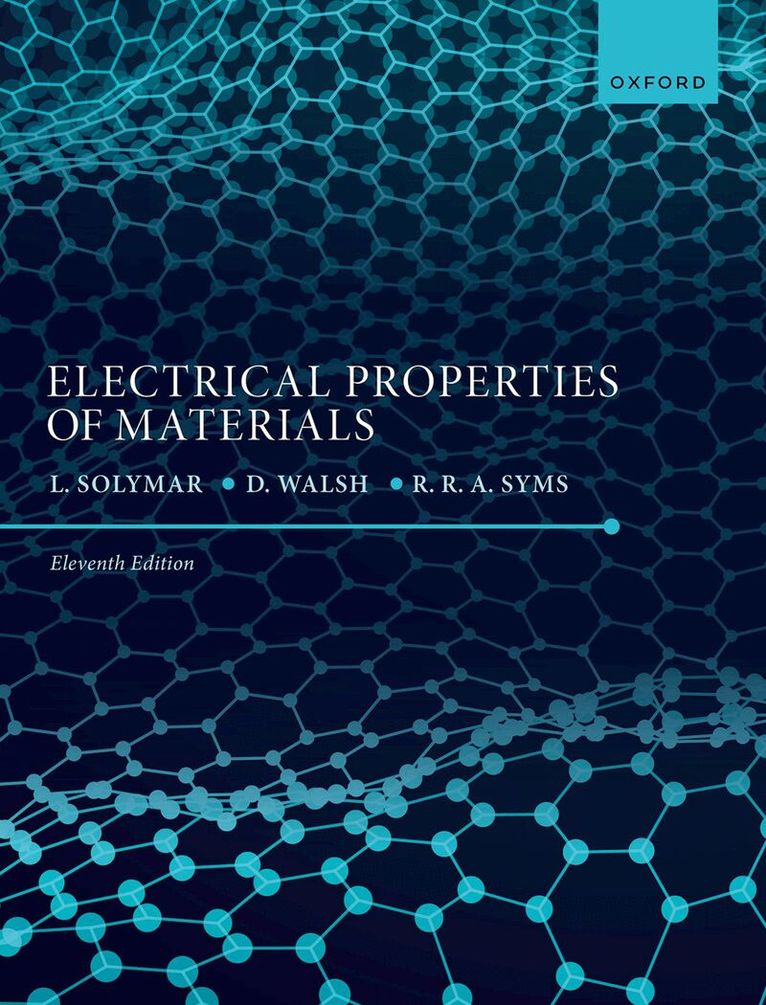
The electrical properties of materials are fundamental to many devices encountered in daily life and in today's industry, ranging from the semiconductors used in microelectronics to the dielectric materials in liquid crystal displays, the magnetic materials in the motors of electric cars and the superconducting materials in MRI scanners. All stem from the response of electrons to electric and magnetic fields. This book explains the phenomena, reviews the best materials, and presents the most relevant applications. The behaviour of electrons in atoms, liquids, solids, and periodic crystals is described, and the possibilities of new artificial materials are discussed. In themselves, electrons are intriguing, sometimes displaying particle-type and other times wave-type behaviour. Full understanding of wave properties requires quantum mechanics, often seen as a barrier due to the unfamiliarity of the concepts involved and the complexity of the mathematical apparatus needed. A key aim is to overcome these difficulties. Underpinning theory is explained as simply as possible. Classical and quantum mechanics are used as appropriate, in each case giving a full development and often presenting complementary viewpoints. Examples are presented in a comprehensive set of problems. This flexible approach allows full understanding both of fundamentals (for example, the properties of atoms in different columns of the periodic table) and of applications (the design of a new laser based on an artificially engineered band structure). The contents have been successfully refined over more than 50 years and are especially suitable for undergraduates and postgraduates in Materials and Electrical Engineering.
1 732 kr
Skickas inom 5-8 vardagar
The electrical properties of materials are fundamental to many devices encountered in daily life and in today's industry, ranging from the semiconductors used in microelectronics to the dielectric materials in liquid crystal displays, the magnetic materials in the motors of electric cars and the superconducting materials in MRI scanners. All stem from the response of electrons to electric and magnetic fields. This book explains the phenomena, reviews the best materials, and presents the most relevant applications. The behaviour of electrons in atoms, liquids, solids, and periodic crystals is described, and the possibilities of new artificial materials are discussed. In themselves, electrons are intriguing, sometimes displaying particle-type and other times wave-type behaviour. Full understanding of wave properties requires quantum mechanics, often seen as a barrier due to the unfamiliarity of the concepts involved and the complexity of the mathematical apparatus needed. A key aim is to overcome these difficulties. Underpinning theory is explained as simply as possible. Classical and quantum mechanics are used as appropriate, in each case giving a full development and often presenting complementary viewpoints. Examples are presented in a comprehensive set of problems. This flexible approach allows full understanding both of fundamentals (for example, the properties of atoms in different columns of the periodic table) and of applications (the design of a new laser based on an artificially engineered band structure). The contents have been successfully refined over more than 50 years and are especially suitable for undergraduates and postgraduates in Materials and Electrical Engineering.